Octans contains the south celestial pole, the point the entire southern sky rotates around. You would expect that to make it famous.
It does not, because the southern sky was dealt a bad hand. Where the north has Polaris at magnitude 2, conveniently bright and easy to find, the south has Sigma Octantis at magnitude 5.4: barely visible to the naked eye under perfect conditions and useless from anywhere with light pollution. This is why southern navigators use the Southern Cross instead.
Where to find Octans
Octans surrounds the south celestial pole, so from the southern hemisphere it is always in the same place: due south, at an altitude equal to your latitude.
The practical way to locate the pole is not to look for Octans at all. Take the long axis of the Southern Cross and extend it about four and a half times its length. That point is the south celestial pole, and Octans is the constellation around it.
Finding Sigma Octantis itself needs a genuinely dark sky and some patience. It is a faint star in a faint constellation, and there is no shortcut.
In sky coordinates Octans sits at right ascension 0h 00m and declination −74.3°. Right ascension is the sky's version of longitude and declination its version of latitude, so those two numbers pin the constellation to one spot on the celestial sphere the way a map reference pins a town. It is a far-southern constellation, so southern observers own it and much of the northern hemisphere never sees it at all. Practically speaking it is visible from anywhere south of latitude 0°N, including the whole southern hemisphere, with the best evening views around October.
What Octans actually looks like
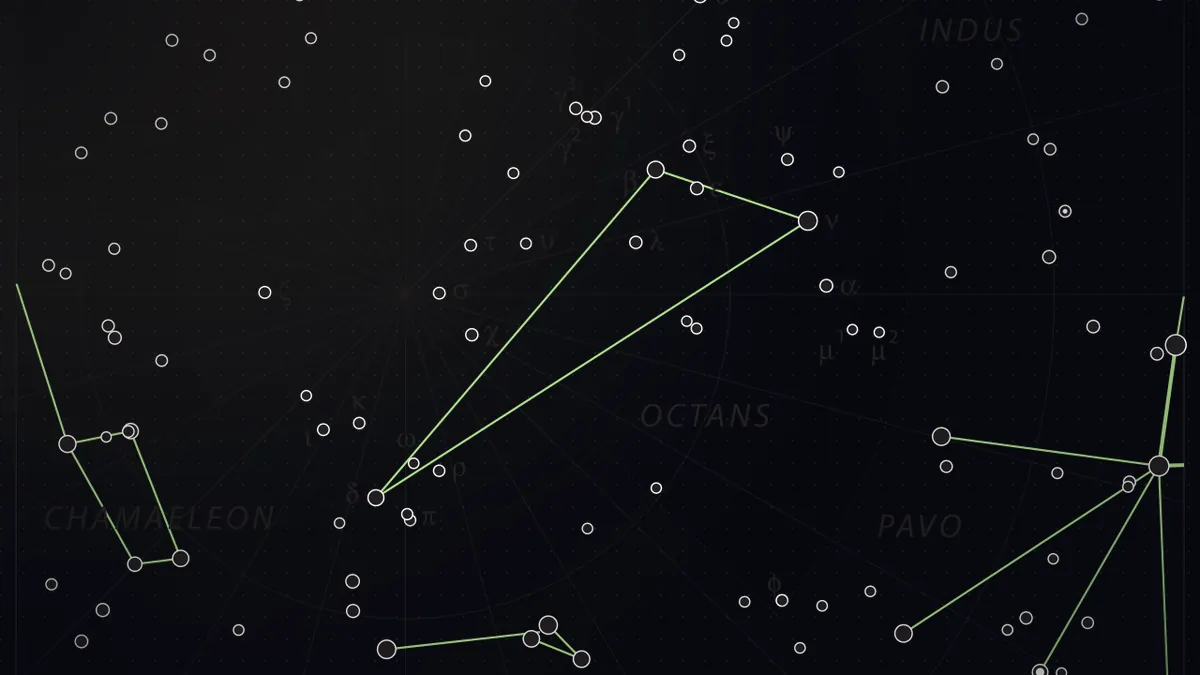
A faint, irregular scatter of stars with no discernible figure. Nothing here reaches magnitude 3.7.
Lacaille created it in the 1750s, naming it after the octant: a navigational instrument for measuring the angle between a celestial object and the horizon, and the direct predecessor of the sextant. Given that the constellation contains the pole that navigators needed to find, the choice is apt.
The pole's position is not fixed. Precession moves it in a slow circle over about 26,000 years, so Sigma Octantis has not always been the southern pole star and will not remain so.
The stars of Octans
-
Nu Octantis (magnitude 3.7) — the brightest star in the constellation, an orange giant with a debated planetary companion on an orbit that is difficult to explain.
-
Sigma Octantis — the south pole star, and a disappointment compared with Polaris. At magnitude 5.4 it is right at the limit of naked-eye visibility, roughly one degree from the true pole, and about 280 light years away. It is a Cepheid-type variable with very small amplitude.
Its faintness has real historical consequence: southern celestial navigation developed entirely different techniques, based on the Southern Cross and the Pointers, because there was no usable pole star.
-
Beta and Delta Octantis — the next brightest, both unremarkable.
Sigma Octantis appears on the flag of Brazil, representing the Federal District: the only star on the flag that is not a state.
The story behind the name
There is no mythology. Octans is a Lacaille creation from the 1750s, named after the octant, a navigational instrument invented in the 1730s and still current when Lacaille was working.
The contrast between the two celestial poles is worth dwelling on, because it shaped exploration. Northern navigators had Polaris: measure its altitude and you know your latitude, immediately and reliably. Southern navigators had nothing equivalent and had to work indirectly from the Southern Cross and other bright southern stars.
That asymmetry is pure accident — there is no reason for a bright star to sit near either pole — but it made the southern oceans measurably harder to cross, and it is one of the more consequential coincidences in the history of navigation.
What else is hiding in Octans
Octans is a sparse constellation with no Messier objects and very little for amateur telescopes.
- NGC 7098 — a barred spiral galaxy, faint and requiring a decent telescope under dark skies.
- The south celestial pole — not an object, but the best thing to do here. Set up a camera on a tripod, point it at the pole, and take a long exposure. Every star in the frame traces a circular arc around a nearly fixed centre. It is the most direct demonstration you can make of Earth's rotation, and it works better in the south than the north precisely because there is no bright star sitting at the centre to distract from the geometry.
Octans is a constellation of position rather than contents, and its position is the most important one in the southern sky.
When and where to see it
Best placed in the evening sky in October, though this is largely academic: Octans surrounds the south celestial pole and is therefore circumpolar from the entire southern hemisphere, visible every night of the year.
It never rises from the northern hemisphere at all.
Sigma Octantis needs a genuinely dark, transparent sky. Do not expect a Polaris equivalent: the honest advice for finding south is to use the Southern Cross and treat locating Sigma Octantis as a separate challenge for a dark night. Once you have seen it, you have seen the faintest important star in the sky.
Octans at a glance
| Name | Octans |
| Abbreviation | Oct |
| Genitive form | Octantis |
| Meaning | the Octant |
| Family | La Caille family |
| First recorded | 1756, Lacaille |
| Right ascension | 0h 00m |
| Declination | −74.3° |
| Area | 291 square degrees (50th largest of 88) |
| Main stars in the figure | 3 |
| Stars brighter than magnitude 3 | 0 |
| Named Bayer / Flamsteed stars | 27 |
| Brightest star | ν Oct (magnitude 3.73) |
| Messier objects | None |
| Meteor showers | None |
| Visible from | Anywhere south of latitude 0°N, including the whole southern hemisphere |
| Best seen at 9 pm in | October |
| Bordering constellations | Apus, Chamaeleon, Hydrus, Indus, Mensa, Pavo, Tucana |
Where to go next
Its neighbours in the sky
These constellations share a border with Octans, so once you have found it you already know where to look next: Apus, Chamaeleon, Hydrus, Indus, Mensa, Pavo, Tucana.
The rest of the La Caille family
Octans belongs to the La Caille family: eighteenth-century southern constellations named after instruments. The others are: Antlia, Caelum, Circinus, Fornax, Horologium, Mensa, Microscopium, Norma, Pictor, Reticulum, Sculptor, Telescopium.
Start from the beginning
New to all this? The 88 constellations: a complete beginner's guide explains what a constellation actually is, how the sky is divided up, and lists all 88 with a link to each one.
Star chart: Octans IAU chart by IAU and Sky & Telescope magazine (Roger Sinnott & Rick Fienberg), used under CC BY 3.0. Observing data cross-checked against Wikipedia's Octans entry.