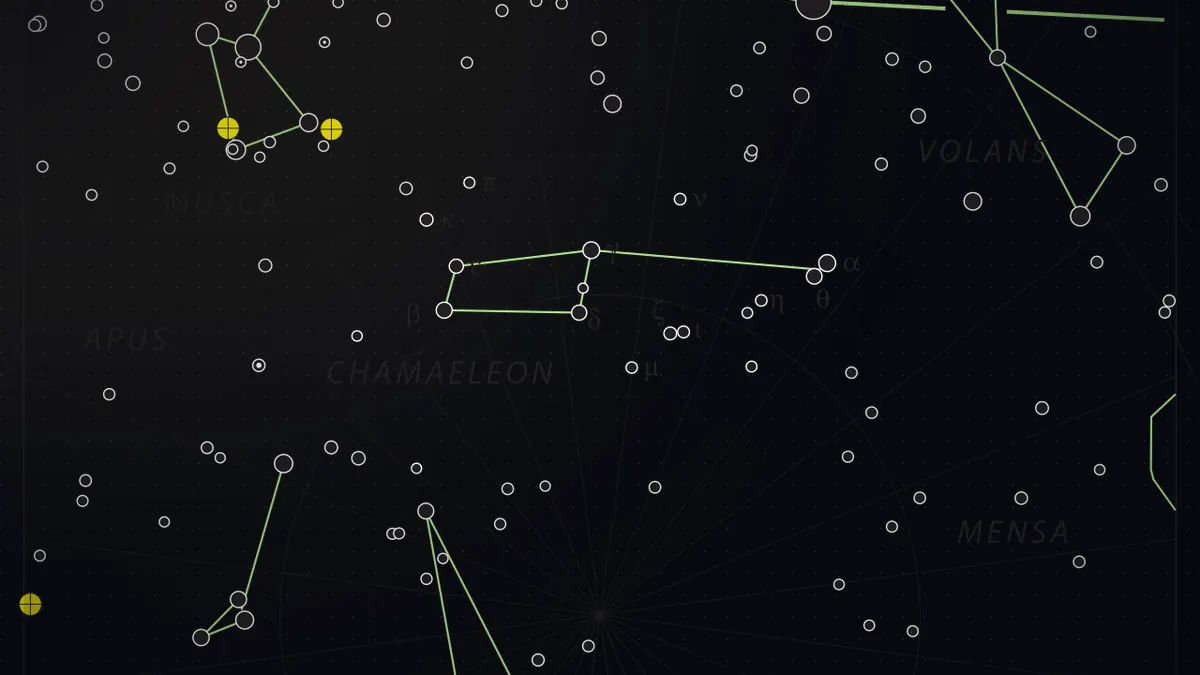
Chamaeleon is a small, faint constellation near the south celestial pole, with nothing brighter than magnitude 4. To the eye there is very little here.
Behind those faint stars, though, lies something genuinely important: the Chamaeleon molecular clouds, one of the closest active star-forming regions to the Sun at around 500 light years. Hundreds of very young stars are forming there right now, many still wrapped in the discs of gas and dust from which planets assemble.
Where to find Chamaeleon
Chamaeleon sits between Carina and the south celestial pole, south of the Southern Cross and west of Apus.
Because it is so faint, work from bright anchors. Find Crux and Musca, then continue south towards the pole. The dim scatter of stars you reach is Chamaeleon.
You will need a genuinely dark sky and well-adapted eyes. This is one of the constellations that simply does not exist under light pollution, and there is no technique that gets around that.
In sky coordinates Chamaeleon sits at right ascension 7h 26m and declination −75.3°. Those two numbers work like a grid reference. Right ascension runs around the sky the way longitude runs around the Earth, and declination measures north and south the way latitude does. It is a far-southern constellation, so southern observers own it and much of the northern hemisphere never sees it at all. In practice you can see it from anywhere south of latitude 7°N, including the whole southern hemisphere, and it stands highest in the evening sky around April.
What Chamaeleon actually looks like
A small, elongated diamond of faint stars. No chameleon is discernible, and the figure is a chart convention.
It is one of the twelve Keyser and de Houtman constellations from the 1590s, and like Apus and Musca it fills part of the far southern sky that no earlier tradition had named because no earlier Mediterranean or Near Eastern astronomer could see it.
The chameleon was another creature Dutch sailors encountered in the East Indies and Africa, and its inclusion fits the group's general pattern of naming southern constellations after exotic animals.
The stars of Chamaeleon
- Alpha Chamaeleontis (magnitude 4.1) — the brightest star, a white subgiant about 63 light years away.
- Gamma Chamaeleontis — a red giant, second brightest.
- Delta Chamaeleontis — a wide optical double, its two components unrelated but appearing close together.
- HD 63454 — a nearby orange dwarf hosting a hot Jupiter exoplanet on a very short orbit.
The individual stars are unremarkable. What matters in Chamaeleon is the population of very young stars in the molecular clouds behind them, most of which are far too faint and too obscured by dust to see, but which make this a heavily studied region for professional astronomers.
The story behind the name
There is no mythology. Chamaeleon was created in the 1590s by Keyser and de Houtman and published by Plancius in 1598.
There is a small piece of chart humour attached to it. On some early celestial maps, Chamaeleon is depicted with its tongue extended towards the neighbouring constellation Musca, the fly: the chameleon eternally about to catch its meal. Given that the two constellations are adjacent, it is a nice bit of staging by the cartographers.
That the far southern sky is populated by a fly, a chameleon, a bird of paradise, a toucan, a peacock, a flying fish and a swordfish says a great deal about what European sailors of the 1590s found remarkable, and essentially nothing about the stars themselves.
What else is hiding in Chamaeleon
Faint constellation, scientifically significant contents, and no Messier objects.
- The Chamaeleon molecular clouds (Cha I, II and III) — one of the nearest star-forming complexes to the Sun. Cha I in particular contains hundreds of young stellar objects, including many brown dwarfs, and it is a key laboratory for studying how low-mass stars and planetary systems form. Visually it is dark nebulosity; scientifically it is one of the more important patches of sky in this guide.
- NGC 3195 — a planetary nebula, the constellation's best conventional telescope target, appearing as a small faint disc.
- Eta Chamaeleontis cluster — a small, young open cluster of about a dozen stars, only around eight million years old.
This is a constellation where knowing what is there matters more than what you can see.
When and where to see it
Best placed in the evening sky in April, through the southern autumn.
Chamaeleon lies close to the south celestial pole and is circumpolar from most of the southern hemisphere, so it is available all year from Australia, southern Africa and southern South America. It never rises from the northern hemisphere.
Dark skies are essential — from anywhere with light pollution there is nothing to see. Even under good conditions this is a modest visual target. The reward is contextual: you are looking at a place where stars and planets are being assembled right now, only 500 light years away, which is practically next door.
Chamaeleon at a glance
| Name | Chamaeleon |
| Abbreviation | Cha |
| Genitive form | Chamaeleontis |
| Meaning | the Chameleon |
| Family | Bayer family |
| First recorded | 1598, Plancius, Keyser, de Houtman |
| Right ascension | 7h 26m |
| Declination | −75.3° |
| Area | 132 square degrees (79th largest of 88) |
| Main stars in the figure | 3 |
| Stars brighter than magnitude 3 | 0 |
| Named Bayer / Flamsteed stars | 16 |
| Brightest star | α Cha (magnitude 4.05) |
| Messier objects | None |
| Meteor showers | None |
| Visible from | Anywhere south of latitude 7°N, including the whole southern hemisphere |
| Best seen at 9 pm in | April |
| Bordering constellations | Apus, Carina, Mensa, Musca, Octans, Volans |
Where to go next
Its neighbours in the sky
Everything here shares a border with Chamaeleon. Find one and the rest are a short hop away: Apus, Carina, Mensa, Musca, Octans, Volans.
The rest of the Bayer family
Chamaeleon belongs to the Bayer family: southern constellations charted by Dutch navigators in the 1590s. The others are: Apus, Dorado, Grus, Hydrus, Indus, Musca, Pavo, Phoenix, Tucana, Volans.
Start from the beginning
If you are starting from scratch, the complete beginner's guide to the 88 constellations covers what a constellation actually is, how the sky is carved up, and links to every one of them.
Star chart: Chamaeleon IAU chart by IAU and Sky & Telescope magazine (Roger Sinnott & Rick Fienberg), used under CC BY 3.0. Observing data cross-checked against Wikipedia's Chamaeleon entry.