Grus is one of the more successful of the Dutch navigators' inventions. Unlike most of the faint southern menagerie, it has genuinely bright stars — two above magnitude 2 — and a figure that reads convincingly as a crane in flight, neck outstretched.
Its stars were originally part of Piscis Austrinus, the southern fish, and Arabic astronomers knew them as the fish's tail. The Dutch cut them loose and made a bird of them.
Where to find Grus
Grus sits directly south of Piscis Austrinus, so start from Fomalhaut, the lone bright star in the autumn sky.
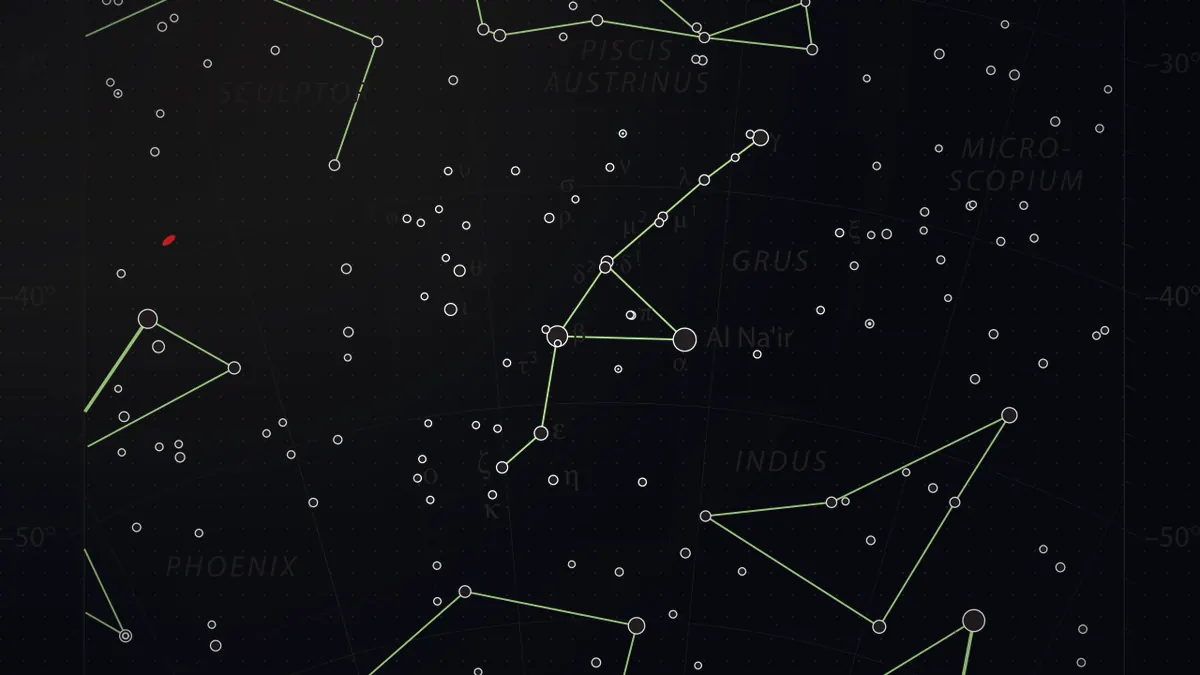
From Fomalhaut, look south. The next bright star you reach is Alnair, and beside it Tiaki. Those two anchor the crane, with a chain of fainter stars running south from them as the body and a shorter line as the neck.
From the southern hemisphere this is easy and the shape is clear. From mid-northern latitudes Grus sits very low or below the horizon.
In sky coordinates Grus sits at right ascension 21h 27m and declination −36.3°. Those two numbers work like a grid reference. Right ascension runs around the sky the way longitude runs around the Earth, and declination measures north and south the way latitude does. It sits in the southern half of the sky, high for southern observers and low on the horizon for northern ones. Practically speaking it is visible from anywhere south of latitude 34°N, including the whole southern hemisphere, with the best evening views around October.
What Grus actually looks like
A long-necked bird in flight. Two bright stars form the body, with a curved line of fainter stars extending as the neck and head, and shorter chains either side suggesting wings.
It is one of the better figures among the southern additions: the long neck genuinely does read as a crane or heron, and the shape is easy to remember once traced.
The constellation is sometimes called the Flamingo in older sources, which fits the outline equally well. Its stars were previously part of Piscis Austrinus, and a couple of Grus's stars still carry names referencing their old role as the fish's tail.
The stars of Grus
- Alnair (Alpha Gruis, magnitude 1.7) — the brightest star, a hot blue-white star about 100 light years away. Its name comes from an Arabic phrase meaning 'the bright one from the fish's tail', preserving the constellation's origin.
- Tiaki (Beta Gruis) — a red giant, and a nice colour contrast with blue-white Alnair. The name is Māori.
- Aldhanab (Gamma Gruis) — another star whose name refers to a tail.
- Delta and Mu Gruis — two naked-eye optical doubles, each pair appearing as two close stars to sharp eyes. They are chance alignments rather than physical pairs, but spotting both without optics is a satisfying test of eyesight and sky quality.
The story behind the name
There is no classical mythology. Grus was introduced by Keyser and de Houtman in the 1590s and published by Plancius in 1598.
The crane was chosen with some thought. In Egyptian tradition the crane was a symbol of the astronomer, because the bird's habit of watching carefully and its association with vigilance made it an apt emblem for someone who studies the sky. Plancius may have had that connection in mind.
Before the Dutch reassignment, these stars belonged to Piscis Austrinus, and Arabic astronomers had used them as the southern fish's tail. The star names Alnair and Aldhanab still carry that older meaning, which makes Grus a nice example of how the sky's naming layers sit on top of one another without ever quite erasing what came before.
What else is hiding in Grus
Grus looks out of the galactic plane and has no Messier objects, but it is decent galaxy territory.
- The Grus Quartet — four interacting spiral galaxies (NGC 7552, 7582, 7590 and 7599) close together on the sky and physically associated. Several show distortion from their mutual gravity. A rewarding field for a medium telescope under dark skies.
- IC 5148, the Spare Tyre Nebula — a planetary nebula with a distinctly ring-like structure and an appropriately unglamorous nickname. It is expanding unusually fast.
- NGC 7213 — a Seyfert galaxy with an active nucleus.
The naked-eye doubles Delta and Mu Gruis are arguably the more enjoyable targets here, precisely because they need no equipment at all.
When and where to see it
Best placed in the evening sky in October, through the southern spring.
Grus is a southern constellation reaching to about 30°N, so it can be glimpsed low from southern Europe, the southern United States and southern Asia. Southern observers get it high and clear.
The bright stars survive moderate light pollution, so the crane's outline is achievable from a suburb in the southern hemisphere. The galaxies want dark skies and a telescope. Try for the two naked-eye doubles first: they cost nothing and tell you immediately how good your conditions are.
Grus at a glance
| Name | Grus |
| Abbreviation | Gru |
| Genitive form | Gruis |
| Meaning | the crane |
| Family | Bayer family |
| First recorded | 1598, Plancius, Keyser, de Houtman |
| Right ascension | 21h 27m |
| Declination | −36.3° |
| Area | 366 square degrees (45th largest of 88) |
| Main stars in the figure | 8 |
| Stars brighter than magnitude 3 | 3 |
| Named Bayer / Flamsteed stars | 28 |
| Brightest star | α Gru (Alnair) (magnitude 1.73) |
| Messier objects | None |
| Meteor showers | None |
| Visible from | Anywhere south of latitude 34°N, including the whole southern hemisphere |
| Best seen at 9 pm in | October |
| Bordering constellations | Indus, Microscopium, Phoenix, Piscis Austrinus, Sculptor, Tucana |
Where to go next
Its neighbours in the sky
Everything here shares a border with Grus. Find one and the rest are a short hop away: Indus, Microscopium, Phoenix, Piscis Austrinus, Sculptor, Tucana.
The rest of the Bayer family
Grus belongs to the Bayer family: southern constellations charted by Dutch navigators in the 1590s. The others are: Apus, Chamaeleon, Dorado, Hydrus, Indus, Musca, Pavo, Phoenix, Tucana, Volans.
Start from the beginning
Not sure where to begin? The guide to all 88 constellations explains how the sky is divided, what a constellation really is, and links to each of the 88.
Star chart: Grus IAU chart by IAU and Sky & Telescope magazine (Roger Sinnott & Rick Fienberg), used under CC BY 3.0. Observing data cross-checked against Wikipedia's Grus entry.