Hercules is the fifth largest constellation in the sky and named after the greatest hero of Greek myth, yet it has no star brighter than magnitude 2.7. It is big, sprawling and surprisingly dim for its reputation.
What it does have is M13, the Great Globular Cluster: several hundred thousand stars packed into a ball about 25,000 light years away, and comfortably the finest object of its kind visible from the northern hemisphere.
Where to find Hercules
Hercules sits between Vega in Lyra and Arcturus in Boötes, which makes it easy to bracket even though it is faint.
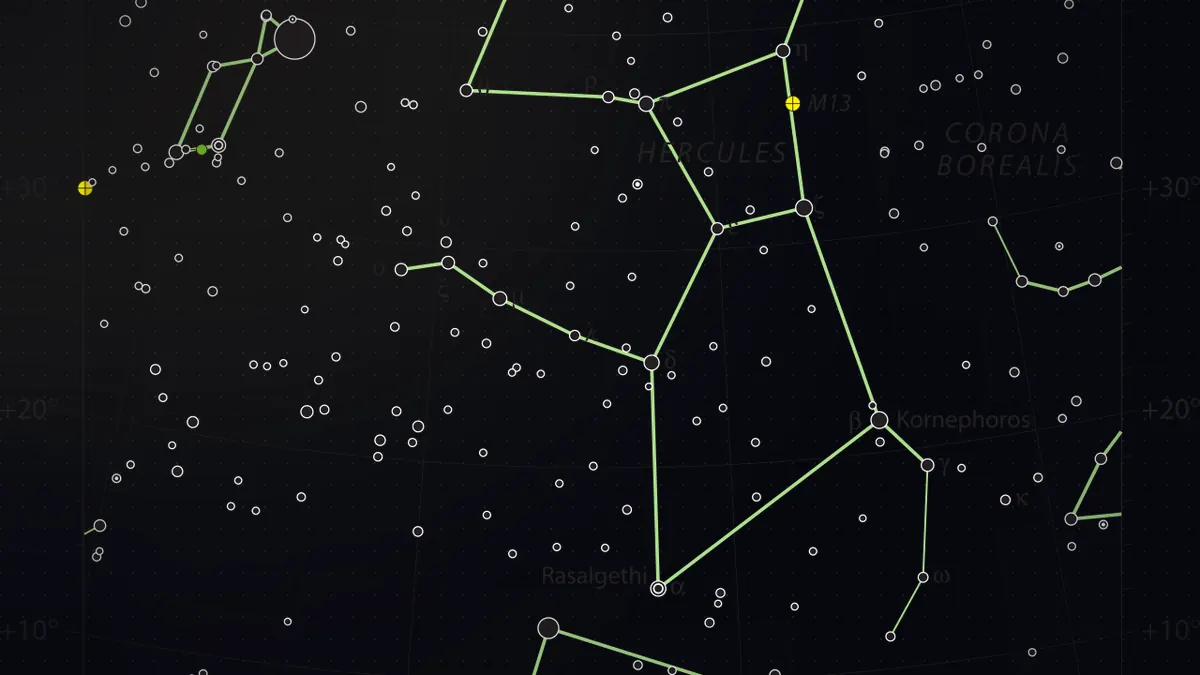
Find Vega (brilliant, high overhead on summer evenings), and look west. You are hunting for the Keystone: four stars forming a slightly lopsided square, like the wedge-shaped stone at the top of an arch.
The Keystone is the key to everything here. M13 sits on its western edge, about a third of the way down from the top corner. Under a dark sky you can just glimpse it as a fuzzy spot without optics.
In sky coordinates Hercules sits at right ascension 17h 00m and declination +30.0°. If the units look unfamiliar, the idea behind them is not: declination is the sky's latitude, right ascension is its longitude, and together they place the constellation exactly. It sits in the northern half of the sky, riding high for northern observers and low for southern ones. You can see it from anywhere north of latitude 39°S, including the whole northern hemisphere, and it sits highest after dark in July.
What Hercules actually looks like
The Keystone — a quadrilateral of four moderately bright stars — forms the hero's torso. From its corners, chains of stars run out as arms and legs, and the figure is drawn kneeling.
Hercules is upside down as we see him, head towards the south. His foot rests on the head of Draco, the dragon he killed in his eleventh labour, which is a nice piece of celestial staging.
For most of its history this constellation had no name at all. The Greeks called it simply Engonasin, 'the kneeling one', and only later attached Hercules to it. Nobody was sure who the kneeling figure was.
The stars of Hercules
- Kornephoros (Beta Herculis, magnitude 2.8) — the brightest star, a yellow giant. The name means 'club-bearer'.
- Rasalgethi (Alpha Herculis) — 'the head of the kneeler', a red supergiant several hundred times the Sun's diameter and a fine double star, pairing an orange primary with a green-blue companion. It is also variable, so its brightness wanders.
- Zeta Herculis — a close binary with a roughly 34-year orbit, challenging but rewarding to split.
- The Solar Apex — not a star, but worth knowing. The Sun is moving through the galaxy at about 20 kilometres per second, and the direction it is heading lies in Hercules, near the border with Lyra. Every time you look at this constellation you are looking at where the Solar System is going.
The story behind the name
Hercules — Heracles to the Greeks — was the son of Zeus and a mortal woman, and Hera's hatred of him drove the whole story. Driven temporarily mad, he killed his own family, and the Twelve Labours were his penance: the Nemean Lion (Leo), the Hydra (Hydra), the crab sent to distract him (Cancer), the dragon guarding the golden apples (Draco).
An unusual number of constellations are characters from this one hero's story, which makes the summer sky readable as a single sequence of labours.
The kneeling posture is the oldest layer. Long before the name Hercules was attached, these stars were simply a kneeling man of unknown identity: possibly borrowed from a Mesopotamian figure. Aratus, writing in the third century BC, admits nobody knows who he is or why he kneels.
What else is hiding in Hercules
- M13, the Great Hercules Cluster — the finest globular cluster in the northern sky. Several hundred thousand stars in a sphere about 145 light years across. In binoculars it is a fuzzy ball; in a small telescope the edges begin to break into individual stars; in a larger one it becomes a swarm. In 1974 the Arecibo radio telescope beamed a message towards M13 as a demonstration of interstellar communication: it will arrive in about 25,000 years.
- M92 — an excellent globular cluster in its own right, and one that would be famous anywhere else. It is more compact than M13 and often skipped simply because of its neighbour.
- NGC 6210 — a small, bright planetary nebula with a distinct blue-green colour, good at high magnification.
- The Hercules Cluster (Abell 2151) — a rich cluster of galaxies about 500 million light years away, for large telescopes and dark skies.
When and where to see it
Best placed in the evening sky in July, through the northern summer.
It reaches to about 50°S, so most of the world can see it, though it is very much a northern-summer constellation and southern observers get it low.
The Keystone survives moderate light pollution; the rest of the figure does not. M13 is the priority — it is bright enough to find from a suburb with a small telescope, and genuinely spectacular from a dark site. If you own binoculars and have one summer night, point them at the Keystone's western edge.
Hercules at a glance
| Name | Hercules |
| Abbreviation | Her |
| Genitive form | Herculis |
| Meaning | Heracles |
| Family | Hercules family |
| First recorded | ancient (Ptolemy) |
| Right ascension | 17h 00m |
| Declination | +30.0° |
| Area | 1225 square degrees (5th largest of 88) |
| Main stars in the figure | 14 |
| Stars brighter than magnitude 3 | 2 |
| Named Bayer / Flamsteed stars | 102 |
| Brightest star | β Her (Kornephoros) (magnitude 2.78) |
| Messier objects | 2 |
| Meteor showers | Tau Herculids |
| Visible from | Anywhere north of latitude 39°S, including the whole northern hemisphere |
| Best seen at 9 pm in | July |
| Bordering constellations | Aquila, Boötes, Corona Borealis, Draco, Lyra, Ophiuchus, Sagitta, Serpens, Vulpecula |
Where to go next
Its neighbours in the sky
Hercules borders all of these, which makes them the natural next targets once you can pick it out: Aquila, Boötes, Corona Borealis, Draco, Lyra, Ophiuchus, Sagitta, Serpens, Vulpecula.
The rest of the Hercules family
Hercules belongs to the Hercules family: the largest family — heroes, serpents and the far southern sky. The others are: Aquila, Ara, Centaurus, Corona Australis, Corvus, Crater, Crux, Cygnus, Hydra, Lupus, Lyra, Ophiuchus, Sagitta, Scutum, Serpens, Sextans, Triangulum Australe, Vulpecula.
Start from the beginning
Not sure where to begin? The guide to all 88 constellations explains how the sky is divided, what a constellation really is, and links to each of the 88.
Star chart: Hercules IAU chart by IAU and Sky & Telescope magazine (Roger Sinnott & Rick Fienberg), used under CC BY 3.0. Observing data cross-checked against Wikipedia's Hercules entry.