Serpens is the only constellation in the sky that comes in two separate, non-touching pieces. Serpens Caput, the serpent's head, lies to the west; Serpens Cauda, the tail, lies to the east; and the constellation Ophiuchus sits between them, holding the snake.
The two halves are treated as one constellation with one set of Bayer letters, and no other constellation works this way. Serpens also contains the Eagle Nebula, home of the Pillars of Creation: probably the most famous astronomical photograph ever taken.
Where to find Serpens
Work from Ophiuchus, the large constellation between Scorpius and Hercules. Serpens is on both sides of it.
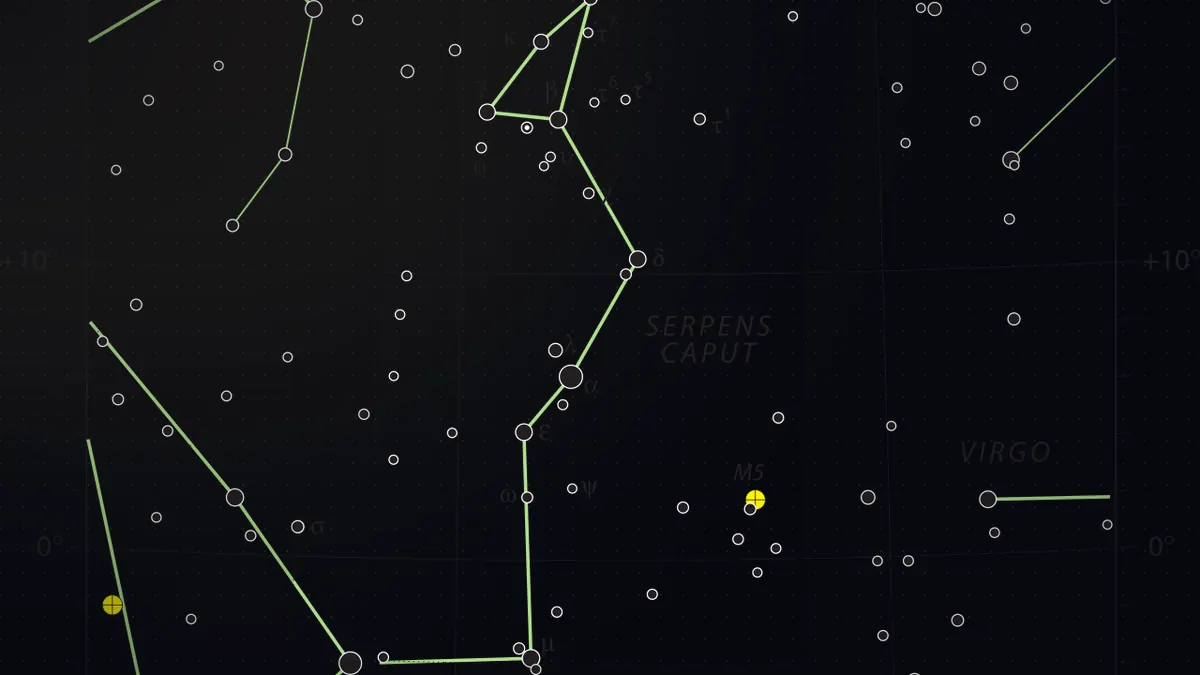
Serpens Caput (the head) is the easier half. Look west of Ophiuchus, below Corona Borealis, for a small triangular group of stars marking the snake's head, with a chain running south from it.
Serpens Cauda (the tail) lies east of Ophiuchus, running down towards Scutum and the Milky Way. The Eagle Nebula sits at its southern end, near the border with Scutum, and is easiest to find by hopping up from M11.
In sky coordinates Serpens sits at right ascension 15h 10m and declination +25.7°. Right ascension is the sky's version of longitude and declination its version of latitude, so those two numbers pin the constellation to one spot on the celestial sphere the way a map reference pins a town. It sits in the northern half of the sky, riding high for northern observers and low for southern ones. Practically speaking it is visible from between latitudes 75°N and 65°S, with the best evening views around July.
What Serpens actually looks like
A long snake in two disconnected sections. The head is a compact triangular group with a chain of stars trailing south; the tail is a shorter line running into the Milky Way.
The division happened because Ptolemy treated Ophiuchus and the serpent as a combined figure — a man wrestling a snake — and when the IAU drew formal boundaries in 1930 it had to make a decision. It kept Ophiuchus whole and let Serpens be split, rather than the other way around.
The result is a genuine oddity: one constellation, two areas, and a total of 637 square degrees split across the sky.
The stars of Serpens
- Unukalhai (Alpha Serpentis, magnitude 2.6) — the brightest star, an orange giant in the head. The name means 'the serpent's neck'.
- Beta Serpentis — a white star forming part of the head triangle.
- Eta Serpentis — the brightest star of the tail half.
- Theta Serpentis (Alya) — a lovely wide double at the tip of the tail, easily split in a small telescope into two near-identical white stars.
- Gliese 710 — an unremarkable-looking orange dwarf with a remarkable future. It is heading towards us, and in about 1.3 million years it will pass through the Sun's Oort Cloud at a distance of roughly 0.2 light years: close enough to disturb comets and potentially send some towards the inner Solar System.
The story behind the name
The serpent is held by Ophiuchus, who is usually identified as Asclepius, the greatest healer of Greek myth. He learned the secret of resurrection by watching one snake bring herbs to revive another, and began raising the dead.
Hades complained to Zeus that the flow of souls to the underworld was drying up, and Zeus killed Asclepius with a thunderbolt: then placed him in the sky with his serpent in recognition of his skill.
The snake is why medicine still uses a serpent-entwined staff as its symbol. The Rod of Asclepius appears on ambulances, hospitals and medical associations worldwide, and its origin is this constellation's story. Snakes were symbols of healing and renewal because they shed their skin and appear reborn.
What else is hiding in Serpens
The two halves offer very different things.
- M16, the Eagle Nebula (in Serpens Cauda) — a star-forming region containing the Pillars of Creation, the towering columns of gas and dust photographed by Hubble in 1995. That image became one of the most reproduced scientific photographs in history. Visually, a telescope shows the open cluster embedded in the nebula clearly, with the nebulosity needing dark skies and ideally a filter. The pillars themselves are a photographic target.
- M5 (in Serpens Caput) — an outstanding globular cluster, one of the oldest known at around 13 billion years, and rated by many observers as the equal of M13. Brilliant in a small telescope.
- Seyfert's Sextet — a compact group of interacting galaxies, extremely faint and a serious challenge.
- Hoag's Object — a rare and beautiful ring galaxy, a perfect circle of blue stars around a yellow core.
When and where to see it
Best placed in the evening sky in July, through the northern summer.
Serpens straddles the celestial equator across both halves, so it is visible from essentially everywhere on Earth.
M5 is bright enough for a suburban telescope and is the easier win. M16 wants a dark sky. If you are working through the Messier catalogue, Serpens is a good night's work: one superb globular in the head, one famous nebula in the tail, and a genuinely odd constellation geometry to explain to whoever you brought with you.
Serpens at a glance
| Name | Serpens |
| Abbreviation | Ser |
| Genitive form | Serpentis |
| Meaning | the Snake |
| Family | Hercules family |
| First recorded | ancient (Ptolemy) |
| Right ascension | 15h 10m |
| Declination | +25.7° |
| Area | 428 square degrees (23rd largest of 88) |
| Main stars in the figure | 11 |
| Stars brighter than magnitude 3 | 1 |
| Named Bayer / Flamsteed stars | 57 |
| Brightest star | α Ser (Unukalhai) (magnitude 2.63) |
| Messier objects | 2 |
| Meteor showers | None |
| Visible from | Between latitudes 75°N and 65°S |
| Best seen at 9 pm in | July |
| Bordering constellations | Aquila, Boötes, Corona Borealis, Hercules, Libra, Ophiuchus, Sagittarius, Scutum, Virgo |
Where to go next
Its neighbours in the sky
These constellations share a border with Serpens, so once you have found it you already know where to look next: Aquila, Boötes, Corona Borealis, Hercules, Libra, Ophiuchus, Sagittarius, Scutum, Virgo.
The rest of the Hercules family
Serpens belongs to the Hercules family: the largest family — heroes, serpents and the far southern sky. The others are: Aquila, Ara, Centaurus, Corona Australis, Corvus, Crater, Crux, Cygnus, Hercules, Hydra, Lupus, Lyra, Ophiuchus, Sagitta, Scutum, Sextans, Triangulum Australe, Vulpecula.
Start from the beginning
If you are starting from scratch, the complete beginner's guide to the 88 constellations covers what a constellation actually is, how the sky is carved up, and links to every one of them.
Star chart: Serpens IAU chart by IAU and Sky & Telescope magazine (Roger Sinnott & Rick Fienberg), used under CC BY 3.0. Observing data cross-checked against Wikipedia's Serpens entry.