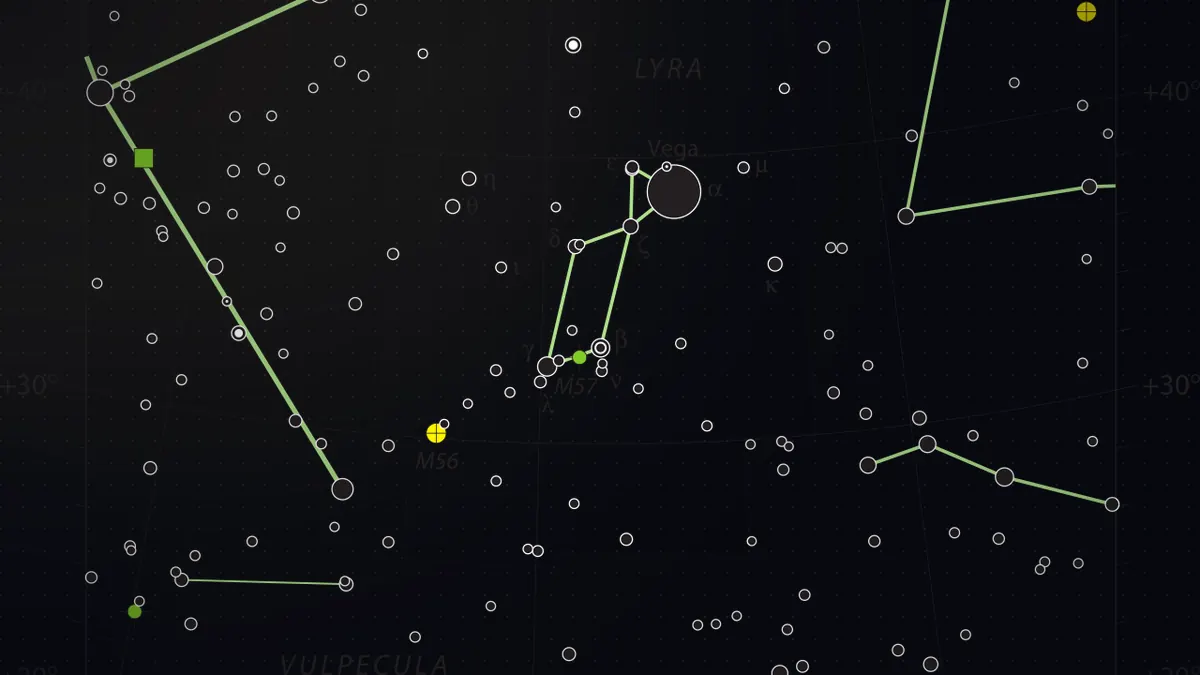
Lyra is small, compact and packed with famous objects. It is dominated by Vega, the fifth brightest star in the night sky and the brightest of the three stars in the Summer Triangle.
Beside Vega sits the Double Double, a star that splits into two, and then each of those splits into two again. And a short hop away is the Ring Nebula, the textbook example of a planetary nebula and one of the most satisfying small-telescope targets there is.
Where to find Lyra
Vega does all the work. On a summer evening, look almost straight up from mid-northern latitudes for a brilliant blue-white star. That is Vega, and it is impossible to mistake.
Just south-east of Vega, four fainter stars form a small parallelogram: the body of the harp. Vega plus that parallelogram is the whole constellation, and it fits comfortably in one binocular field.
The Ring Nebula sits between the two southern stars of the parallelogram, almost exactly halfway. That makes it one of the easiest deep-sky objects in the sky to locate. You cannot really miss it.
In sky coordinates Lyra sits at right ascension 18h 14m and declination +25.7°. Right ascension is the sky's version of longitude and declination its version of latitude, so those two numbers pin the constellation to one spot on the celestial sphere the way a map reference pins a town. It sits in the northern half of the sky, riding high for northern observers and low for southern ones. You can see it from anywhere north of latitude 40°S, including the whole northern hemisphere, and it sits highest after dark in August.
What Lyra actually looks like
A brilliant star with a small parallelogram hanging below it. That is Lyra: five stars, compact, unmistakable.
The figure is a lyre — a small stringed instrument — with Vega at the top where the strings would be anchored. It is one of the few constellations representing a man-made object rather than a person or animal, and given its small tidy shape the identification works reasonably well.
Its compactness is a virtue. Where big constellations like Hercules require patience, Lyra is immediately graspable and holds together even from a fairly bright suburb.
The stars of Lyra
- Vega (Alpha Lyrae, magnitude 0.03) — the fifth brightest star in the night sky, just 25 light years away. It was the first star ever photographed and one of the first to have its spectrum recorded, and for many years it defined the zero point of the magnitude scale. Precession will make it the pole star around 13,700 AD.
- Epsilon Lyrae, the Double Double — the sky's best-known multiple star. Binoculars split it into two stars; a telescope at moderate magnification splits each of those into two again. Four stars, gravitationally bound, and a genuinely delightful thing to show someone.
- Sheliak (Beta Lyrae) — an eclipsing binary so close that the two stars are distorted into eggs and are actively transferring material between them. Its brightness changes visibly over about 13 days.
- RR Lyrae — the prototype of a class of pulsating variables used, like Cepheids, as standard candles for measuring distances.
The story behind the name
The lyre belonged to Orpheus, the greatest musician of Greek myth, whose playing could move stones and tame wild animals. When his wife Eurydice died, he went down into the underworld and his music persuaded Hades to release her, on the condition that he not look back at her until they reached the surface.
He looked back a moment too soon, and lost her permanently.
Orpheus was later killed, and his lyre was thrown into a river. Zeus sent an eagle to retrieve it and placed both in the sky, which is why Lyra sits beside Aquila, the eagle. The two constellations are neighbours because of the ending of the story.
What else is hiding in Lyra
- M57, the Ring Nebula — the classic planetary nebula, and the one everybody learns first. It is a smoke ring of gas puffed off by a dying star, and in even a small telescope it appears as a distinct, unmistakable grey donut. Its position between the parallelogram's southern stars makes it trivially easy to find. This is what our Sun will do in about five billion years.
- M56 — a modest globular cluster, a reasonable secondary target.
- Epsilon Lyrae — worth listing twice. Splitting all four components is one of the classic tests of a small telescope and steady air.
- The Lyrids — a meteor shower peaking around 22 April, producing about 18 meteors an hour from debris of Comet Thatcher. It has been observed for over 2,600 years, making it one of the oldest recorded showers, and it occasionally produces surprise outbursts.
When and where to see it
Best placed in the evening sky in August, and high overhead through the northern summer.
It is a northern constellation reaching to about 40°S, so it is visible from most of the world, but northern observers get it directly overhead while southern observers see it low in the north.
Vega cuts through any amount of light pollution. M57 is bright enough to find from a suburb with a small telescope, which makes Lyra one of the best constellations for someone with modest equipment and imperfect skies. For its size it offers more famous objects than almost anywhere else.
Lyra at a glance
| Name | Lyra |
| Abbreviation | Lyr |
| Genitive form | Lyrae |
| Meaning | Lyre, harp |
| Family | Hercules family |
| First recorded | ancient (Ptolemy) |
| Right ascension | 18h 14m |
| Declination | +25.7° |
| Area | 286 square degrees (52nd largest of 88) |
| Main stars in the figure | 5 |
| Stars brighter than magnitude 3 | 1 |
| Named Bayer / Flamsteed stars | 25 |
| Brightest star | Vega (α Lyr) (magnitude 0.03) |
| Messier objects | 2 |
| Meteor showers | Lyrids, June Lyrids, Alpha Lyrids |
| Visible from | Anywhere north of latitude 40°S, including the whole northern hemisphere |
| Best seen at 9 pm in | August |
| Bordering constellations | Cygnus, Draco, Hercules, Vulpecula |
Where to go next
Its neighbours in the sky
Everything here shares a border with Lyra. Find one and the rest are a short hop away: Cygnus, Draco, Hercules, Vulpecula.
The rest of the Hercules family
Lyra belongs to the Hercules family: the largest family — heroes, serpents and the far southern sky. The others are: Aquila, Ara, Centaurus, Corona Australis, Corvus, Crater, Crux, Cygnus, Hercules, Hydra, Lupus, Ophiuchus, Sagitta, Scutum, Serpens, Sextans, Triangulum Australe, Vulpecula.
Start from the beginning
Not sure where to begin? The guide to all 88 constellations explains how the sky is divided, what a constellation really is, and links to each of the 88.
Star chart: Lyra IAU chart by IAU and Sky & Telescope magazine (Roger Sinnott & Rick Fienberg), used under CC BY 3.0. Observing data cross-checked against Wikipedia's Lyra entry.