Triangulum Australe is a small triangle of three stars in the far southern sky, and it is a rare case of the southern imitation outshining the original. Its stars are considerably brighter than those of the northern Triangulum, making it far easier to spot.
It sits in a rich stretch of the Milky Way near Alpha Centauri, and although it is small and has no mythology, it is one of the more immediately satisfying southern constellations to find.
Where to find Triangulum Australe
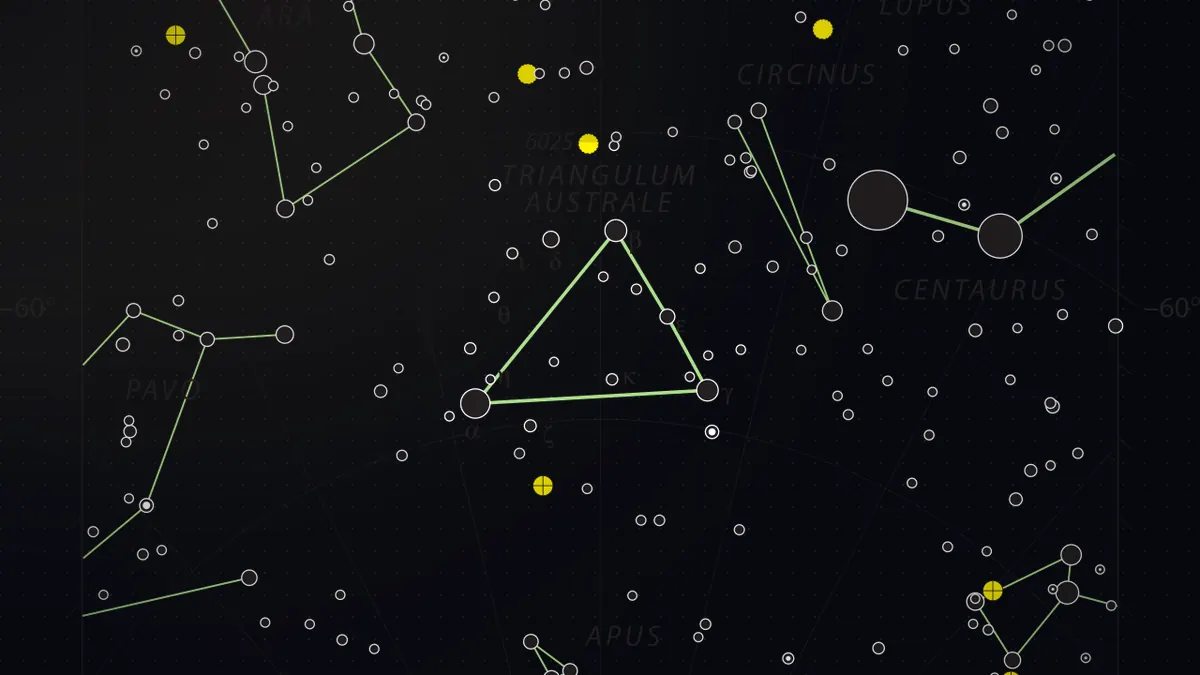
Find Alpha and Beta Centauri, the Pointers beside the Southern Cross, then look south and east. The compact, obvious triangle you find there is Triangulum Australe.
Its brightest star is magnitude 1.9, which is bright enough to hold up under moderate light pollution, and the triangle is nearly equilateral, so the shape is unmistakable.
It sits between Centaurus, Ara and Apus, in a part of the sky where several small southern constellations cluster together. Of that group it is by far the easiest to identify.
In sky coordinates Triangulum Australe sits at right ascension 14h 56m and declination −60.3°. Declination is latitude by another name and right ascension is longitude, so the pair fixes the constellation at one point on the celestial sphere. It is a far-southern constellation, so southern observers own it and much of the northern hemisphere never sees it at all. You can see it from anywhere south of latitude 20°N, including the whole southern hemisphere, and it sits highest after dark in July.
What Triangulum Australe actually looks like
Three bright stars in a near-equilateral triangle. That is all of it, and it needs no imagination whatsoever.
Along with Crux and the northern Triangulum, it belongs to the small category of constellations named honestly for their geometry rather than dressed up as a figure.
It was introduced by the Dutch navigators Pieter Dirkszoon Keyser and Frederick de Houtman in the 1590s, during voyages to the East Indies, and published by Petrus Plancius. It appears on Johann Bayer's 1603 Uranometria, which is how most of these southern constellations entered European astronomy.
The stars of Triangulum Australe
- Atria (Alpha Trianguli Australis, magnitude 1.9) — the brightest star, an orange giant about 390 light years away. Its name is simply a contraction of the constellation's name, which is a slightly unimaginative but practical solution.
- Beta Trianguli Australis — a white star about 40 light years away, considerably closer than Atria.
- Gamma Trianguli Australis — another white star completing the triangle.
The three are unrelated to each other, at very different distances, and happen to line up into a triangle from our point of view. That is true of nearly every constellation, but it is unusually easy to appreciate when the figure is only three stars.
The story behind the name
There is no mythology. Triangulum Australe was created in the 1590s by Dutch navigators mapping the southern sky, and the naming is purely descriptive.
It is one of twelve constellations attributed to Keyser and de Houtman, who catalogued southern stars during Dutch trading voyages. That group (including Apus, Chamaeleon, Dorado, Grus, Hydrus, Indus, Musca, Pavo, Phoenix, Tucana and Volans) makes up the Bayer family, and most of them are named after exotic animals the sailors encountered or heard about.
Triangulum Australe is the exception in that group: a plain geometric shape among a menagerie of birds, fish and reptiles. There is an earlier possible reference by Amerigo Vespucci, but the Dutch navigators are the ones who fixed it in the record.
What else is hiding in Triangulum Australe
Small constellation with a Milky Way background and no Messier objects: Messier, observing from Paris, could never see it.
- NGC 6025 — a bright open cluster of about 60 stars, and comfortably the best target here. It is an easy binocular object and pleasant in a small telescope, with the brighter members forming a rough line.
- NGC 5979 — a small planetary nebula, faint and requiring a decent telescope.
- ESO 69-6 — a pair of interacting galaxies drawn out into long tidal tails, a photographic target.
The realistic plan is NGC 6025 plus a general sweep of the surrounding Milky Way, which is dense in this part of the sky and rewarding even without specific targets.
When and where to see it
Best placed in the evening sky in July, through the southern winter.
This is a far-southern constellation, reaching only to about 20°N in theory but realistically a southern-hemisphere object. From most of the northern hemisphere it never rises. From the southern hemisphere it is circumpolar across much of Australia, southern Africa and southern South America: visible every night of the year.
The triangle needs nothing but your eyes and survives moderate light pollution. NGC 6025 wants binoculars. It is a good constellation for building confidence when you are first learning the southern sky, because you can be certain you have found it.
Triangulum Australe at a glance
| Name | Triangulum Australe |
| Abbreviation | TrA |
| Genitive form | Trianguli Australis |
| Meaning | the Southern Triangle |
| Family | Hercules family |
| First recorded | 1598, Plancius, Keyser, de Houtman |
| Right ascension | 14h 56m |
| Declination | −60.3° |
| Area | 110 square degrees (83rd largest of 88) |
| Main stars in the figure | 3 |
| Stars brighter than magnitude 3 | 3 |
| Named Bayer / Flamsteed stars | 10 |
| Brightest star | α TrA (Atria) (magnitude 1.91) |
| Messier objects | None |
| Meteor showers | None |
| Visible from | Anywhere south of latitude 20°N, including the whole southern hemisphere |
| Best seen at 9 pm in | July |
| Bordering constellations | Apus, Ara, Circinus, Norma |
Where to go next
Its neighbours in the sky
Everything here shares a border with Triangulum Australe. Find one and the rest are a short hop away: Apus, Ara, Circinus, Norma.
The rest of the Hercules family
Triangulum Australe belongs to the Hercules family: the largest family — heroes, serpents and the far southern sky. The others are: Aquila, Ara, Centaurus, Corona Australis, Corvus, Crater, Crux, Cygnus, Hercules, Hydra, Lupus, Lyra, Ophiuchus, Sagitta, Scutum, Serpens, Sextans, Vulpecula.
Start from the beginning
Not sure where to begin? The guide to all 88 constellations explains how the sky is divided, what a constellation really is, and links to each of the 88.
Star chart: Triangulum Australe IAU chart by IAU and Sky & Telescope magazine (Roger Sinnott & Rick Fienberg), used under CC BY 3.0. Observing data cross-checked against Wikipedia's Triangulum Australe entry.