Circinus is the fourth smallest constellation in the sky, a narrow wedge of faint stars tucked right beside Alpha Centauri. It is very easy to look straight past, because the brightest stars in the southern sky are immediately next door.
It contains the Circinus Galaxy, the nearest Seyfert galaxy to Earth — a galaxy with a violently active nucleus powered by a supermassive black hole — which went unnoticed until 1977 because our own Milky Way was in the way.
Where to find Circinus
Circinus is directly beside Alpha Centauri, which makes it one of the easiest faint constellations to locate even though its own stars are dim.
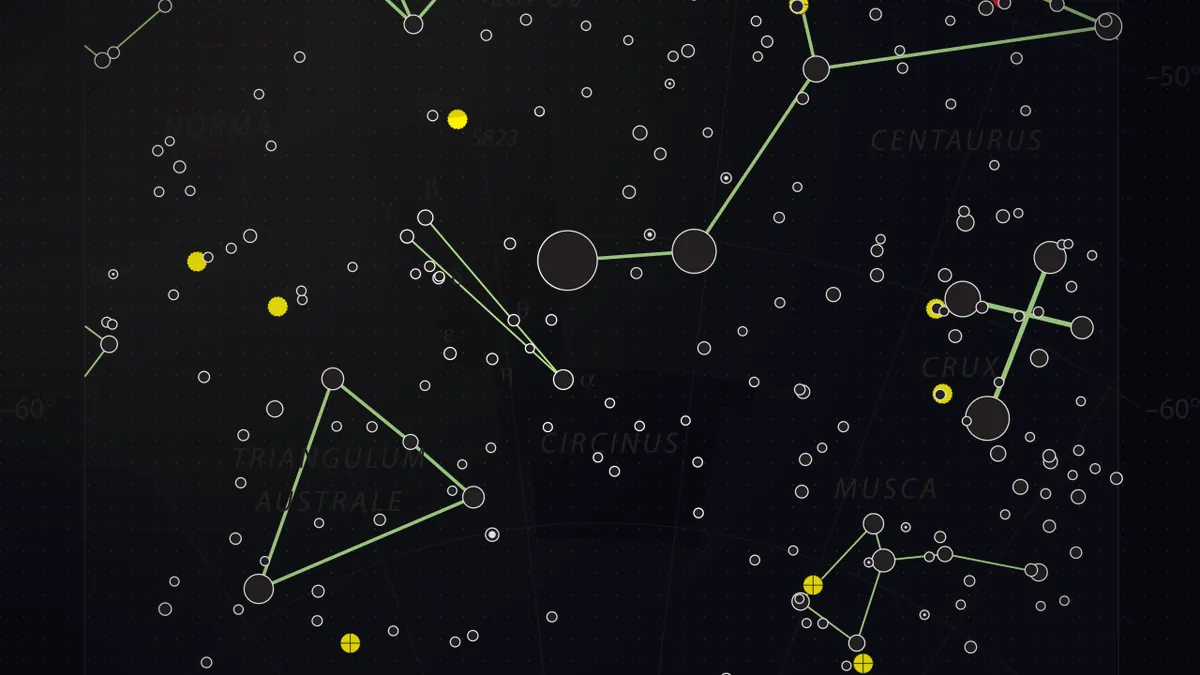
Find the Pointers (Alpha and Beta Centauri, next to the Southern Cross), and look immediately south and east of Alpha Centauri. The small, narrow triangle of faint stars there is Circinus.
Its brightest star is magnitude 3.2, so it is visible from a reasonably dark site. Having the third brightest star in the night sky as a signpost is a considerable advantage.
In sky coordinates Circinus sits at right ascension 13h 38m and declination −55.4°. Right ascension is the sky's version of longitude and declination its version of latitude, so those two numbers pin the constellation to one spot on the celestial sphere the way a map reference pins a town. It is a far-southern constellation, so southern observers own it and much of the northern hemisphere never sees it at all. Practically speaking it is visible from anywhere south of latitude 30°N, including the whole southern hemisphere, with the best evening views around June.
What Circinus actually looks like
A narrow triangle of three stars, a long thin wedge. It is meant to represent a pair of drawing compasses, the instrument used to draw circles, and the narrow V shape actually suits that reasonably well.
It is distinct from Pyxis, the mariner's compass, which is a different instrument entirely in a different part of the sky. The two get confused because English uses the same word for both.
Lacaille created it in the 1750s as part of his fourteen, and its placement beside Centaurus and Norma keeps his drafting tools together: the square, the rule and the compasses in adjacent constellations.
The stars of Circinus
- Alpha Circini (magnitude 3.2) — the brightest star, and a notable one: it is the brightest rapidly oscillating Ap star known, a class of chemically peculiar stars with strong magnetic fields that pulsate over just a few minutes. It is a binary about 54 light years away.
- Beta Circini — a white star, second brightest.
- Gamma Circini — a binary of a blue star and a yellow one, a rewarding split in a medium telescope.
- AX Circini — a Cepheid variable.
Alpha Circini's rapid oscillations are the sort of thing that can only be detected with precise photometry, but they make an otherwise ordinary star scientifically interesting.
The story behind the name
There is no mythology. Circinus was created by Lacaille in the 1750s during his Cape of Good Hope survey, named after the drafting compasses used by draughtsmen and navigators.
Lacaille's grouping is deliberate. Norma (the square and rule), Circinus (the compasses) and Triangulum Australe sit together, forming a small cluster of geometry and drafting instruments in the southern sky. Nearby are the telescope, the microscope, the level and the clock.
Whatever one thinks of the aesthetics, the scheme is coherent: an eighteenth-century astronomer filling the last unmapped part of the sky with the tools of his own trade, right at the moment when precise measurement was transforming what astronomy could do.
What else is hiding in Circinus
Small constellation in the Milky Way, with no Messier objects.
- The Circinus Galaxy — the highlight scientifically. It is the nearest Seyfert galaxy to us at about 13 million light years, meaning it has an actively feeding supermassive black hole at its centre. It went undiscovered until 1977 because it lies close to the Milky Way's plane and is heavily obscured by foreground dust. Visually it is faint and needs a decent telescope.
- NGC 5823 — an open cluster, a good binocular target.
- PSR B1509-58 — a pulsar whose surrounding nebula, imaged in X-rays by Chandra, resembles a giant hand reaching out. It has become one of the most recognisable X-ray images in astronomy.
- Circinus X-1 — an X-ray binary containing a neutron star, notable for its unusual and erratic behaviour.
When and where to see it
Best placed in the evening sky in July, through the southern winter.
Circinus is a far-southern constellation reaching to about 20°N in theory, but effectively a southern-hemisphere object. From much of the southern hemisphere it is circumpolar.
The proximity to Alpha Centauri makes it unusually easy to locate for such a faint constellation, and a moderately dark sky is enough for the triangle. The Circinus Galaxy needs dark skies and aperture. Gamma Circini is a satisfying double for a medium telescope, and is probably the best straightforward visual target here.
Circinus at a glance
| Name | Circinus |
| Abbreviation | Cir |
| Genitive form | Circini |
| Meaning | Compass |
| Family | La Caille family |
| First recorded | 1756, Lacaille |
| Right ascension | 13h 38m |
| Declination | −55.4° |
| Area | 93 square degrees (85th largest of 88) |
| Main stars in the figure | 3 |
| Stars brighter than magnitude 3 | 0 |
| Named Bayer / Flamsteed stars | 9 |
| Brightest star | α Cir (Xami) (magnitude 3.19) |
| Messier objects | None |
| Meteor showers | Alpha Circinids (ACI) |
| Visible from | Anywhere south of latitude 30°N, including the whole southern hemisphere |
| Best seen at 9 pm in | June |
| Bordering constellations | Apus, Centaurus, Lupus, Musca, Norma, Triangulum Australe |
Where to go next
Its neighbours in the sky
These constellations share a border with Circinus, so once you have found it you already know where to look next: Apus, Centaurus, Lupus, Musca, Norma, Triangulum Australe.
The rest of the La Caille family
Circinus belongs to the La Caille family: eighteenth-century southern constellations named after instruments. The others are: Antlia, Caelum, Fornax, Horologium, Mensa, Microscopium, Norma, Octans, Pictor, Reticulum, Sculptor, Telescopium.
Start from the beginning
If you are starting from scratch, the complete beginner's guide to the 88 constellations covers what a constellation actually is, how the sky is carved up, and links to every one of them.
Star chart: Circinus IAU chart by IAU and Sky & Telescope magazine (Roger Sinnott & Rick Fienberg), used under CC BY 3.0. Observing data cross-checked against Wikipedia's Circinus entry.