Fornax is a faint constellation with an outsized place in modern astronomy. It holds the Fornax Cluster, one of the richest nearby galaxy clusters, and it is the patch of sky where Hubble took the Ultra Deep Field.
That image (a tiny piece of apparently empty sky, stared at for the equivalent of eleven days) revealed roughly ten thousand galaxies, some of them seen as they were only a few hundred million years after the Big Bang. It is arguably the most profound photograph ever taken.
Where to find Fornax
Fornax sits in a loop of the river Eridanus, south of Cetus.
Because it is faint — nothing brighter than magnitude 3.8 — work from the river. Trace Eridanus south from Rigel in Orion, and where the river makes a large bend, Fornax sits inside the curve.
Alternatively, find Achernar at the river's end and move north and east. The region is dim and you will need dark-adapted eyes; from a suburb, Fornax effectively does not appear.
In sky coordinates Fornax sits at right ascension 3h 00m and declination −30.0°. Declination is latitude by another name and right ascension is longitude, so the pair fixes the constellation at one point on the celestial sphere. It sits in the southern half of the sky, high for southern observers and low on the horizon for northern ones. You can see it from anywhere south of latitude 50°N, including the whole southern hemisphere, and it sits highest after dark in December.
What Fornax actually looks like
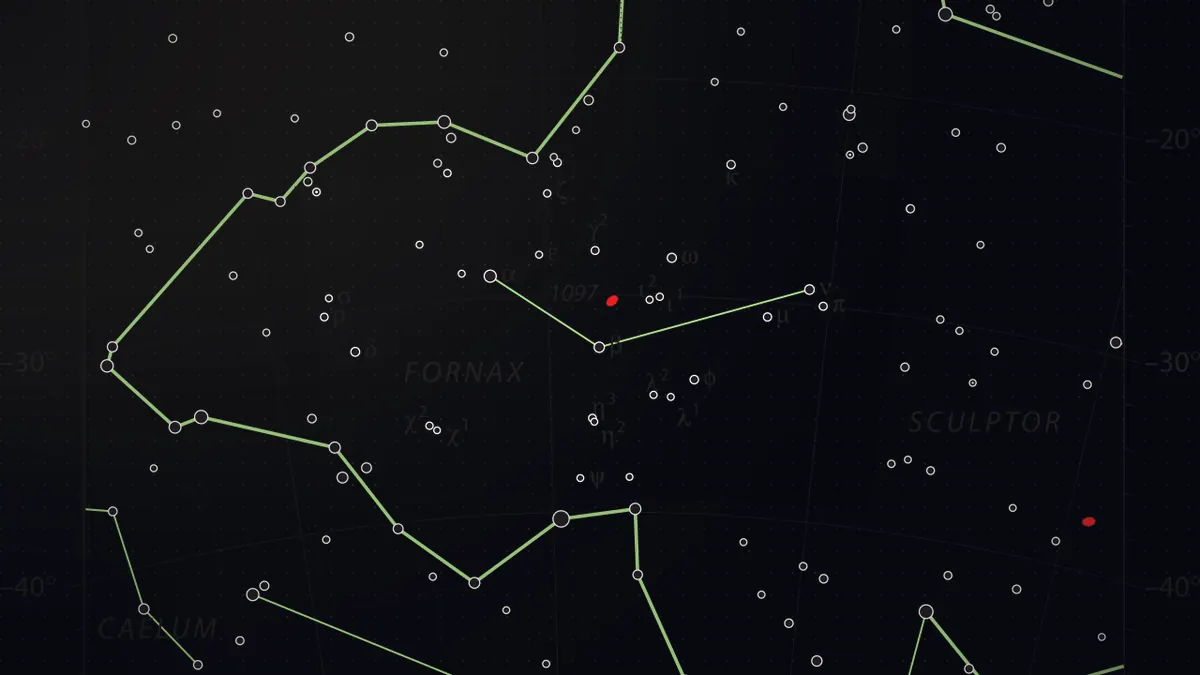
A shallow, sparse arc of three or four faint stars. There is no figure to speak of, and no furnace is discernible.
Lacaille created it in the 1750s as Fornax Chemica, the chemical furnace, honouring the apparatus used by the chemist Antoine Lavoisier. The name was later shortened.
As with the rest of Lacaille's fourteen, the point was to celebrate the instruments of contemporary science. A chemical furnace was, in the eighteenth century, a piece of cutting-edge laboratory equipment: the equivalent of naming a constellation after a particle accelerator today.
The stars of Fornax
- Dalim (Alpha Fornacis, magnitude 3.8) — the brightest star, a binary about 46 light years away whose primary is a yellow-white subgiant.
- Beta Fornacis — a yellow giant, second brightest.
- LP 944-20 — a brown dwarf about 21 light years away, one of the nearest known. In 1999 it was observed emitting a flare, which was surprising for an object that is not a true star.
- UDFj-39546284 — not a star at all but one of the most distant objects ever identified, a candidate galaxy seen as it was around 400 million years after the Big Bang, found in the Ultra Deep Field.
The story behind the name
There is no mythology. Fornax was created by Nicolas-Louis de Lacaille in the 1750s from stars within a bend of Eridanus, and named for a chemical furnace.
Its modern significance comes from a decision made in the 1990s and 2000s. Astronomers wanted to point Hubble at a piece of sky that was as empty as possible (no bright stars, no nearby galaxies, minimal dust), and simply collect light for as long as possible to see what was behind it.
The Hubble Ultra Deep Field, released in 2004, covered an area of sky roughly one-thirteenth the width of the full Moon. It contained about 10,000 galaxies. Later exposures of the same region went deeper still. The result reframed how people think about the sky: there is no empty patch, only patches we have not looked at long enough.
What else is hiding in Fornax
Excellent extragalactic territory, and no Messier objects since Messier could not observe this far south.
- NGC 1365 — a magnificent barred spiral galaxy, one of the best-known examples of the type, with a prominent straight bar and two sweeping arms. It is bright enough for a modest telescope and is a textbook illustration of galactic structure.
- The Fornax Cluster — a rich cluster of around 60 large galaxies about 62 million light years away, the second nearest major cluster after Virgo. Sweeping it with a telescope under dark skies yields galaxy after galaxy.
- NGC 1316 (Fornax A) — a giant elliptical galaxy and powerful radio source, showing dust lanes from a past merger.
- The Fornax Dwarf Galaxy — a satellite of the Milky Way containing several globular clusters of its own.
When and where to see it
Best placed in the evening sky in December, through the southern summer and northern winter.
Fornax lies south of the celestial equator but reaches far enough north to be visible from most inhabited latitudes. Southern observers get the galaxy cluster considerably higher, which matters a great deal for faint extragalactic work.
Dark skies are essential. NGC 1365 is the priority target and is genuinely rewarding: being able to see a barred spiral's bar through an eyepiece is not something many galaxies offer. And it is worth knowing you can point at the Ultra Deep Field's location, even though there is nothing there to see.
Fornax at a glance
| Name | Fornax |
| Abbreviation | For |
| Genitive form | Fornacis |
| Meaning | the brazier |
| Family | La Caille family |
| First recorded | 1756, Lacaille, as Fourneau Chymique |
| Right ascension | 3h 00m |
| Declination | −30.0° |
| Area | 398 square degrees (41st largest of 88) |
| Main stars in the figure | 2 |
| Stars brighter than magnitude 3 | 0 |
| Named Bayer / Flamsteed stars | 27 |
| Brightest star | α For (magnitude 3.80) |
| Messier objects | None |
| Meteor showers | None |
| Visible from | Anywhere south of latitude 50°N, including the whole southern hemisphere |
| Best seen at 9 pm in | December |
| Bordering constellations | Cetus, Eridanus, Phoenix, Sculptor |
Where to go next
Its neighbours in the sky
These constellations share a border with Fornax, so once you have found it you already know where to look next: Cetus, Eridanus, Phoenix, Sculptor.
The rest of the La Caille family
Fornax belongs to the La Caille family: eighteenth-century southern constellations named after instruments. The others are: Antlia, Caelum, Circinus, Horologium, Mensa, Microscopium, Norma, Octans, Pictor, Reticulum, Sculptor, Telescopium.
Start from the beginning
If you are starting from scratch, the complete beginner's guide to the 88 constellations covers what a constellation actually is, how the sky is carved up, and links to every one of them.
Star chart: Fornax IAU chart by IAU and Sky & Telescope magazine (Roger Sinnott & Rick Fienberg), used under CC BY 3.0. Observing data cross-checked against Wikipedia's Fornax entry.