Musca is the only insect in the sky. Among 88 constellations full of heroes, animals, birds and instruments, exactly one is a fly.
It sits just south of Crux, the Southern Cross, in a rich stretch of the Milky Way, and it contains one of the most striking dark nebulae anywhere: the Dark Doodad, a long, sharply defined lane of dust that looks like a black river cutting through the star fields.
Where to find Musca
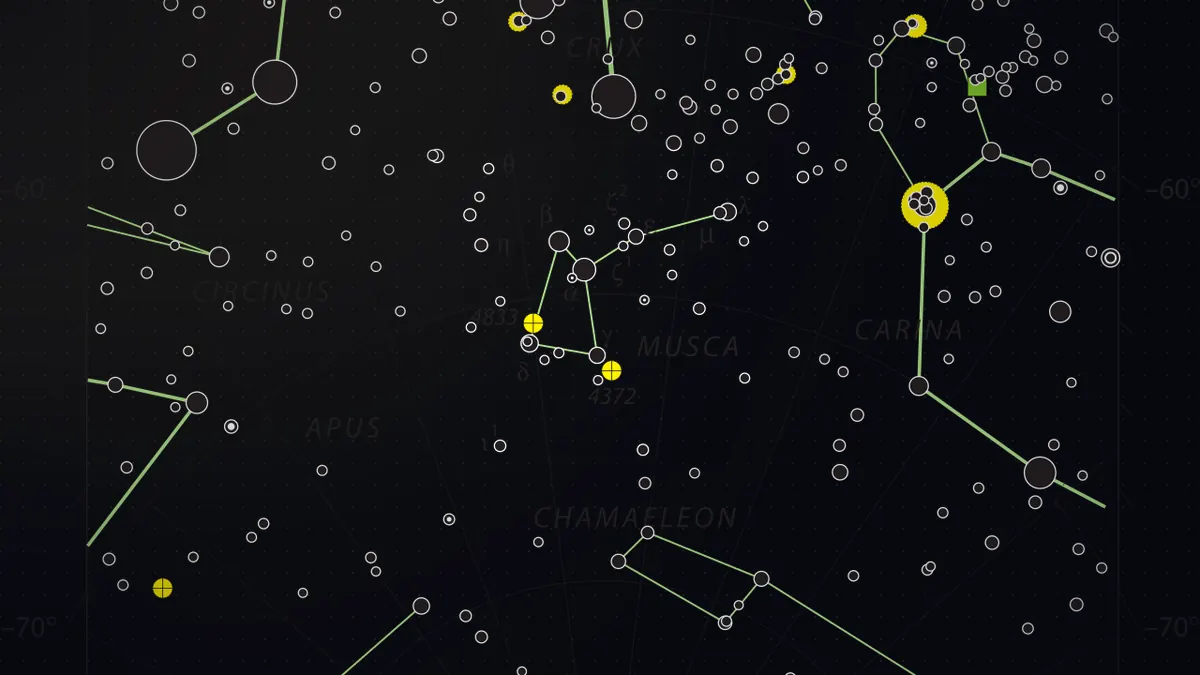
Find the Southern Cross, then look immediately south. The compact group of moderately bright stars just below Crux is Musca.
It is small but reasonably bright, with its leading star at magnitude 2.7, so it holds together well once you know where to look. Being right beside the most recognisable pattern in the southern sky makes it one of the easier small constellations to locate.
The Dark Doodad Nebula is nearby, and under a genuinely dark sky it is visible in binoculars as a distinct dark streak against the Milky Way.
In sky coordinates Musca sits at right ascension 11h 19m and declination −64.6°. Those two numbers work like a grid reference. Right ascension runs around the sky the way longitude runs around the Earth, and declination measures north and south the way latitude does. It is a far-southern constellation, so southern observers own it and much of the northern hemisphere never sees it at all. In practice that means you can find it from anywhere south of latitude 10°N, including the whole southern hemisphere; it rides highest in the evening sky in May.
What Musca actually looks like
A small, compact group of stars, roughly a bent line or shallow arc. No fly is discernible, but the group is tidy and its position directly below Crux makes it easy to remember.
It was originally named Apis, the bee, by Petrus Plancius, and only later became Musca, the fly. For a period it was called Musca Australis, the southern fly, to distinguish it from a northern fly constellation near Aries that has since been abolished.
With that northern rival gone, Musca no longer needs the qualifier, and it holds the insect franchise alone.
The stars of Musca
- Alpha Muscae (magnitude 2.7) — the brightest star, a blue-white giant and a Beta Cephei variable with very slight pulsations. It belongs to the Scorpius-Centaurus association of young stars.
- Beta Muscae — a close binary of two blue-white stars, a challenging split.
- Theta Muscae — a multiple system containing a Wolf-Rayet star, a massive star that has stripped away its outer layers and is pouring out an intense stellar wind. It is one of the more luminous star systems in the galaxy.
- HD 100546 — a young star surrounded by a protoplanetary disc in which a forming planet may have been detected, making it a significant target for studying how planetary systems assemble.
The story behind the name
There is no mythology. Musca was introduced by Keyser and de Houtman in the 1590s and published by Plancius, originally as Apis, the bee.
The renaming to Musca happened gradually and somewhat confusingly. Bayer called it Apis; Lacaille later used Musca Australis; other charts variously used the bee, the southern fly, or both. There was also a short-lived Musca Borealis, a northern fly made from stars in Aries, which competed for the name until it was abolished.
The IAU settled the matter in 1922 by fixing the name as plain Musca. It is a small reminder that the modern list of 88 is the outcome of centuries of overlapping, competing proposals, and that a good deal of tidying was required before the sky was agreed on.
What else is hiding in Musca
The Milky Way location makes Musca richer than its size suggests, though there are no Messier objects: Messier could not see this far south from Paris.
- The Dark Doodad Nebula — the standout. A long, narrow, remarkably well-defined dark nebula stretching about three degrees across the sky, looking like a black rope laid over the star fields. It is a dense filament of interstellar dust blocking the light behind it, and it is one of the most photogenic dark nebulae anywhere. Best in binoculars or a wide-field telescope under dark skies.
- NGC 4833 — a good globular cluster, resolvable in a modest telescope.
- NGC 5189, the Spiral Planetary Nebula — an unusually complex planetary nebula with an S-shaped structure, thought to result from a binary central star. Striking in images and interesting visually.
When and where to see it
Best placed in the evening sky in May, through the southern autumn.
Musca is a far-southern constellation and is circumpolar from much of the southern hemisphere. From the northern hemisphere it never rises.
The constellation's stars survive moderate light pollution, but the Dark Doodad absolutely does not: dark nebulae are visible only by contrast against a bright Milky Way, and any light pollution destroys that contrast. Take binoculars somewhere genuinely dark. Seeing a dark nebula for the first time is a slightly disorienting experience, because you are looking at a hole in the sky rather than an object in it.
Musca at a glance
| Name | Musca |
| Abbreviation | Mus |
| Genitive form | Muscae |
| Meaning | the Fly |
| Family | Bayer family |
| First recorded | 1598, Plancius, Keyser, de Houtman |
| Right ascension | 11h 19m |
| Declination | −64.6° |
| Area | 138 square degrees (77th largest of 88) |
| Main stars in the figure | 6 |
| Stars brighter than magnitude 3 | 1 |
| Named Bayer / Flamsteed stars | 13 |
| Brightest star | α Mus (magnitude 2.69) |
| Messier objects | None |
| Meteor showers | None |
| Visible from | Anywhere south of latitude 10°N, including the whole southern hemisphere |
| Best seen at 9 pm in | May |
| Bordering constellations | Apus, Carina, Centaurus, Chamaeleon, Circinus, Crux |
Where to go next
Its neighbours in the sky
These constellations share a border with Musca, so once you have found it you already know where to look next: Apus, Carina, Centaurus, Chamaeleon, Circinus, Crux.
The rest of the Bayer family
Musca belongs to the Bayer family: southern constellations charted by Dutch navigators in the 1590s. The others are: Apus, Chamaeleon, Dorado, Grus, Hydrus, Indus, Pavo, Phoenix, Tucana, Volans.
Start from the beginning
New to all this? The 88 constellations: a complete beginner's guide explains what a constellation actually is, how the sky is divided up, and lists all 88 with a link to each one.
Star chart: Musca IAU chart by IAU and Sky & Telescope magazine (Roger Sinnott & Rick Fienberg), used under CC BY 3.0. Observing data cross-checked against Wikipedia's Musca entry.