Vulpecula is faint enough that most people never notice it, tucked inside the Summer Triangle below Cygnus with no star brighter than magnitude 4.4.
It contains two things that matter a great deal. M27, the Dumbbell Nebula, was the first planetary nebula ever discovered and remains one of the brightest and easiest. And in 1967, from a patch of sky in Vulpecula, Jocelyn Bell Burnell detected the regular radio pulses that turned out to be the first known pulsar.
Where to find Vulpecula
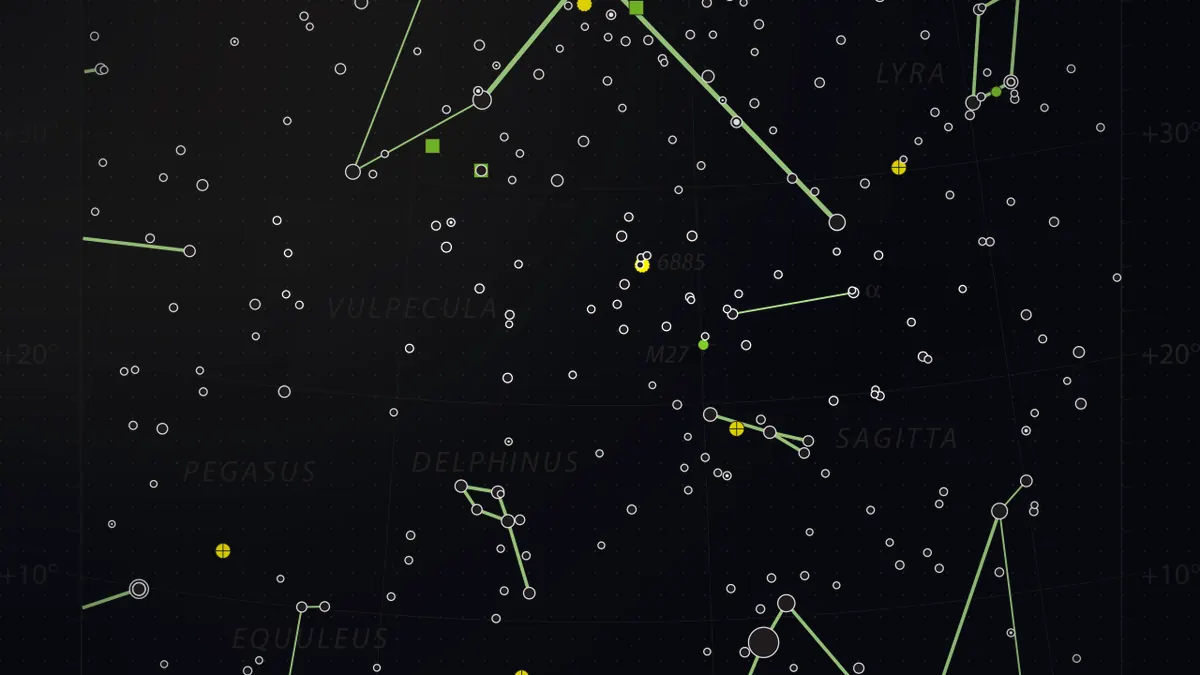
Vulpecula fills the space between Cygnus above and Sagitta below, inside the Summer Triangle.
Because its own stars are so faint, use the arrow. Find Sagitta, then look just north of it: that region is Vulpecula. For the Dumbbell Nebula specifically, go to Gamma Sagittae at the arrow's tip and move about three degrees north.
M27 is easier to find than the constellation containing it, which is a slightly comic situation but genuinely how most people navigate here.
In sky coordinates Vulpecula sits at right ascension 20h 00m and declination +25.0°. Those two numbers work like a grid reference. Right ascension runs around the sky the way longitude runs around the Earth, and declination measures north and south the way latitude does. It sits in the northern half of the sky, riding high for northern observers and low for southern ones. You can see it from anywhere north of latitude 55°S, including the whole northern hemisphere, and it sits highest after dark in September.
What Vulpecula actually looks like
There is no real figure. Vulpecula is a scattering of fifth-magnitude stars with no discernible pattern, and pretending otherwise would be dishonest.
Johannes Hevelius created it in 1687 as Vulpecula cum Ansere, 'the little fox with the goose': a fox carrying a goose in its jaws. The goose was later dropped from the name, though it survives in the name of the star Anser.
Hevelius placed a hunting animal here deliberately, near the eagle and the swan, filling a gap in the Milky Way with something thematically appropriate. The pattern is not visible, but the idea was sound.
The stars of Vulpecula
- Anser (Alpha Vulpeculae, magnitude 4.4) — the brightest star, a red giant. Its name means 'goose', the surviving fragment of the constellation's original longer name.
- 23 Vulpeculae — the second brightest, an orange giant.
- PSR B1919+21 — not visible, but historically enormous. In 1967 Jocelyn Bell Burnell, then a graduate student, noticed a signal repeating every 1.34 seconds with extraordinary regularity. The precision was so unlike anything natural that the source was half-jokingly labelled LGM-1, for 'Little Green Men'. It turned out to be a rapidly rotating neutron star: the first pulsar ever found, and the confirmation that neutron stars exist. The discovery won a Nobel Prize, though controversially not for Bell Burnell herself.
- Brocchi's Cluster — see below; it sits partly in Vulpecula and is the constellation's best-known naked-eye feature.
The story behind the name
There is no mythology. Vulpecula is one of the seven constellations Johannes Hevelius invented in 1687 to fill unclaimed gaps, and it has no Greek, Roman or Babylonian ancestry.
Hevelius described the figure as a fox carrying a goose towards neighbouring Cerberus and Hercules: a small predatory scene set among the birds of the summer Milky Way. The goose was gradually dropped from charts and finally from the official name.
The constellation's genuine significance is entirely modern. That an invented filler constellation with no bright stars and no myth turned out to contain both the first planetary nebula discovered and the first pulsar detected is a nice reminder that the sky does not care which patches we decided were important.
What else is hiding in Vulpecula
- M27, the Dumbbell Nebula — the first planetary nebula ever discovered, found by Charles Messier in 1764. It is large, bright and one of the easiest deep-sky objects to see well: in binoculars a small glowing patch, and in a modest telescope a distinct two-lobed apple-core shape. For many observers it rivals or beats the Ring Nebula. It is a dying Sun-like star that has thrown off its outer layers.
- Brocchi's Cluster (the Coathanger) — an asterism of about ten stars forming an unmistakable coathanger: a straight bar with a hook on top. It is a chance alignment rather than a true cluster, and it is one of the best binocular sights in the summer sky. Under dark skies it is faintly visible to the naked eye.
- NGC 6940 — a rich open cluster, a good binocular target on the constellation's eastern edge.
When and where to see it
Best placed in the evening sky in September, through the northern summer.
It is a northern constellation but reaches far enough south for most of the world to see it, with northern observers getting it overhead.
The constellation itself needs a dark sky; from a city its stars are gone entirely. But M27 and the Coathanger are both bright enough to enjoy from a suburb, which makes Vulpecula unusually rewarding for how faint it is. Use binoculars for the Coathanger — it is too large for a telescope — and a telescope for the Dumbbell.
Vulpecula at a glance
| Name | Vulpecula |
| Abbreviation | Vul |
| Genitive form | Vulpeculae |
| Meaning | the Fox |
| Family | Hercules family |
| First recorded | 1690, Hevelius, as Vulpecula cum Ansere |
| Right ascension | 20h 00m |
| Declination | +25.0° |
| Area | 268 square degrees (55th largest of 88) |
| Main stars in the figure | 5 |
| Stars brighter than magnitude 3 | 0 |
| Named Bayer / Flamsteed stars | 33 |
| Brightest star | α Vul (Anser) (magnitude 4.44) |
| Messier objects | 1 |
| Meteor showers | None |
| Visible from | Anywhere north of latitude 55°S, including the whole northern hemisphere |
| Best seen at 9 pm in | September |
| Bordering constellations | Cygnus, Delphinus, Hercules, Lyra, Pegasus, Sagitta |
Where to go next
Its neighbours in the sky
Everything here shares a border with Vulpecula. Find one and the rest are a short hop away: Cygnus, Delphinus, Hercules, Lyra, Pegasus, Sagitta.
The rest of the Hercules family
Vulpecula belongs to the Hercules family: the largest family — heroes, serpents and the far southern sky. The others are: Aquila, Ara, Centaurus, Corona Australis, Corvus, Crater, Crux, Cygnus, Hercules, Hydra, Lupus, Lyra, Ophiuchus, Sagitta, Scutum, Serpens, Sextans, Triangulum Australe.
Start from the beginning
Not sure where to begin? The guide to all 88 constellations explains how the sky is divided, what a constellation really is, and links to each of the 88.
Star chart: Vulpecula IAU chart by IAU and Sky & Telescope magazine (Roger Sinnott & Rick Fienberg), used under CC BY 3.0. Observing data cross-checked against Wikipedia's Vulpecula entry.