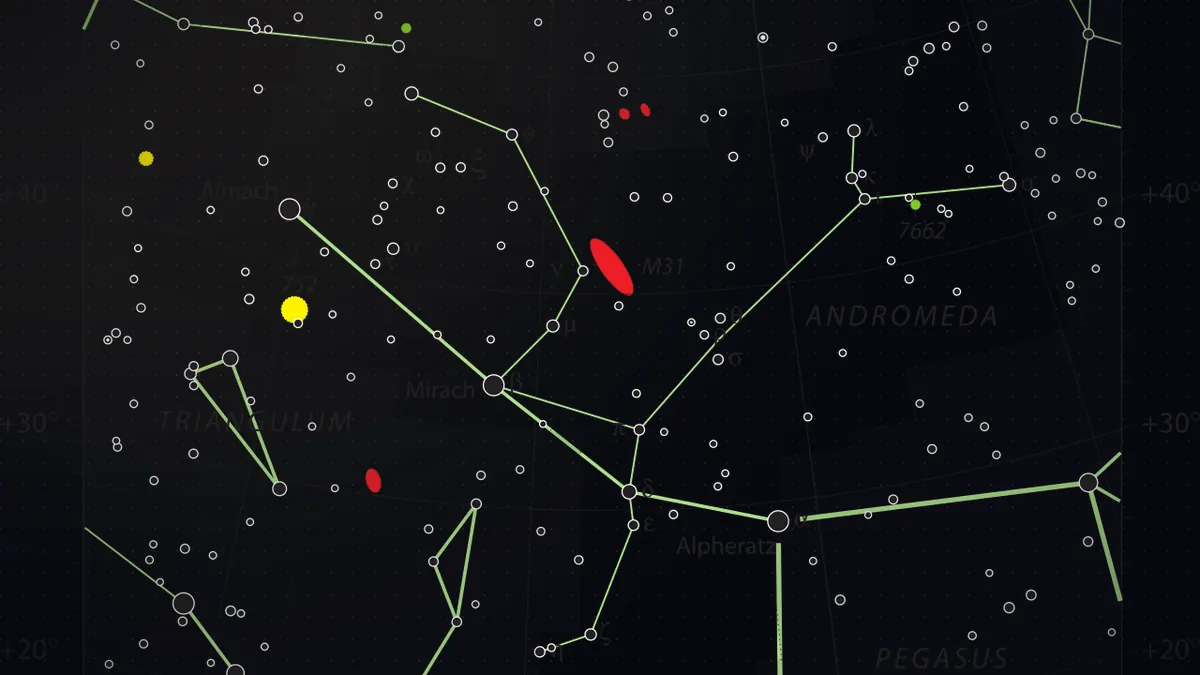
The First Point of Aries has been in Pisces since 68 BC. It is not a star and not a fixed spot among the stars. It is the point where the Sun, climbing north along the ecliptic, crosses the celestial equator each March, and that point slides westward through the zodiac at about 50 arcseconds a year.
Today it sits in a thin, starless part of southern Pisces, south-east of the Circlet. J2000 puts it at right ascension 23h 58.7m, declination -00° 09'. In its own frame it is 0h 00m 00s and 0° 00' 00", because it is the zero point right ascension counts from. The name is a two-thousand-year-old label nobody has bothered to update.
It crossed out of Aries in 68 BC and reaches Aquarius in AD 2597. Both of those dates are decided by lines that did not exist until 1930, drawn by one man along a coordinate grid that was already fifty-five years out of date when he used it. Change the lines and you change the dates, which is the part most answers leave out.
What the point actually is
Two great circles cross the sky. The celestial equator is Earth's equator projected outwards. The ecliptic is the plane of Earth's orbit, which is the line the Sun appears to trace over a year. They are tilted with respect to each other by the obliquity of the ecliptic, which for 2026 is 23° 26' 09".
Two tilted circles on a sphere intersect at two points, 180° apart. The one the Sun passes through going from south to north is the March equinox, also called the vernal equinox, also called the First Point of Aries. In 2026 the Sun reaches it on 20 March at 14:46 UTC.
The other intersection is the September equinox, historically the First Point of Libra. It left Libra for Virgo in 730 BC, moving at the same rate and for the same reason.
That point is not decorative. It is the origin of the equatorial coordinate system. Right ascension is measured eastward from it; ecliptic longitude is measured from it too. Every catalogue position you have ever seen counts from this spot.
Where it is right now
Because the equator and ecliptic both move, a coordinate is only meaningful with an epoch attached. Here is the same point in three frames.
| Frame | Right ascension | Declination |
|---|---|---|
| Equinox of date (its definition) | 0h 00m 00s | +00° 00' 00" |
| J2000.0 | 23h 58.7m | -00° 09' |
| B1875.0 (the frame the IAU boundaries use) | 23h 52.3m | -00° 50' |
Look that last row up in the official boundary tables and the answer comes back Pisces.
Nothing marks the spot visually. Omega Piscium, magnitude 4.0, sits 7.0° due north of it; 27 Piscium, magnitude 4.9, sits 3.4° due south. Between them is empty sky. Point a telescope at right ascension zero and you will see nothing worth looking at, which is a fair summary of how astronomy treats the point: important, invisible.
Why it moves
Earth spins tilted, and it is not a sphere. It bulges at the equator by about 21 kilometres. The Sun and the Moon pull on that bulge, and because the bulge is tilted relative to their orbits, the pull produces a torque. A spinning body responds to torque by precessing, so Earth's axis sweeps out a cone with a half-angle equal to the tilt, roughly 23.4°.
The equator goes with the axis, so the equator's intersection with the ecliptic walks westward along the ecliptic.
The rate is well measured. The IAU 2006 model gives general precession in longitude as 5028.796195 arcseconds per Julian century at J2000, increasing by about 2.21 arcseconds per century every century. That works out to:
- roughly 50.29 arcseconds per year
- one degree in about 71.6 years, which is where the familiar "one degree per 72 years" comes from
- one full circuit in 25,771.58 years, usually rounded to about 25,772
Hipparchus noticed this around 129 BC, comparing his own star positions against measurements Timocharis had made a century and a half earlier. The stars had shifted in longitude, and he correctly blamed a moving equinox. His rate, at least one degree per century, was low.
Precession is also why star catalogues carry epochs at all, and why B1950 positions do not match J2000 positions. The modern fix was to stop using it as an anchor. Since 1998 the fundamental reference frame has been the ICRS, tied to distant quasars rather than to anything that moves. Its right ascension origin sits about 15 milliarcseconds from the J2000 dynamical equinox, close enough that J2000 catalogues did not need reworking, but the equinox is no longer the definition.
Where the equinox has been and where it goes next
Applying the current IAU boundaries backwards and forwards gives this sequence. Jean Meeus published the two middle figures, and recomputing them from the published Delporte boundary file reproduces them.
| The March equinox enters | Year |
|---|---|
| Aries | 1865 BC |
| Pisces | 68 BC |
| Aquarius | AD 2597 |
| Capricornus | about AD 4312 |
So the "Age of Pisces", in the only sense that has a checkable definition, began in 68 BC and runs for about 2,664 years. The crossing into Aquarius happens at a specific place: the ecliptic meets the Pisces and Aquarius border on the parallel of declination -04° 00', at B1875 right ascension 23h 22.8m.
IAU 1976 and IAU 2006 put the 68 BC crossing two weeks apart, and the AD 2597 one three weeks apart. The model is not the uncertainty. The boundary is.
Why 68 BC is a convention, not a measurement
The date depends entirely on where you agree the line is, and there was no agreed line until 1930.
The boundaries are modern. The IAU adopted the 88 constellations and their three-letter abbreviations in 1922. Boundaries came later. The Belgian astronomer Eugène Delporte was asked to draw them, his scheme was approved at the IAU General Assembly in Leiden in 1928, and the tables and charts were published in 1930 as Délimitation Scientifique des Constellations. Delporte built on southern boundaries that Benjamin Gould had already drawn for epoch 1875, which is why the whole system is anchored to B1875.0 rather than to a rounder date.
Delporte put the Pisces and Aries line where he did to keep the naked-eye stars on the sides the older charts had given them. Nothing in 68 BC required it to be there. Shift that meridian by a single degree and the crossing date moves by about 72 years.
Equal divisions give a completely different answer. Astrology divides the ecliptic into twelve equal 30° signs. Astronomy uses areas that run from Virgo's 1,294 square degrees down to Capricornus's 414. Under equal division the crossing dates change, and there is no consensus on where to start counting: Nicholas Campion's survey of published claims for the start of the Age of Aquarius found proposals spanning AD 1447 to AD 3597.
Year numbering trips people up. Astronomical year -67 is 68 BC, because astronomical year 0 is 1 BC. Sources that convert carelessly land on 67 BC.
So the honest statement is: by the boundaries in force today, the first century BC, most precisely 68 BC. Anyone giving you a date to the day is over-claiming.
The Pisces and Aries boundary, exactly
Queries for this often quote something like "RA 23h 50m to 2h 10m". That is a bounding box, not a border, and treating it as one is the root of the confusion.
A constellation boundary is not a line segment. It is a closed staircase of alternating segments, each one running along a line of constant right ascension or constant declination in B1875.0 coordinates. The whole sky is tiled this way, which is why the boundaries look like the borders of Colorado and Wyoming rather than like anything organic.
The Pisces and Aries border happens to be one of the simplest in the sky. It is exactly two segments:
- a meridian at right ascension 1h 40m, running from declination +09° 55' north to +25° 00'
- a parallel at declination +09° 55', running from right ascension 1h 40m east to 2h 00m
They meet at a right angle at (1h 40m, +09° 55'). Aries is north and east of the corner; Pisces is south and west of it. Precessed to J2000 that corner lands at right ascension 1h 46.6m, declination +10° 33', the north end of the meridian at 1h 47.0m and +25° 38', and the east end of the parallel at 2h 06.7m and +10° 31'.
The ecliptic crosses that meridian at B1875 declination +10° 23', which in J2000 is right ascension 1h 46.6m, declination +11° 00'. That is the exact patch of sky where the Sun leaves Pisces for Aries every April.
Notice what precession does to the shape. In the B1875 catalogue file, the outline of Pisces is 26 corner points, because every segment is dead straight along the grid. The same outline expressed in J2000 needs 194 points, since the lines are no longer parallel to the coordinate grid and have to be approximated as curves. The border did not move. The grid did.
For the record, the bounding boxes people quote are these. Pisces spans J2000 right ascension 22h 51m to 2h 07m and declination -6.3° to +33.7°. Aries spans 1h 47m to 3h 30m and +10.4° to +31.2°. Both boxes contain large areas belonging to other constellations, which is precisely why a range of right ascension cannot tell you where a border is.
How to check a position yourself
The published method is Nancy Roman's, from a 1987 paper in Publications of the Astronomical Society of the Pacific, and it is three steps.
- Precess the position to B1875.0. Any precession routine will do; the boundaries are only defined in that frame.
- Look it up in the boundary table. Roman's table is distributed by CDS as catalogue VI/42. Each row is a lower right ascension, an upper right ascension, a lower declination, and a constellation abbreviation, sorted so that the first row your position falls inside is the answer.
- Read off the abbreviation.
Worked on the point this page is about: the 2026 March equinox precesses to B1875 right ascension 23h 52.3m, declination -00° 50'. The first matching row in Roman's table is Pisces. Done.
If you want the polygons rather than the lookup table, CDS catalogue VI/49 carries Delporte's boundary vertices in both B1875 and J2000 form. And if you want no arithmetic at all, Stellarium names the constellation under your cursor, and astropy's get_constellation() runs exactly these three steps against Roman's table.
Why your birth sign does not match the sky
The zodiac used in Western astrology is tropical. Its Aries begins at the March equinox by definition and runs for exactly 30° of ecliptic longitude, so it has never moved and never will. It was pinned to the constellation Aries roughly 2,200 years ago and has been drifting away from it ever since.
The constellations are unequal areas fixed to the stars. The two have drifted about a full sign apart.
Here is where the Sun actually was in 2026, computed against the IAU boundaries. Dates shift by up to a day from year to year.
| Constellation | Sun inside it, 2026 |
|---|---|
| Capricornus | 20 January to 16 February |
| Aquarius | 16 February to 12 March |
| Pisces | 12 March to 19 April |
| Aries | 19 April to 14 May |
| Taurus | 14 May to 21 June |
| Gemini | 21 June to 21 July |
| Cancer | 21 July to 11 August |
| Leo | 11 August to 17 September |
| Virgo | 17 September to 31 October |
| Libra | 31 October to 23 November |
| Scorpius | 23 November to 30 November |
| Ophiuchus | 30 November to 18 December |
| Sagittarius | 18 December to 20 January |
The tropical sign Aries runs from the equinox on 20 March until the Sun reaches 30° of longitude on 20 April. The Sun does not enter the constellation Aries until 19 April. So for all but the last day of the sign, someone born under Aries has the Sun in front of Pisces.
Three other things fall out of that table:
- The Sun spends about six and a half days in Scorpius, less than in any other constellation it crosses. It clips a corner.
- It spends about 18 days in Ophiuchus, which is not a sign at all but is unambiguously on the ecliptic under the IAU boundaries.
- It spends about 44 days in Virgo, nearly seven times as long as in Scorpius, because Virgo is enormous.
None of this makes astrology wrong on its own terms, since the tropical zodiac never claimed to track the constellations. It does mean that "the Sun was in Aries when I was born" is a statement about a coordinate convention rather than about the sky.
Questions people ask
Is the First Point of Aries the same thing as the vernal equinox?
Yes. The vernal equinox has two meanings that get mixed up: the moment in March when the Sun crosses the equator, and the point on the sky where it happens. The First Point of Aries is the second of those. "March equinox" is the better term for the moment, since it is not spring everywhere.
Why is it still called the First Point of Aries?
Inertia. Renaming it would break two thousand years of literature for no gain. The symbol is still the ram. Textbooks write the point with the Aries glyph, and some sources prefer the March equinox point, or just the vernal point.
What are the coordinates of the First Point of Aries?
In the equinox-of-date frame it is 0h 00m 00s, 0° 00' 00", by definition, always. If you need it in a fixed frame, J2000 puts it at right ascension 23h 58.7m, declination -00° 09', and B1875 at 23h 52.3m, -00° 50'.
When exactly does the Age of Aquarius start?
Under the IAU boundaries, AD 2597, when the equinox point crosses the declination -04° 00' parallel that separates Pisces from Aquarius. Under equal 30° divisions the answer depends on where you anchor the divisions, and published claims run from the fifteenth century to the thirty-sixth.
Why are constellation boundaries defined in 1875 coordinates?
Because Benjamin Gould had already drawn southern boundaries for epoch 1875 in his Uranometria Argentina, and when Delporte extended the scheme to the whole sky in the late 1920s he kept Gould's frame rather than redoing the work. The choice is historical, not physical.
Does precession change the seasons or the calendar?
Not the seasons, because the tropical year is defined equinox to equinox and the calendar tracks that. It does move the seasons relative to the stars. In about 13,000 years the northern hemisphere will have summer where it now has winter with respect to the constellations, while the calendar date of the solstice stays put.
Does the pole star change too?
Yes, and for the same reason. Polaris is closest to the north celestial pole around the year 2100. Thuban in Draco held the position around 3000 BC. Vega comes within a few degrees of it in roughly 12,000 years.
Is the equinox point moving through Cetus at any stage?
No. Its track runs from Pisces directly into Aquarius. Cetus stays south of that track the whole way, so the point crosses the Pisces and Aquarius parallel at declination -04° without ever entering Cetus.
Keep reading
- Pisces constellation, for the faint autumn figure the equinox point currently sits inside, and how to find the Circlet.
- Aries constellation, the constellation the point left in 68 BC and the one it is still named after.
- Aquarius constellation, where the equinox arrives in AD 2597, with the Helix Nebula as compensation for the wait.
- Ophiuchus constellation, the thirteenth constellation on the ecliptic, where the Sun spends 18 days a year.
- The 88 constellations: a complete beginner's guide, for how the sky was carved into 88 numbered regions and what the boundaries are for.
Boundary coordinates computed from CDS catalogue VI/49, Davenhall and Leggett's machine-readable form of Delporte (1930), and cross-checked against Roman's lookup table, CDS VI/42. Precession values are IAU 2006. Crossing dates agree with Jean Meeus as reported by EarthSky.