The Sun really does pass through Ophiuchus. It crosses the constellation every year from roughly 30 November to 17 December, about eighteen days, which is more than twice as long as it spends inside Scorpius.
It is still not a zodiac sign. That is not an oversight or a cover-up. A sign and a constellation are two different things that happen to share twelve names: signs are twelve equal slices of a circle, fixed by Babylonian astronomers around the fifth century BCE, while constellations are ragged patches of sky of wildly different sizes whose exact edges nobody drew until 1930.
Hold those two apart and the thirteenth-sign story stops being a scandal. It turns into a units problem.
A sign is not a constellation
This distinction carries the whole answer.
A sign is a 30-degree arc of the ecliptic, the circle the Sun appears to trace against the stars over a year. Twelve of them fill 360 degrees exactly. Every sign is the same width, by definition, because the scheme starts with the arithmetic and applies the names afterwards.
A constellation is a region of the celestial sphere with a defined boundary. All 88 of them together cover the whole sky, poles included. They are not the same size. They were never designed to be, and nothing about them adds up to a neat twelve.
| Sign | Constellation | |
|---|---|---|
| What it is | a 30° arc of the ecliptic | a bounded region of the sky |
| How many | 12, always | 88, of which the Sun crosses 13 |
| Size | all identical, 30° each | uneven; among the zodiac twelve, 414 to 1,294 square degrees |
| Who fixed it | Babylonian astronomers, by around the 5th century BCE | the IAU: names in 1922, boundaries in 1930 |
| Anchored to | the March equinox, in Western astrology | the stars, at the 1875 epoch |
Both are useful. They are just not measurements of the same thing, and the confusion is entirely because they share a vocabulary.
How long the Sun actually spends in each constellation
These are the constellation crossings, worked out from the IAU boundaries. They have nothing to do with the sign dates printed in a newspaper column.
| Constellation | Sun passes through | Days |
|---|---|---|
| Pisces | 12 Mar – 18 Apr | 38 |
| Aries | 19 Apr – 13 May | 25 |
| Taurus | 14 May – 19 Jun | 37 |
| Gemini | 20 Jun – 20 Jul | 31 |
| Cancer | 21 Jul – 9 Aug | 20 |
| Leo | 10 Aug – 15 Sep | 37 |
| Virgo | 16 Sep – 30 Oct | 45 |
| Libra | 31 Oct – 22 Nov | 23 |
| Scorpius | 23 Nov – 29 Nov | 7 |
| Ophiuchus | 30 Nov – 17 Dec | 18 |
| Sagittarius | 18 Dec – 18 Jan | 32 |
| Capricornus | 19 Jan – 15 Feb | 28 |
| Aquarius | 16 Feb – 11 Mar | 24 |
Treat every date as give or take a day. The Sun crosses a boundary at a particular hour, not at midnight, and leap years shuffle the calendar underneath it, so different sources print dates that differ by one. The pattern is what matters.
Look at the range. Virgo gets 45 days, Scorpius gets 7, and the twelve signs named after them all run within a day or two of 30. Scorpius is the extreme case: the constellation covers only about seven degrees of the ecliptic, because the ecliptic clips its northern corner and then leaves. Ophiuchus takes roughly eighteen degrees of the same stretch. The Sun leaves Scorpius, spends two and a half weeks in the Serpent Bearer, and comes out in Sagittarius.
Why twelve, and why exactly 30 degrees
The twelve-sign zodiac is a calendar tool before it is anything else.
Babylonian sky records go back a long way. The compilation known as MUL.APIN, whose oldest dated copy was written in 686 BCE, already lists the constellations that lie along the Moon's path: seventeen of them, or eighteen, depending on how you count. That is a description of the sky. It is messy, because the sky is messy.
The tidy version came later. By around the fifth century BCE, Babylonian astronomers were dividing the ecliptic into twelve equal 30-degree sections, each named after a constellation that sat roughly in it. That change is the origin of every zodiac in use today. Twelve was chosen because it matched a twelve-month lunar calendar and divides 360 cleanly, not because anyone counted the constellations on the Sun's path and got twelve.
The names were labels for arithmetic slices. Ophiuchus was not thrown out of the scheme. It was never a candidate for a scheme that had already decided on twelve equal parts.
Nobody drew the edges until 1930
Here is the part most retellings skip. For most of the zodiac's history, constellations had no boundaries at all.
Ptolemy's Almagest, around 150 CE, catalogued 48 constellations by listing which stars belonged to which figure. Ophiuchus is one of them. Ptolemy wrote in Greek; the Latin name Serpentarius, the Serpent Holder, came from the translators who carried the Almagest west, which is why that name still turns up on older charts and in search queries. But a list of member stars is not a boundary. Ask where Ophiuchus stopped and Scorpius began and there was no answer, only convention and the mapmaker's taste.
The International Astronomical Union settled the list of 88 constellations and their three-letter abbreviations in 1922. The boundaries came eight years later, from the Belgian astronomer Eugène Delporte, whose Délimitation scientifique des constellations was published in 1930. He drew every border along lines of constant right ascension and declination, which is why constellation edges on a modern chart look like a staircase rather than an outline.
Delporte used coordinates for the epoch B1875.0, matching earlier boundary work by Benjamin Gould so the southern sky would line up. That decision has a visible consequence: because the coordinate grid itself drifts, the 1930 boundaries now sit slightly skewed against present-day coordinates, and the skew grows a little every year.
So the sequence is not what the headlines imply. The twelve signs were settled in the fifth century BCE. The thirteen constellation crossings only became a checkable fact in 1930, once someone drew the lines. Ophiuchus did not gain a share of the ecliptic. It was measured for the first time.
Precession moved the starting line
The third ingredient is the slow wobble of the Earth's axis.
Our planet turns like a spinning top that is tilting as it goes. One full wobble takes about 25,800 years. The visible effect is that the March equinox, the point where the Sun crosses the celestial equator going north, slides westward against the stars at about 50 arcseconds a year. That works out at one degree every 72 years, or a full 30-degree sign in a little over 2,100 years.
Hipparchus noticed this in the second century BCE by comparing his own star positions against older records. It has been in the textbooks ever since.
Western astrology uses the tropical zodiac, which pins the start of Aries to the March equinox rather than to any star. That point was on its way out of the constellation Aries when Hellenistic astrologers set the system down. It has been crossing Pisces ever since. Aquarius comes next, several centuries from now. The zero point is still called the First Point of Aries, out of habit, even though it has not sat in Aries for around two thousand years.
That drift is why the sign dates and the constellation dates in the table above no longer line up, usually by a few weeks. Someone born on 5 August has the Sun in the sign Leo and in the constellation Cancer at the same time. Nothing has gone wrong. The two systems measure from different starting lines, and the gap between those lines widens by one degree every 72 years.
What NASA actually said
The story resurfaces every few years, usually as "NASA changes the zodiac" or "NASA adds a thirteenth sign". The January 2011 round began when the Minneapolis Star Tribune quoted the astronomer Parke Kunkle on the mismatch between signs and constellations. The 2016 round is the one people remember.
That one started with a NASA education post written for children, explaining how the calendar and the constellations relate. It made the plain point that the Babylonians had already settled on twelve signs to match twelve months, and that Ophiuchus was left out of that scheme even though the Sun passes through it. Nothing in it was new. Nothing in it changed anything.
NASA's own reply, posted publicly in 2016, was short: it studies astronomy, not astrology, it did not change any zodiac signs, and, in its words, it "just did the math."
That is the accurate version. An agency that measures where things are does not have the authority to redefine a symbolic system, and it did not claim to. It restated a boundary fact from 1930 alongside an arithmetic fact from around 400 BCE, and a headline turned the pair of them into an announcement.
Sidereal astrology does not add Ophiuchus either
There is a second astrological tradition to account for, and it is the one most readers in Nepal and India grew up with.
Jyotish, the Indian system, uses a sidereal zodiac. Instead of anchoring to the equinox, it anchors to a fixed point among the stars, and the offset between the two systems is called the ayanamsa. Under the widely used Lahiri value, that offset is a little over 24 degrees in the mid-2020s, and it grows by about 50 arcseconds a year for exactly the reason described above.
Sidereal astrology therefore tracks the stars far more closely than the tropical system does. It still uses twelve equal signs of 30 degrees each. Ophiuchus is not one of them. Adding a thirteenth would break the arithmetic every other calculation in the system rests on.
Twelve is a structural choice in both traditions, not an observational claim about the sky. A few astrologers have tried to rebuild it anyway. Steven Schmidt's Astrology 14, published in 1970, added Ophiuchus and Cetus; Walter Berg's The 13 Signs of the Zodiac followed in 1995. They exist. They never displaced the twelve, because the twelve are what the whole framework is built out of.
Which zodiac constellation is actually the smallest
A question that often arrives attached to the Ophiuchus one, usually with the wrong answer.
Ophiuchus is not small. At 948 square degrees it is the eleventh largest of all 88 constellations, bigger than Pisces, bigger than Sagittarius, nearly twice the size of Scorpius.
Among the traditional twelve, the smallest is Capricornus: 414 square degrees, 40th of the 88. Aries is next at 441, then Scorpius at 497 and Cancer at 506. Virgo is the giant of the set. At 1,294 square degrees it is the second largest constellation in the sky, behind Hydra.
Sky area and ecliptic share are separate measurements, and it pays to keep them apart. The ecliptic barely grazes Scorpius, a mid-sized constellation, and cuts clean across the bottom of Ophiuchus, a very large one. Neither fact predicts the other.
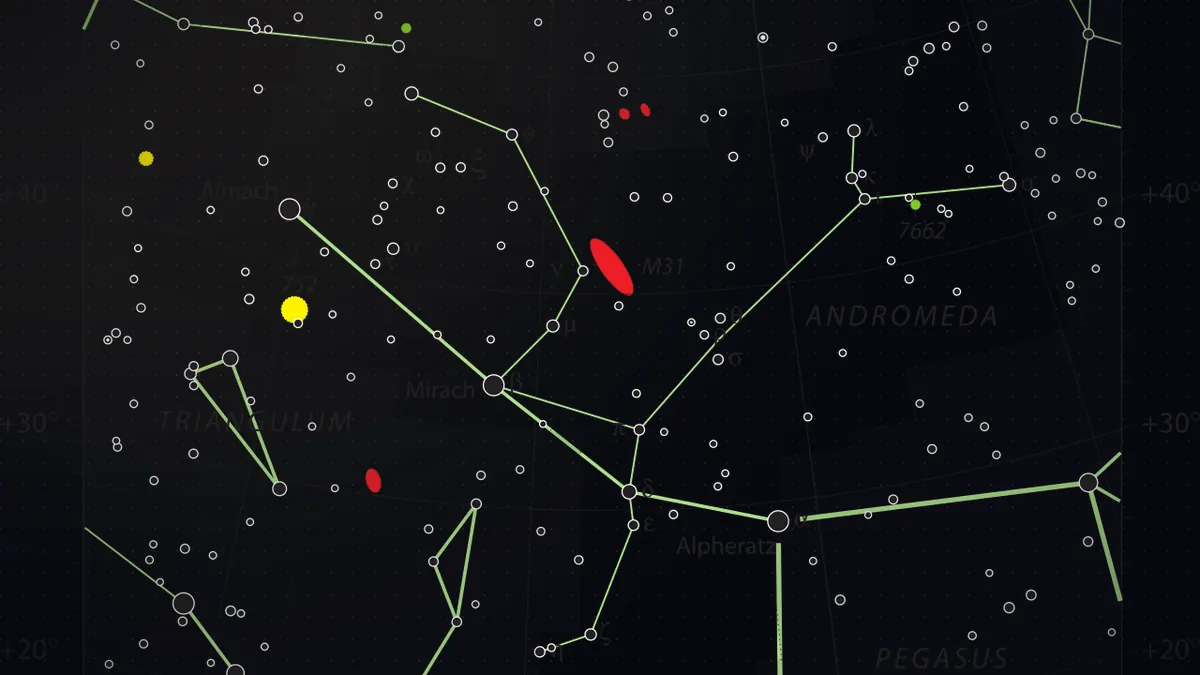
If you want to see the thing for yourself, find red Antares in Scorpius on a summer evening and look north. The large, moderately faint outline above it, shaped something like a coffin, is Ophiuchus, with Rasalhague at magnitude 2.08 marking the head. It sits at right ascension 17h and declination −8°, is highest after dark in July, and can be seen from anywhere between 60°N and 75°S, which is very nearly everybody.
Questions people ask
Is Ophiuchus a real constellation?
Yes. It is one of the 88 official IAU constellations, catalogued by Ptolemy around 150 CE and given exact boundaries in 1930. The Sun genuinely passes through it every year. What it is not is a sign in the twelve-sign zodiac, which is a different kind of object.
What dates would an Ophiuchus sign cover?
The Sun is inside the constellation from about 30 November to 17 December, so those are the dates quoted whenever someone proposes a thirteenth sign. Note that this is a constellation crossing, not a sign. Adopting it would also mean redrawing all twelve existing sign dates, since a thirteenth slice changes the width of the others.
Did NASA add a thirteenth zodiac sign?
No. NASA published an educational page explaining that the Sun passes through thirteen constellations while astrology uses twelve signs, which is a fact that has been checkable since 1930. It stated afterwards that it had not changed any signs and does not work on astrology.
Why is Ophiuchus sometimes called Serpentarius?
Serpentarius is the Latin name for the same figure, the Serpent Holder, and it appears throughout older star atlases. Ophiuchus is the Greek-derived form the IAU adopted in 1922. They refer to the same patch of sky, so a search for one should get you the other.
Does the Sun pass through any other constellations?
No. The centre of the Sun crosses exactly the thirteen in the table above. The Moon and the planets are a different matter: their orbits are tilted a few degrees from the ecliptic, so they wander into neighbouring constellations the Sun never enters, Cetus, Orion and Sextans among them.
Has my star sign changed?
Not in the system that assigned it. Western astrology uses the tropical zodiac, anchored to the March equinox rather than to the constellations, so its sign dates are stable by construction and none of this shifts them. What is true is that the constellation the Sun occupied on your birthday is usually the one before your sign. That gap has been widening steadily since the scheme was written down.
Why don't the sign dates match the constellation dates?
Because of precession. The Earth's axis wobbles once every 25,800 years or so, dragging the equinox westward against the stars by one degree every 72 years. The two starting lines are now about 24 degrees apart, so the dates run roughly three weeks out of step.
Which constellation is the zodiac's biggest?
Virgo, at 1,294 square degrees, the second largest constellation in the sky after Hydra. The Sun spends 45 days in it, the longest stay on the list.
Keep reading
- Ophiuchus, the Serpent Bearer — the full constellation guide: Rasalhague, Barnard's Star, the seven Messier globulars and how to find them.
- Scorpius — the constellation the ecliptic barely touches, and the one Ophiuchus takes the December days from.
- Pisces — where the March equinox sits today, which is why this faint constellation matters more than it looks.
- Aries — the First Point of Aries is named after it and left it two thousand years ago.
- The 88 constellations: a complete guide, which explains what a constellation is, how the IAU carved up the sky, and links to every one of them.