The Plough is not one of the 88 constellations. It is an asterism: a pattern people recognise, sitting inside the constellation Ursa Major, which is the official region of sky that contains it.
That is the entire distinction. A constellation is an area of sky with fixed borders, and there are exactly 88 of them. An asterism is a shape, with no borders, no official list, and no obligation to stay inside one constellation. The Plough (the Big Dipper in North America) is seven stars sitting inside the 1,280 square degrees the IAU handed to Ursa Major, the third largest constellation in the sky.
Once that clicks, a lot of half-remembered sky knowledge sorts itself out. The Summer Triangle is not a constellation. Neither is Orion's Belt, the Teapot, the Sickle or the Great Square of Pegasus. All of them are asterisms, and all of them are more useful to a beginner than most of the 88.
What the IAU actually settled
Two decisions, eight years apart.
In 1922, at its first General Assembly in Rome, the International Astronomical Union fixed the list at 88 constellations and gave each one a standard three-letter abbreviation: Ori for Orion, UMa for Ursa Major, Cas for Cassiopeia.
In 1930 the Belgian astronomer Eugène Delporte published the borders. He drew them as straight segments running along lines of constant right ascension and declination, so that the sky ended up divided like a map of rectangular fields rather than a jigsaw of curves. He used the coordinate grid of epoch B1875.0, because Benjamin Gould had already used that grid for southern boundaries and matching it kept the earlier work usable.
That choice has a visible side effect. Precession swings the Earth's axis about 50 arcseconds a year, a degree every seventy-two years, so the 1875 grid has been sliding against the modern one for a century and a half. On a chart plotted for today's coordinates the constellation boundaries look faintly tilted, like fence lines on land that has shifted. They will tilt further.
That tiling has consequences.
- The 88 tile the whole celestial sphere. No gaps, no overlaps, no leftover sky. Every point belongs to exactly one constellation.
- Membership is decided by position, not by picture. When an astronomer says a comet is "in Taurus", they mean its coordinates fall inside the Taurus boundary. The comet need not be anywhere near the stars of the bull.
- A constellation is not a physical group. The three stars of Orion's Belt look evenly spaced, but Alnilam in the middle lies several hundred light years beyond the two that flank it.
There is one shape that surprises people. Serpens is a single constellation in two disconnected pieces, Serpens Caput and Serpens Cauda, separated by Ophiuchus lying across the middle. It still counts once, with one genitive (Serpentis) and one abbreviation (Ser).
An asterism is whatever people keep pointing at
Nobody ratifies asterisms. There is no register, no boundary file, no three-letter code, and no body that arbitrates whether a pattern qualifies. If enough sky-watchers use a name, the name sticks.
They come in three shapes.
- Inside one constellation. The Plough, the Sickle, the Teapot, the Keystone, Orion's Belt.
- Across several constellations. The Summer Triangle, the Winter Hexagon, the Great Square, the False Cross.
- Small enough to need binoculars. The Coathanger in Vulpecula, Kemble's Cascade in Camelopardalis.
Here are the ones worth learning by name.
| Asterism | Constellations it uses | What to look for |
|---|---|---|
| The Plough / Big Dipper | Ursa Major | Seven stars, four in a bowl and three in a curved handle |
| Orion's Belt | Orion | Three bright stars in a short straight line |
| The Sickle | Leo | Six stars in a backwards question mark |
| The Teapot | Sagittarius | Eight stars forming a pot with lid, handle and spout |
| The Keystone | Hercules | A lopsided quadrilateral west of Vega |
| The Circlet | Pisces | A small faint ring below the Great Square |
| The Northern Cross | Cygnus | A long cross laid along the Milky Way |
| The Great Square | Pegasus and Andromeda | A large empty box of four stars |
| The Summer Triangle | Lyra, Cygnus, Aquila | Vega, Deneb and Altair, high on summer evenings |
| The Winter Triangle | Orion, Canis Major, Canis Minor | Betelgeuse, Sirius and Procyon |
| The Winter Hexagon | Six constellations | A huge ring of six bright stars around Betelgeuse |
| The False Cross | Carina and Vela | A cross larger and dimmer than Crux, with no Pointers |
| The Coathanger | Vulpecula | A straight bar of stars with a hook, best in binoculars |
The Summer Triangle spans three constellations
This is the clearest case of an asterism ignoring boundaries entirely. Its three corners sit in three separate constellations:
- Vega, magnitude 0.03, in Lyra
- Altair, magnitude 0.76, in Aquila
- Deneb, magnitude 1.25, in Cygnus
It is not equilateral. Vega and Deneb sit about 24° apart, and from that short northern side the shape reaches away south to Altair, 34° from Vega and 38° from Deneb. That long lopsided reach is what makes it easy to pick out once you have it. Start from Vega, the brightest of the three.
The name is recent. It was popularised in English by Patrick Moore in the 1950s, and a German equivalent was in use before that. Nobody had to approve it, which is exactly the point: an asterism becomes real by being used.
Deneb also does double duty. It is the tail of the swan and the top of the Northern Cross, a second asterism that lives entirely inside Cygnus. One star, two patterns, one constellation.
The Winter Triangle and the Winter Hexagon
The Winter Triangle is roughly equilateral and made of three of the easiest stars in the sky:
- Sirius, magnitude −1.46, in Canis Major, the brightest star in the night sky
- Procyon, magnitude 0.34, in Canis Minor
- Betelgeuse, the orange shoulder of Orion
Three stars, three constellations, and every one of them bright enough to survive a city.
The Winter Hexagon is the larger version and uses six constellations at once: Rigel in Orion, Aldebaran in Taurus, Capella in Auriga, Pollux in Gemini, Procyon in Canis Minor and Sirius in Canis Major. Betelgeuse sits inside the ring rather than on it. There is a spring counterpart too, the Great Diamond of Virgo, built from Arcturus in Boötes, Spica in Virgo, Denebola in Leo and Cor Caroli in Canes Venatici.
The Sickle sits wholly inside Leo
Not every asterism crosses a border. The Sickle is six stars forming a backwards question mark, with Regulus (magnitude 1.35) as the dot at the bottom. It marks the lion's head and mane, and it is entirely inside Leo.
Nothing about it is official. Leo is one of the 88 and covers 947 square degrees; the Sickle is a handful of stars within that area that happen to draw a recognisable curve. The rest of Leo is a triangle further east ending at Denebola, the tail, and most people who can point out Leo are really pointing out the Sickle.
The Leonid meteors radiate from near the Sickle, peaking around 17 November. The radiant is defined by where the meteors appear to come from, and it is quoted by constellation, not by asterism, because the constellation is the thing with a boundary.
The Teapot sits wholly inside Sagittarius
Same arrangement, different hemisphere of the sky. Sagittarius is officially a centaur drawing a bow. In practice everyone learns the Teapot: eight moderately bright stars forming a pot in profile, with a triangular lid, a handle on one side and a spout on the other.
Under a dark sky the Milky Way rises from the spout like steam, which is the giveaway that confirms the identification. You are looking towards the centre of the galaxy. Sagittarius A*, the supermassive black hole at the galactic centre, lies roughly 26,000 light years away just off the spout.
The Teapot lies between about −25° and −35° declination, which means northern observers see it low and southern observers get it high overhead. It is best placed on August evenings.
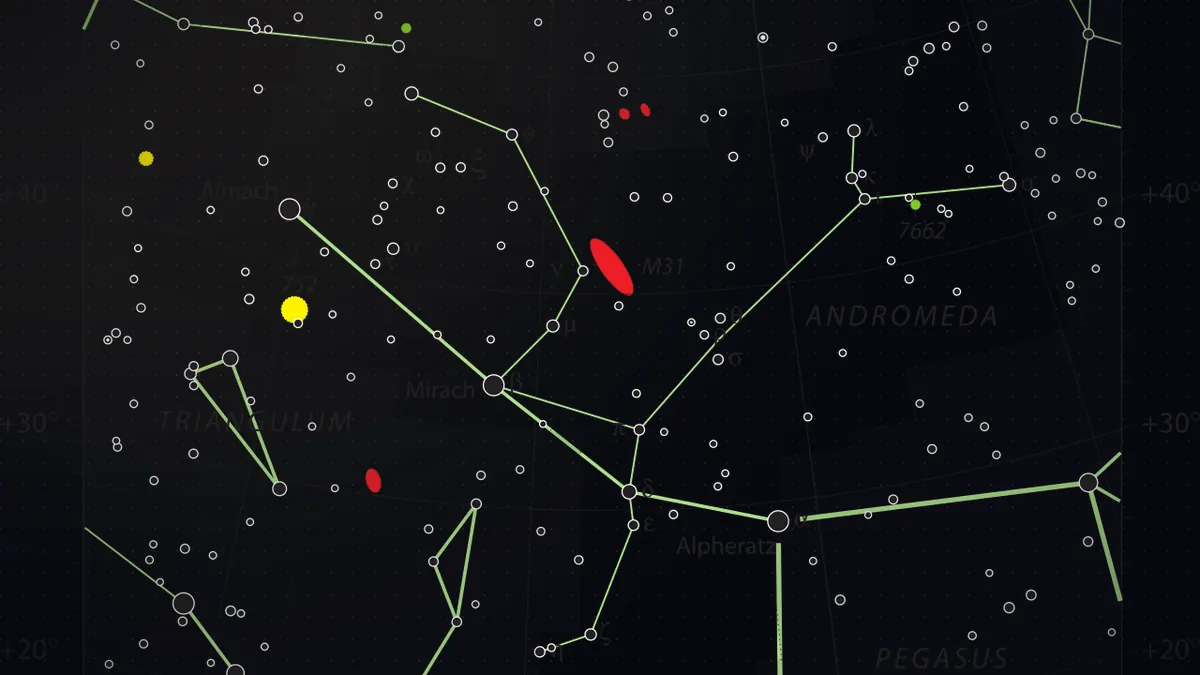
The Great Square of Pegasus straddles a border
This one is the best teaching example on the whole subject, because the border runs straight through it.
Three of the Square's four corners are Pegasus stars: Markab (Alpha Pegasi), Scheat (Beta Pegasi) and Algenib (Gamma Pegasi). The fourth corner is Alpheratz, magnitude 2.06, and Alpheratz is Alpha Andromedae. It belongs to Andromeda.
Johann Bayer, working in 1603 before any of this was settled, gave that star two designations: Alpha Andromedae and Delta Pegasi. The 1930 boundaries put it on the Andromeda side of the line, so the Pegasus letter was dropped and the star's official name now comes from a constellation whose figure it barely participates in. Delporte drew his borders to leave most stars holding the letters they already had. Where a star held two, the border decided which one survived.
The Square is also a decent sky meter. Counting the stars you can see inside it is a rough test of how dark your site is: from a city you will often see none at all, and from a genuinely dark site the count runs into the dozens.
Which constellation is opposite the Big Dipper
Cassiopeia. It sits on the far side of Polaris, and it is the answer people are usually after.
The geometry is checkable. Alioth, the brightest star of the Plough, sits at right ascension 12h 54m, declination +56.0°. Schedar, usually the brightest in Cassiopeia, sits at 0h 40m, +56.5°. Twelve hours and fourteen minutes of right ascension separate them, near enough half the sky, and both are about 34° from the north celestial pole.
That has two practical results.
- From anywhere north of about 34°N, both are circumpolar. Neither ever sets. They wheel around Polaris on opposite sides, so one is always usably placed.
- When one is high, the other is low. On spring evenings the Plough is overhead and Cassiopeia scrapes the northern horizon. On autumn evenings it is the other way round. You can read the season off the pair.
Use them together. Draw a line from Merak through Dubhe, the two Pointers at the outer edge of the Plough's bowl, extend it about five times that distance, and you land on Polaris. Keep going the same distance again on the far side and you arrive at Cassiopeia's W.
If you meant "opposite" in the strict sense, the answer is different and much less useful. The point diametrically opposite Alioth is at right ascension 0h 54m, declination −56°, which lands in faint far-southern Phoenix, a shade north of the Tucana border. North of about 34°N it never rises at all, which is most of the audience for a question about the Plough.
Where the difference actually bites
Four places the distinction stops being pedantic.
Star names follow the constellation. Every Bayer letter, Flamsteed number and variable-star designation is tied to a constellation. Alpheratz kept the Andromeda letter and lost the Pegasus one because of which side of the border it landed on. No asterism has ever named a star.
Positions are quoted by constellation. Meteor shower radiants, novae, comets and deep-sky objects are all located by the region they fall in, because a region has a defined edge and an asterism does not.
Clusters are not asterisms. The Pleiades and the Hyades in Taurus are physically bound groups of stars that formed together and move together. The Coathanger in Vulpecula looks like a cluster in binoculars but is a chance alignment of unrelated stars at different distances.
The Plough is a strange hybrid. Five of its seven stars really are related, drifting together as the Ursa Major Moving Group, the scattered remains of an old cluster. Dubhe and Alkaid are not members and are moving the other way, so over tens of thousands of years the pattern will visibly deform. The asterism will change shape. The constellation boundary will not, because it is drawn on the coordinate grid rather than on the stars.
Questions people ask
Is the Big Dipper a constellation or an asterism?
An asterism. It is seven stars inside Ursa Major, which is the constellation. In Britain and Ireland the same seven stars are the Plough, and older English has Charles's Wain. India has the Saptarishi, the seven sages; China has the Northern Dipper.
Is the Little Dipper an asterism too?
Yes, but it is an odd case. The Little Dipper covers nearly all of Ursa Minor, so the asterism and the constellation are almost the same thing and people use the two names interchangeably without causing confusion. Polaris is the tip of its handle.
Is Orion's Belt a constellation?
No. Orion is the constellation, and the Belt is three stars inside it: Alnitak, Alnilam and Mintaka. Orion's Sword, hanging below the Belt, is a second asterism in the same constellation.
Are the Pleiades an asterism?
No. The Pleiades are a genuine open cluster, catalogued as M45, sitting inside Taurus. The stars formed together and are gravitationally related, which is what separates a cluster from an asterism. An asterism is a chance line of sight.
How many asterisms are there?
There is no official count. The IAU maintains the list of 88 constellations and their boundaries, but nothing equivalent exists for asterisms, so the number depends entirely on who is counting and which regional names they include.
Can an asterism become one of the 88?
Not any more. The list closed in 1922 and the boundaries were finalised in 1930, and neither has been reopened. Constellations that were proposed and rejected before that, including several named after kings and patrons, simply vanished.
Why is a constellation called a region rather than a pattern?
Because that is what astronomers needed. A pattern cannot tell you where an object is, but a region with exact edges can, so since 1930 every point in the sky has had a single unambiguous constellation attached to it.
Keep reading
- Ursa Major, the constellation that contains the Plough, with the Pointer trick and the moving group that will one day pull the shape apart.
- Cassiopeia, the W on the far side of Polaris, and the other half of the answer to which constellation lies opposite the Big Dipper.
- The 88 constellations: a complete beginner's guide, for what a constellation is, how the sky is carved up, and a link to every one of them.
- Sagittarius, if you want the Teapot in full, including the fifteen Messier objects packed around the galactic centre.
- Pegasus, for the Great Square in its own right and the autumn constellations you can reach from its corners.