Ursa Major is the third largest constellation in the sky, but almost nobody looks for the whole bear. What they look for is the seven bright stars inside it that form the Big Dipper, or the Plough, or the Saucepan, or Charles's Wain, depending on where you grew up.
That pattern is the single most useful thing in the northern sky. It is bright enough to survive city light, it never sets for most of Europe and North America, and two of its stars point directly at the North Star. Learn it once and you always know which way you are facing.
Where to find Ursa Major
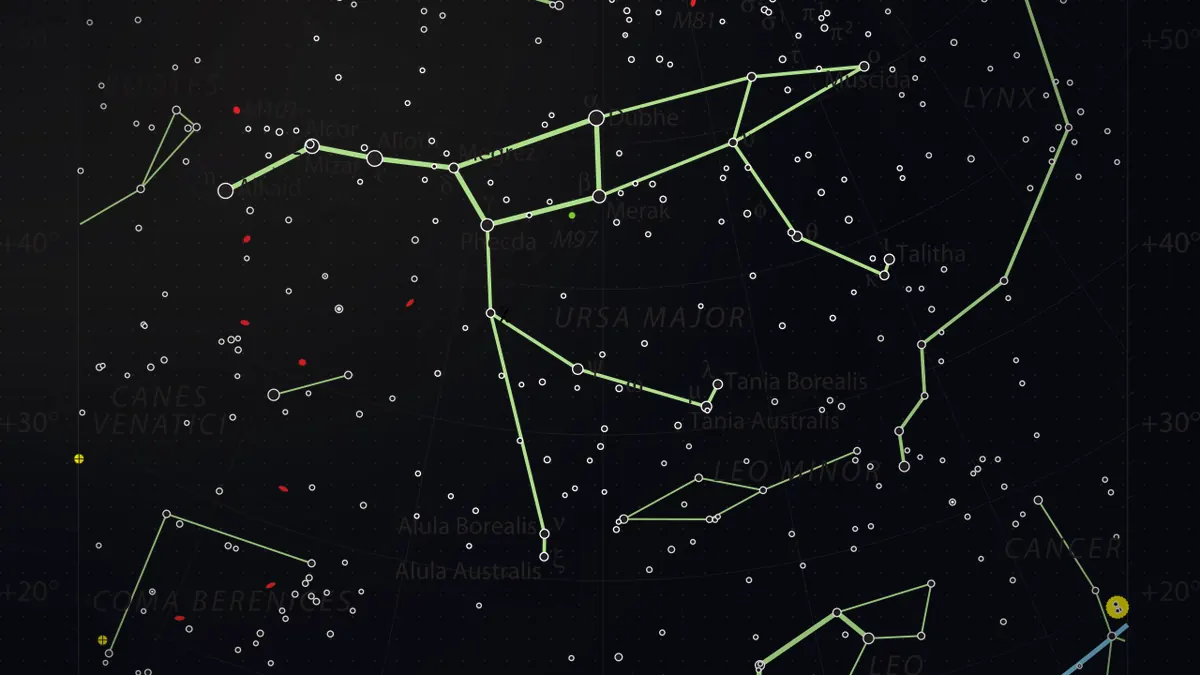
Look north on any clear night from the northern hemisphere. You are hunting for seven stars in a shape most people describe as a saucepan: four making a squarish bowl, three trailing off as a curved handle.
Then use it. The two stars at the outer edge of the bowl, Dubhe and Merak, are called the Pointers. Draw a line from Merak through Dubhe, extend it about five times that distance, and you land on Polaris, the North Star. That is true north, and it works every night of the year.
A second trick: follow the curve of the handle away from the bowl and arc to Arcturus in Boötes, then spike to Spica in Virgo. Two of the brightest stars in the sky, found from one pattern.
In sky coordinates Ursa Major sits at right ascension 10h 40m and declination +55.4°. Those two numbers work like a grid reference. Right ascension runs around the sky the way longitude runs around the Earth, and declination measures north and south the way latitude does. It is a far-northern constellation, so northern observers get the best of it and it never rises for much of the southern hemisphere. You can see it from anywhere north of latitude 30°S, including the whole northern hemisphere, and it sits highest after dark in April.
What Ursa Major actually looks like
The Dipper is only the bear's hindquarters and tail. The full constellation is much larger and considerably fainter: a long body stretching west, with three pairs of stars marking the paws.
There is an obvious problem with the picture: bears do not have long tails. Various explanations have been offered, the most charming being that the bear was swung into the sky by its tail, which stretched. The handle stars are also a useful eye test. The middle one, Mizar, has a fainter companion called Alcor right beside it. Being able to split the pair without optics was used as a vision test by several cultures.
The stars of Ursa Major
- Alioth (Epsilon Ursae Majoris, magnitude 1.76) — the brightest star here, sitting where the handle meets the bowl. Despite that, it carries the Epsilon label rather than Alpha.
- Dubhe and Merak — the Pointers. Dubhe is an orange giant; Merak is a white main-sequence star.
- Mizar and Alcor — the famous naked-eye double in the handle. A telescope splits Mizar itself into two, and spectroscopy reveals that the system is actually six stars bound together.
- Lalande 21185 — invisible to the naked eye, but at 8.3 light years it is one of the closest stars to the Sun.
Here is something lovely: five of the seven Dipper stars are physically related. They are moving together through space as the Ursa Major Moving Group, the scattered remnant of a cluster. Dubhe and Alkaid are not members, so over tens of thousands of years the Dipper will slowly deform as they drift the other way.
The story behind the name
The Greek version has Callisto, a companion of Artemis, seduced by Zeus and turned into a bear by a jealous Hera. Her son Arcas nearly killed her while hunting, so Zeus placed them both in the sky: Callisto as the Great Bear, Arcas nearby.
What makes Ursa Major remarkable is that the bear identification appears independently across cultures with no contact. Several Native American traditions also see a bear here, with the handle stars as hunters pursuing it. Some anthropologists argue this shared reading is genuinely ancient: possibly carried across the Bering land bridge, which would make it one of the oldest surviving stories humans tell.
Elsewhere it is not a bear at all. In Britain it is the Plough. In India it is the Saptarishi, the seven great sages. In China it is the Northern Dipper, a celestial administrator. Same seven stars, entirely different meanings.
What else is hiding in Ursa Major
Ursa Major looks out of the plane of our galaxy, so instead of nebulae and clusters you get galaxies: seven Messier objects, most of them external star systems.
- M81 (Bode's Galaxy) and M82 (the Cigar Galaxy) — a spectacular pair in the same low-power field. M81 is a classic spiral seen face-on; M82 is an edge-on starburst galaxy being torn up by its neighbour's gravity. This is one of the best two-for-one views in the sky.
- M101, the Pinwheel Galaxy — a large face-on spiral. Beautiful in photographs, but its light is spread thin, so it needs dark skies.
- M97, the Owl Nebula — a planetary nebula with two dark patches that look convincingly like eyes.
- The Hubble Deep Field — the patch of apparently empty Ursa Major that Hubble stared at for ten days in 1995, revealing thousands of distant galaxies and changing our sense of how full the universe is.
When and where to see it
Ursa Major is best placed in the evening sky in April, but that matters less here than almost anywhere else, because from most of the northern hemisphere it is circumpolar: it never sets. It simply rotates around Polaris through the night and the year.
That rotation is worth knowing: in spring evenings the Dipper is high overhead and upside down; in autumn evenings it is low and the right way up. Same stars, different attitude.
Southern hemisphere observers are less lucky. Below about 30°S the Dipper never fully clears the horizon, and from Australia or southern Africa you will not see it at all. The galaxies need a telescope and genuinely dark skies; the Dipper needs nothing.
Ursa Major at a glance
| Name | Ursa Major |
| Abbreviation | UMa |
| Genitive form | Ursae Majoris |
| Meaning | the Great Bear |
| Family | Ursa Major family |
| First recorded | ancient (Ptolemy) |
| Right ascension | 10h 40m |
| Declination | +55.4° |
| Area | 1280 square degrees (3rd largest of 88) |
| Main stars in the figure | 7 |
| Stars brighter than magnitude 3 | 7 |
| Named Bayer / Flamsteed stars | 93 |
| Brightest star | Alioth (ε UMa) (magnitude 1.76) |
| Messier objects | 7 |
| Meteor showers | Alpha Ursae Majorids, Kappa Ursae Majorids, October Ursae Majorids |
| Visible from | Anywhere north of latitude 30°S, including the whole northern hemisphere |
| Best seen at 9 pm in | April |
| Bordering constellations | Boötes, Camelopardalis, Canes Venatici, Coma Berenices, Draco, Leo, Leo Minor, Lynx |
Where to go next
Its neighbours in the sky
Everything here shares a border with Ursa Major. Find one and the rest are a short hop away: Boötes, Camelopardalis, Canes Venatici, Coma Berenices, Draco, Leo, Leo Minor, Lynx.
The rest of the Ursa Major family
Ursa Major belongs to the Ursa Major family: the circumpolar northern group anchored by the Big Dipper. The others are: Boötes, Camelopardalis, Canes Venatici, Coma Berenices, Corona Borealis, Draco, Leo Minor, Lynx, Ursa Minor.
Start from the beginning
If you are starting from scratch, the complete beginner's guide to the 88 constellations covers what a constellation actually is, how the sky is carved up, and links to every one of them.
Star chart: Ursa Major IAU chart by IAU and Sky & Telescope magazine (Roger Sinnott & Rick Fienberg), used under CC BY 3.0. Observing data cross-checked against Wikipedia's Ursa Major entry.