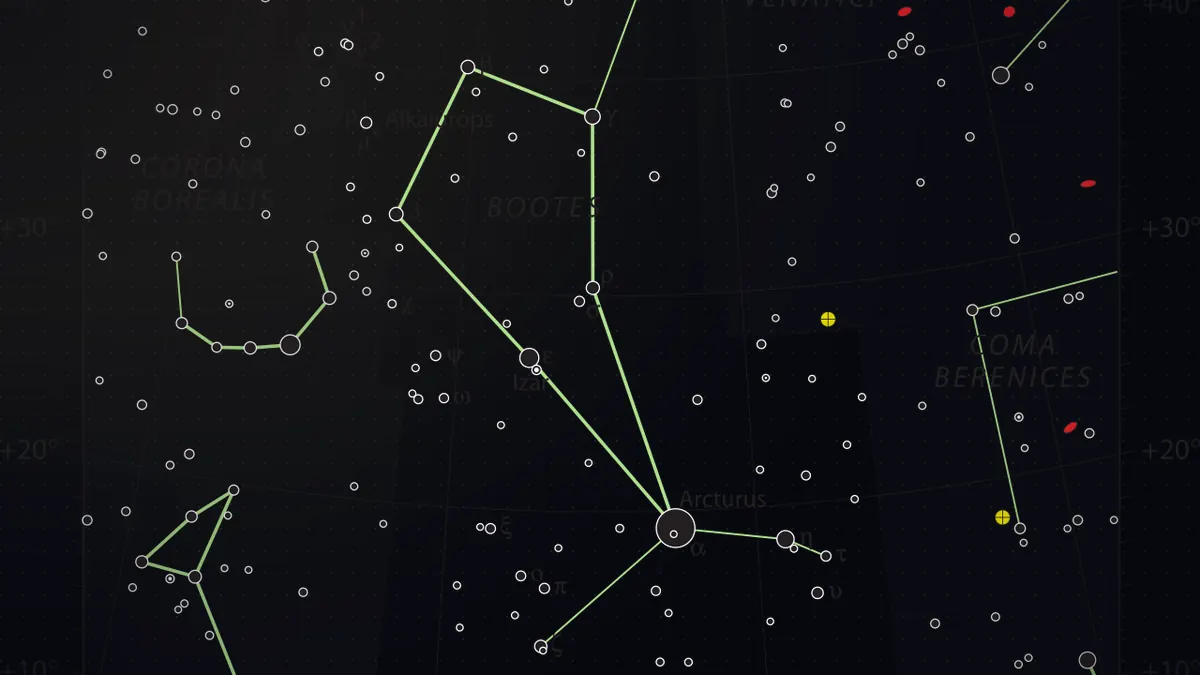
Boötes (pronounced boh-OH-teez, three syllables, the two dots meaning the o's are said separately) is the Herdsman, and it is home to Arcturus, the fourth brightest star in the entire night sky and the brightest anywhere in the northern celestial hemisphere.
Arcturus has a distinct warm orange colour that is obvious once you know to look for it, and it anchors one of the easiest star-hops there is. If you can find the Big Dipper, you can find Boötes in about four seconds.
Where to find Boötes
Use the classic phrase: arc to Arcturus.
Find the Big Dipper's handle. Follow its curve away from the bowl, keeping the same arc going, and the first brilliant star you meet is Arcturus. It is unmistakable — nothing else nearby is close in brightness, and the orange tint confirms it.
Carry the same arc onwards and you reach Spica in Virgo, which is why the full mnemonic runs 'arc to Arcturus, then spike to Spica'. From Arcturus, the rest of Boötes opens upwards as an elongated kite.
In sky coordinates Boötes sits at right ascension 13h 36m and declination +7.4°. Right ascension is the sky's version of longitude and declination its version of latitude, so those two numbers pin the constellation to one spot on the celestial sphere the way a map reference pins a town. It straddles the celestial equator, which is the happy case: essentially everyone on Earth can see it. In practice you can see it from anywhere north of latitude 35°S, including the whole northern hemisphere, and it stands highest in the evening sky around June.
What Boötes actually looks like
Boötes is drawn as a kite or an ice-cream cone, with Arcturus at the pointed bottom end. Above it, four stars widen out to form the body, and the whole figure is roughly twice as tall as it is wide.
Classically he is a herdsman or ploughman driving the bear around the pole, sometimes holding the leashes of the hunting dogs of Canes Venatici. The kite is far easier to see than the man, and most observers never bother with the herdsman at all.
It is a big constellation — thirteenth largest — with twenty-nine stars visible to the naked eye under good conditions, so there is more here than the basic kite once your eyes adapt.
The stars of Boötes
- Arcturus (Alpha Boötis, magnitude −0.04) — an orange giant just 37 light years away, roughly 25 times the Sun's diameter. It is an old star and, unusually, it is not travelling with the galactic disc: it belongs to an older population moving at a steep angle to the plane, probably absorbed from a small galaxy the Milky Way swallowed long ago. Arcturus is passing through our neighbourhood, not living in it.
- Izar (Epsilon Boötis) — a beautiful double star of a bright orange primary and a fainter blue-green companion. The colour contrast is striking, and the astronomer Otto Struve nicknamed it Pulcherrima, 'most beautiful'.
- Muphrid (Eta Boötis) — a bright star close to Arcturus in the sky and, coincidentally, close to it in space too.
- Tau Boötis — hosts one of the earliest known hot Jupiter exoplanets, orbiting its star in just over three days.
The story behind the name
The name comes from a Greek word for ox-driver, and the figure is usually read as a ploughman driving the oxen of Ursa Major around the pole: a neat fit, since the Big Dipper is called the Plough in Britain.
The most common identification is Arcas, son of Zeus and Callisto, placed in the sky near his mother the bear. The name Arcturus itself means 'guardian of the bear', which preserves the relationship in the star's name. Another version makes him Icarius, taught winemaking by Dionysus and murdered by men who thought they had been poisoned.
Arcturus had a practical role too: its rising and setting marked points in the agricultural calendar for Greek farmers, and Hesiod uses it as a seasonal marker in Works and Days.
What else is hiding in Boötes
Boötes is a lesson in expectation management. It is the thirteenth largest constellation and contains no Messier objects at all: it looks out of the galactic plane into relatively empty sky.
- NGC 5466 — a loose, sparse globular cluster, faint but reachable in a medium telescope.
- The Boötes Void — the headline act, and you cannot see it. It is a roughly spherical region about 330 million light years across containing far fewer galaxies than it should. It is one of the largest known voids in the universe, and if the Milky Way sat at its centre we would not have discovered other galaxies until the 1960s.
- The Quadrantids — one of the year's strongest meteor showers, peaking around 3 January with up to 120 meteors an hour. It radiates from northern Boötes and is named after Quadrans Muralis, a constellation that was abolished when the IAU fixed the modern 88.
When and where to see it
Boötes is best placed in the evening sky in June, and is a comfortable spring-and-summer constellation for the northern hemisphere.
It reaches to about 35°S, so most of the inhabited world can see Arcturus at some point in the year, though southern observers get it low. Northern observers get it high overhead, which is the best possible position.
Arcturus punches through city light without difficulty and is a good target for urban observers. Izar is the one telescopic must-see here: the orange-and-blue pairing is one of the prettiest doubles in the sky, and it needs only a small instrument to split.
Boötes at a glance
| Name | Boötes |
| Abbreviation | Boo |
| Genitive form | Boötis |
| Meaning | The Herdsman |
| Family | Ursa Major family |
| First recorded | ancient (Ptolemy) |
| Right ascension | 13h 36m |
| Declination | +7.4° |
| Area | 907 square degrees (13th largest of 88) |
| Main stars in the figure | 7 |
| Stars brighter than magnitude 3 | 3 |
| Named Bayer / Flamsteed stars | 59 |
| Brightest star | Arcturus (α Boo) (magnitude −0.04) |
| Messier objects | None |
| Meteor showers | January Bootids, June Bootids, Quadrantids |
| Visible from | Anywhere north of latitude 35°S, including the whole northern hemisphere |
| Best seen at 9 pm in | June |
| Bordering constellations | Canes Venatici, Coma Berenices, Corona Borealis, Draco, Hercules, Serpens, Ursa Major, Virgo |
Where to go next
Its neighbours in the sky
Boötes borders all of these, which makes them the natural next targets once you can pick it out: Canes Venatici, Coma Berenices, Corona Borealis, Draco, Hercules, Serpens, Ursa Major, Virgo.
The rest of the Ursa Major family
Boötes belongs to the Ursa Major family: the circumpolar northern group anchored by the Big Dipper. The others are: Camelopardalis, Canes Venatici, Coma Berenices, Corona Borealis, Draco, Leo Minor, Lynx, Ursa Major, Ursa Minor.
Start from the beginning
New to all this? The 88 constellations: a complete beginner's guide explains what a constellation actually is, how the sky is divided up, and lists all 88 with a link to each one.
Star chart: Boötes IAU chart by IAU and Sky & Telescope magazine (Roger Sinnott & Rick Fienberg), used under CC BY 3.0. Observing data cross-checked against Wikipedia's Boötes entry.