Camelopardalis is a paradox: the eighteenth largest constellation in the sky, and one of the hardest to see. Its brightest star only reaches magnitude 4. From anywhere with streetlights, the region between Polaris, Auriga and the Big Dipper looks simply empty.
The name is worth unpacking, because it is one of the best in the sky. It comes from Greek kamelos (camel) and pardalis (spotted): the ancients described a giraffe as a camel with leopard spots. Camelopardalis is, literally, the camel-leopard.
Where to find Camelopardalis
You find Camelopardalis by finding the hole. Locate Polaris, the Big Dipper and bright Capella in Auriga. The large, conspicuously blank region bounded by those three is the giraffe.
That blankness is the identification method. There is no shortcut, because there is no bright star to aim at. Under a dark sky, let your eyes adapt for twenty minutes and a scatter of fourth- and fifth-magnitude stars will slowly fill the space in.
For deep-sky targets, star-hop in from Polaris or from the Dipper's bowl rather than trying to navigate within the constellation itself.
In sky coordinates Camelopardalis sits at right ascension 3h 15m and declination +86.1°. Those two numbers work like a grid reference. Right ascension runs around the sky the way longitude runs around the Earth, and declination measures north and south the way latitude does. It is a far-northern constellation, so northern observers get the best of it and it never rises for much of the southern hemisphere. In practice that means you can find it from anywhere north of latitude 4°S, including the whole northern hemisphere; it rides highest in the evening sky in February.
What Camelopardalis actually looks like
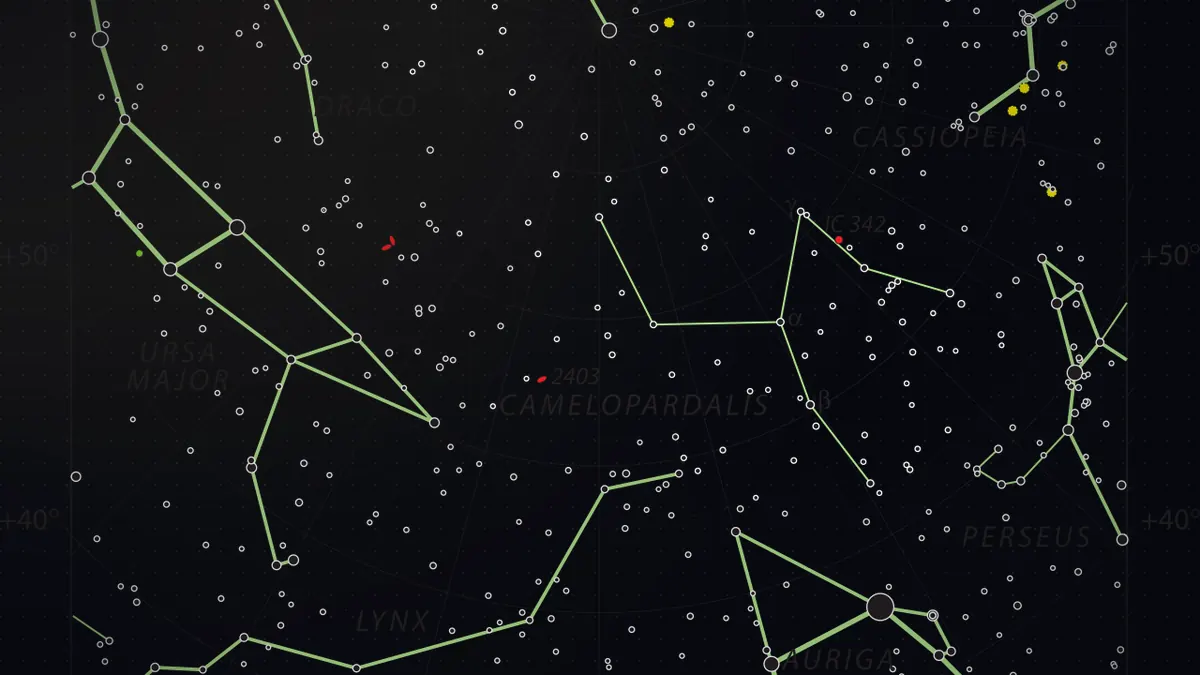
There is no traditional figure and no realistic hope of tracing one. Charts draw a long-necked giraffe using stars around magnitude 4 to 5, and the outline is essentially a cartographic convention.
Camelopardalis was introduced by Petrus Plancius in 1612 or 1613, and its whole purpose was to fill an awkward, empty stretch of northern sky that the Greeks had left unnamed: precisely because there was nothing there to name. Older books sometimes give the name as Camelopardalus or Camelopardus; the IAU settled on Camelopardalis to match the genitive form used in star designations.
The stars of Camelopardalis
- Beta Camelopardalis (magnitude 4.03) — the brightest star, a yellow supergiant roughly a thousand light years away and a fine double in a small telescope.
- Alpha Camelopardalis — a blue supergiant and a runaway star, travelling fast enough that it has ploughed up a visible bow shock in the surrounding interstellar gas. It is one of the most luminous stars in the sky and looks faint only because it is thousands of light years away.
- CS Camelopardalis — a variable blue supergiant embedded in a reflection nebula.
- Gliese 445 — a nearby red dwarf with a curious future: the Voyager 1 spacecraft is heading in its general direction and will pass within about 1.6 light years of it in roughly 40,000 years.
The constellation contains only a handful of stars above magnitude 5, which for its size is remarkable.
The story behind the name
Camelopardalis has no classical mythology at all. It is a seventeenth-century invention with no Greek, Roman or Babylonian pedigree.
Plancius appears to have had a biblical scene in mind rather than a zoological one. The most repeated interpretation is that the giraffe represents the camel that carried Rebecca to Isaac in the Book of Genesis: part of a broader effort in that era to populate the sky with scriptural figures instead of pagan ones. The programme mostly failed; Camelopardalis is one of the few that survived into the modern 88.
The English word is first attested in 1785, which gives you a sense of how recent this whole corner of the sky is compared with Orion or Ursa Major.
What else is hiding in Camelopardalis
Faint to the eye, but genuinely worthwhile with equipment.
- NGC 2403 — an excellent bright spiral galaxy, one of the finest that Messier missed. It belongs to the M81 group in neighbouring Ursa Major and is well within reach of a modest telescope.
- Kemble's Cascade — a beautiful chain of more than twenty stars running in a straight line for about five Moon-widths, with a small cluster at one end. It is a chance alignment rather than a real structure, and it is one of the best binocular sights in the northern sky. Named after the Canadian amateur astronomer Lucian Kemble.
- NGC 1502 — the compact open cluster sitting at the foot of the Cascade.
- IC 342, the Hidden Galaxy — a large face-on spiral that would be one of the brightest galaxies in the sky if it were not partly obscured by dust in our own Milky Way.
When and where to see it
Best placed in the evening sky in February, though for most northern observers Camelopardalis is circumpolar and technically available all year.
It is a firmly northern constellation, reaching only to about 4°S, so southern hemisphere observers effectively never see it.
Sky darkness is everything here. From a city there is nothing, not a single star of the figure will register. From a dark site, sweep the area with binoculars and Kemble's Cascade alone makes the effort worthwhile. This is a constellation best treated as a set of coordinates for good targets rather than a pattern to admire.
Camelopardalis at a glance
| Name | Camelopardalis |
| Abbreviation | Cam |
| Genitive form | Camelopardalis |
| Meaning | Giraffe |
| Family | Ursa Major family |
| First recorded | 1613, Plancius |
| Right ascension | 3h 15m |
| Declination | +86.1° |
| Area | 757 square degrees (18th largest of 88) |
| Main stars in the figure | 2 |
| Stars brighter than magnitude 3 | 0 |
| Named Bayer / Flamsteed stars | 36 |
| Brightest star | β Cam (magnitude 4.03) |
| Messier objects | None |
| Meteor showers | October Camelopardalids |
| Visible from | Anywhere north of latitude 4°S, including the whole northern hemisphere |
| Best seen at 9 pm in | February |
| Bordering constellations | Auriga, Cassiopeia, Cepheus, Draco, Lynx, Perseus, Ursa Major, Ursa Minor |
Where to go next
Its neighbours in the sky
These constellations share a border with Camelopardalis, so once you have found it you already know where to look next: Auriga, Cassiopeia, Cepheus, Draco, Lynx, Perseus, Ursa Major, Ursa Minor.
The rest of the Ursa Major family
Camelopardalis belongs to the Ursa Major family: the circumpolar northern group anchored by the Big Dipper. The others are: Boötes, Canes Venatici, Coma Berenices, Corona Borealis, Draco, Leo Minor, Lynx, Ursa Major, Ursa Minor.
Start from the beginning
New to all this? The 88 constellations: a complete beginner's guide explains what a constellation actually is, how the sky is divided up, and lists all 88 with a link to each one.
Star chart: Camelopardalis IAU chart by IAU and Sky & Telescope magazine (Roger Sinnott & Rick Fienberg), used under CC BY 3.0. Observing data cross-checked against Wikipedia's Camelopardalis entry.