Cancer has the unenviable distinction of being the faintest constellation in the zodiac. Its brightest star only reaches magnitude 3.5, and from a city it effectively does not exist.
Which makes what it contains all the more surprising. Sitting right in the middle of this dim little constellation is M44, the Beehive Cluster: one of the nearest star clusters to Earth, visible to the naked eye as a misty patch, and known since antiquity as a weather forecaster.
Where to find Cancer
Cancer hides in the gap between Gemini and Leo, and the reliable method is to bracket it.
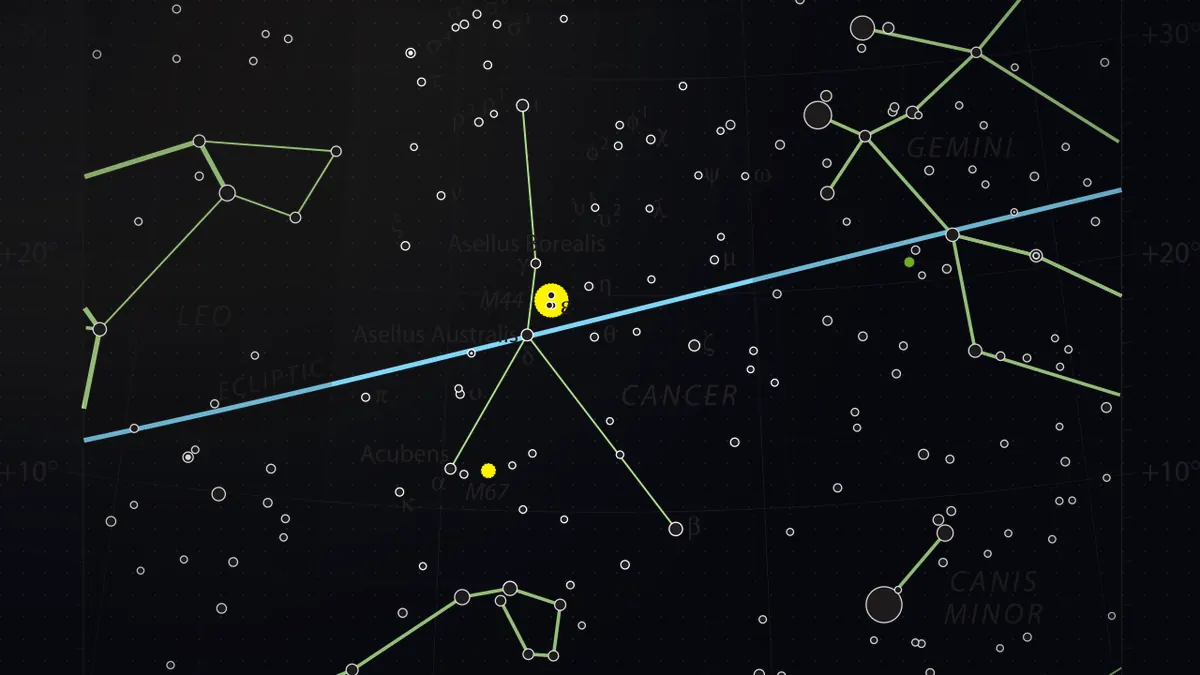
Find Castor and Pollux in Gemini on one side, and Regulus at the base of Leo's Sickle on the other. Cancer occupies the dim space between them. Look roughly midway along that line for a faint fuzzy patch. That is the Beehive, and it is easier to spot than any of the constellation's actual stars.
A useful trick: look slightly to one side of where you expect the Beehive. Averted vision, using the more light-sensitive edges of your retina, makes faint objects noticeably clearer.
In sky coordinates Cancer sits at right ascension 7h 55m and declination +33.1°. Right ascension is the sky's version of longitude and declination its version of latitude, so those two numbers pin the constellation to one spot on the celestial sphere the way a map reference pins a town. It sits in the northern half of the sky, riding high for northern observers and low for southern ones. In practice you can see it from anywhere north of latitude 60°S, including the whole northern hemisphere, and it stands highest in the evening sky around March.
What Cancer actually looks like
An upside-down Y, or a faint inverted crab. Four modest stars sketch a shape that most beginners never manage to see at all, and there is no point pretending otherwise.
The two stars flanking the Beehive have wonderful old names: Asellus Borealis and Asellus Australis, the northern and southern donkeys. The cluster between them was Praesepe, the manger they were feeding from. That imagery long predates the crab.
Because it is so faint, Cancer is a good honesty test for a sky. If you can trace the crab, you are somewhere genuinely dark.
The stars of Cancer
- Al Tarf (Beta Cancri, magnitude 3.5) — the brightest star, an orange giant about 290 light years away. The name means 'the end', referring to a leg or claw.
- Acubens (Alpha Cancri) — despite the Alpha designation, only magnitude 4.3. The name means 'the claw'.
- Asellus Australis (Delta Cancri) — the southern donkey, an orange giant, and a handy pointer to the Beehive.
- 55 Cancri — a nearby binary hosting five known planets, including 55 Cancri e, a super-Earth so close to its star that its year lasts about eighteen hours and its surface is probably molten. It has been described, somewhat loosely, as a possible diamond planet.
Nothing here is bright. Cancer's stars are a supporting cast for the cluster at its centre.
The story behind the name
In the Greek story, Cancer is the crab sent by Hera to distract Hercules while he fought the Hydra. It nipped his foot; he crushed it underfoot essentially without noticing. Hera placed it in the sky as thanks for its brief service, which explains why it is so faint. It is a consolation prize for a crab that achieved almost nothing.
Praesepe, the manger, is far more interesting historically. Because the cluster is a faint misty patch, it disappears when there is any haze in the atmosphere. Aratus and Pliny both recorded that if Praesepe became invisible while the surrounding stars stayed clear, rain was coming. That is a genuinely functional weather forecast built from a naked-eye observation, and it works: high thin cloud kills the cluster before it affects brighter stars.
Cancer also once marked the Sun's northernmost point, which is why we still call that line of latitude the Tropic of Cancer, though precession has since moved it into Taurus.
What else is hiding in Cancer
- M44, the Beehive Cluster (Praesepe) — about 600 light years away and one of the nearest open clusters to us. To the naked eye it is a fuzzy glow; in binoculars it explodes into dozens of stars; in a telescope you lose the effect because it is too wide for the field. Galileo turned his telescope on it in 1609 and resolved around 40 stars, one of the first demonstrations that nebulous patches could be made of stars.
- M67 — a much older, more compact open cluster. At roughly 4 billion years it is one of the oldest known open clusters, which is unusual: most disperse long before that. It is a good comparison object right after looking at the young Beehive.
Two Messier objects in the faintest zodiac constellation is a good return, and both are worth the trouble of finding Cancer in the first place.
When and where to see it
Best placed in the evening sky in March, with a season through late winter and spring.
It reaches far enough south to be seen from almost everywhere, so no hemisphere is excluded, though it sits comfortably higher for northern observers.
Sky quality matters more here than in any other zodiac constellation. From a city, Cancer is invisible and the Beehive is gone. From a dark rural site, the cluster is an easy naked-eye object and the crab's outline appears with a little patience. Use binoculars, not a telescope, for M44. This is one of those objects that magnification actively ruins.
Cancer at a glance
| Name | Cancer |
| Abbreviation | Cnc |
| Genitive form | Cancri |
| Meaning | the Crab |
| Family | Zodiac family |
| First recorded | ancient (Ptolemy) |
| Right ascension | 7h 55m |
| Declination | +33.1° |
| Area | 506 square degrees (31st largest of 88) |
| Main stars in the figure | 0 |
| Stars brighter than magnitude 3 | 0 |
| Named Bayer / Flamsteed stars | 70 |
| Brightest star | β Cnc (Tarf) (magnitude 3.53) |
| Messier objects | 2 |
| Meteor showers | Delta Cancrids |
| Visible from | Anywhere north of latitude 60°S, including the whole northern hemisphere |
| Best seen at 9 pm in | March |
| Bordering constellations | Canis Minor, Gemini, Hydra, Leo, Leo Minor, Lynx |
Where to go next
Its neighbours in the sky
Everything here shares a border with Cancer. Find one and the rest are a short hop away: Canis Minor, Gemini, Hydra, Leo, Leo Minor, Lynx.
The rest of the Zodiac family
Cancer belongs to the Zodiac family: the twelve constellations the Sun, Moon and planets travel through. The others are: Aquarius, Aries, Capricornus, Gemini, Leo, Libra, Pisces, Sagittarius, Scorpius, Taurus, Virgo.
Start from the beginning
New to all this? The 88 constellations: a complete beginner's guide explains what a constellation actually is, how the sky is divided up, and lists all 88 with a link to each one.
Star chart: Cancer IAU chart by IAU and Sky & Telescope magazine (Roger Sinnott & Rick Fienberg), used under CC BY 3.0. Observing data cross-checked against Wikipedia's Cancer entry.