Crater is the cup — the one Apollo sent the crow to fill, and the reason the crow is still in trouble. It sits on the back of Hydra, right beside Corvus, and the three constellations tell one story between them.
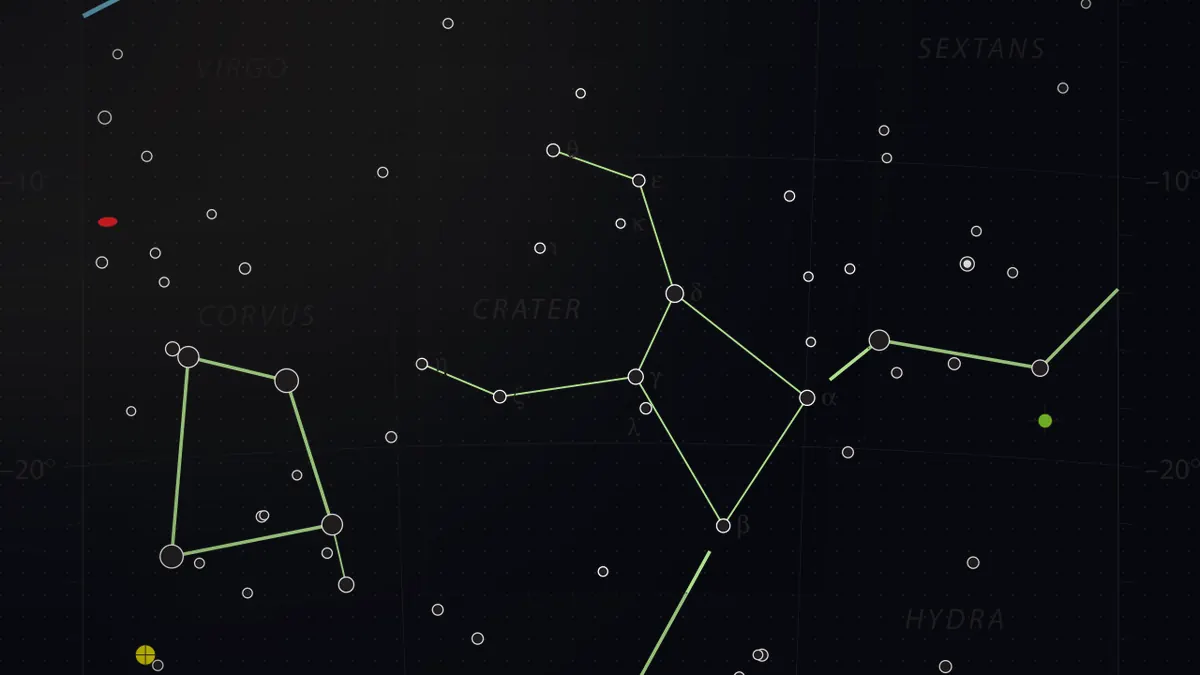
It is faint, with nothing brighter than magnitude 3.6, but its shape is surprisingly good: a genuine cup or goblet outline, open at the top, which is far more than most faint constellations manage.
Where to find Crater
Find Corvus first — the compact quadrilateral south-west of Spica. Crater lies immediately west of Corvus, along the body of Hydra.
You are looking for a shape like a wide goblet or bowl on a short stem, formed from stars around magnitude 4. It needs a reasonably dark sky; from a bright suburb it will not register.
Another approach is to drop south from Leo: Crater sits below the lion's hindquarters, roughly midway between Leo and Hydra's body.
In sky coordinates Crater sits at right ascension 10h 51m and declination −6.7°. Those two numbers work like a grid reference. Right ascension runs around the sky the way longitude runs around the Earth, and declination measures north and south the way latitude does. It straddles the celestial equator, which is the happy case: essentially everyone on Earth can see it. In practice that means you can find it from anywhere south of latitude 65°N, including the whole southern hemisphere; it rides highest in the evening sky in April.
What Crater actually looks like
A cup, and a decent one. Several stars form a rounded bowl open towards the north, with a couple more below suggesting a base or stem.
For a constellation this faint, the figure is unusually legible. Once you have picked out the arc of the bowl, the whole thing falls into place, and it is genuinely satisfying in a way that many brighter but shapeless constellations are not.
It is one of Ptolemy's original 48, and the cup identification has been stable throughout: Babylonian records also show a vessel here, which suggests the shape has been read the same way for a very long time.
The stars of Crater
- Labrum (Delta Crateri, magnitude 3.6) — the brightest star, an orange giant about 195 light years away. The name means 'the lip', referring to the rim of the cup.
- Alkes (Alpha Crateri) — an orange giant whose name comes from the Arabic for 'the cup'. Despite the Alpha designation it is fainter than Delta.
- Beta Crateri — a white star with a white dwarf companion.
- Gamma Crateri — a double star, splittable in a small telescope.
Crater has no bright or famous stars, and that is simply its character. It is a constellation of shape rather than of individual objects, and it is better for it.
The story behind the name
Crater is the cup that Apollo gave the crow, sending it to fetch water from a spring. The crow dawdled beside a fig tree waiting for the fruit to ripen, then returned with a water snake in its claws and claimed the snake had blocked the spring.
Apollo was not deceived. He placed the crow, the cup and the snake in the sky together, positioning them so that Hydra eternally prevents Corvus from drinking from the cup beside it.
It is one of the more elegantly staged punishments in the sky, and unlike most constellation myths it is genuinely legible from the arrangement: three adjacent constellations, one continuous scene, with the geometry doing the storytelling. In other traditions the cup is associated with Dionysus and wine, or with the Holy Grail in later Christian readings.
What else is hiding in Crater
Crater looks out of the galactic plane into a sparse region and has no Messier objects. It is honestly a thin constellation for observing.
- NGC 3511 and NGC 3513 — a pair of spiral galaxies, faint but reachable in a medium telescope under dark skies.
- NGC 3981 — a spiral galaxy with distorted arms, evidence of a past gravitational encounter.
- Crater 2 — a very faint dwarf satellite galaxy of the Milky Way, discovered only in 2016. It is remarkably large but extremely diffuse, which is why it went unnoticed for so long. Not an amateur target, but a good illustration that our galaxy's neighbourhood still holds surprises.
Realistically, Crater is a constellation you visit for the shape and the story rather than for what a telescope will show you.
When and where to see it
Best placed in the evening sky in April, through the spring.
It sits south of the celestial equator but reaches well north, so it is visible from most of the world. Southern observers get it higher.
You need a moderately dark sky to see the cup at all, from a city it disappears completely. From a decent rural site it is an easy and pleasant find, and it pairs naturally with Corvus next door. Learn the two together with the story attached, and you will remember both permanently. That is genuinely the best use of this part of the sky.
Crater at a glance
| Name | Crater |
| Abbreviation | Crt |
| Genitive form | Crateris |
| Meaning | the cup |
| Family | Hercules family |
| First recorded | ancient (Ptolemy) |
| Right ascension | 10h 51m |
| Declination | −6.7° |
| Area | 282 square degrees (53rd largest of 88) |
| Main stars in the figure | 4 |
| Stars brighter than magnitude 3 | 0 |
| Named Bayer / Flamsteed stars | 12 |
| Brightest star | δ Crt (magnitude 3.57) |
| Messier objects | None |
| Meteor showers | Eta Craterids |
| Visible from | Anywhere south of latitude 65°N, including the whole southern hemisphere |
| Best seen at 9 pm in | April |
| Bordering constellations | Corvus, Hydra, Leo, Sextans, Virgo |
Where to go next
Its neighbours in the sky
Everything here shares a border with Crater. Find one and the rest are a short hop away: Corvus, Hydra, Leo, Sextans, Virgo.
The rest of the Hercules family
Crater belongs to the Hercules family: the largest family — heroes, serpents and the far southern sky. The others are: Aquila, Ara, Centaurus, Corona Australis, Corvus, Crux, Cygnus, Hercules, Hydra, Lupus, Lyra, Ophiuchus, Sagitta, Scutum, Serpens, Sextans, Triangulum Australe, Vulpecula.
Start from the beginning
New to all this? The 88 constellations: a complete beginner's guide explains what a constellation actually is, how the sky is divided up, and lists all 88 with a link to each one.
Star chart: Crater IAU chart by IAU and Sky & Telescope magazine (Roger Sinnott & Rick Fienberg), used under CC BY 4.0. Observing data cross-checked against Wikipedia's Crater entry.