Scutum is small, faint and easy to overlook, with nothing brighter than magnitude 3.8. It is also one of the most rewarding places in the sky to point a pair of binoculars.
That is because of the Scutum Star Cloud, the brightest and densest visible patch of the Milky Way: a window through the dust into the galaxy's inner regions. Sitting inside it is M11, the Wild Duck Cluster, one of the richest open clusters in the entire sky.
Where to find Scutum
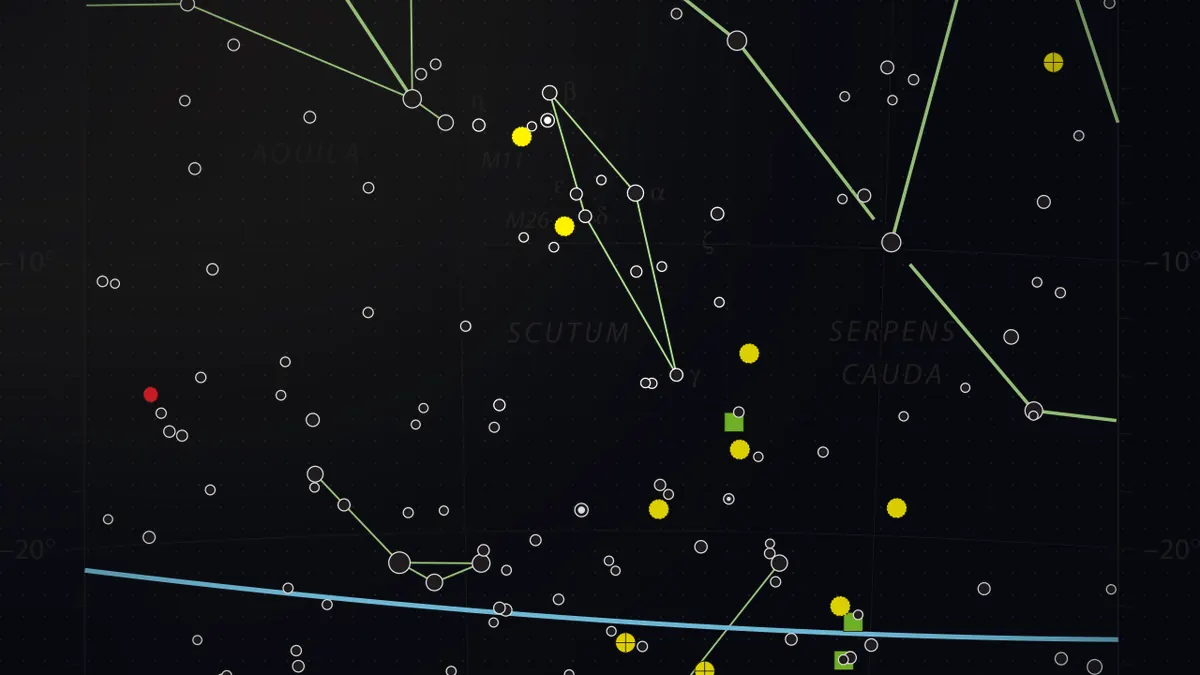
Scutum sits between Aquila and Sagittarius, along the Milky Way.
Start at Altair and follow the Milky Way south-west. Before you reach the Teapot of Sagittarius, you will pass a notably bright, dense patch of the Milky Way: brighter than the surrounding band. That patch is the Scutum Star Cloud, and Scutum is around it.
You are more likely to notice the star cloud than the constellation's own stars. That is the correct way round: use the glow to find the constellation, not the other way about.
In sky coordinates Scutum sits at right ascension 18h 42m and declination −10.0°. Those two numbers work like a grid reference. Right ascension runs around the sky the way longitude runs around the Earth, and declination measures north and south the way latitude does. It sits in the southern half of the sky, high for southern observers and low on the horizon for northern ones. Practically speaking it is visible from anywhere south of latitude 75°N, including the whole southern hemisphere, with the best evening views around August.
What Scutum actually looks like
A small, faint diamond or kite of four stars. There is not much to it, and the star cloud behind is far more conspicuous than the figure itself.
Scutum has an unusual distinction: it is the only constellation named after a real historical person's achievement rather than a myth, a device or a place. Johannes Hevelius created it in 1684 as Scutum Sobiescianum, the Shield of Sobieski, honouring King John III Sobieski of Poland.
The name was later shortened to plain Scutum, which quietly removed the political dedication while keeping the shield.
The stars of Scutum
- Alpha Scuti (magnitude 3.8) — the brightest star, an orange giant about 200 light years away.
- Beta Scuti — a yellow giant, second brightest.
- Delta Scuti — the prototype of the Delta Scuti variables, a class of stars that pulse rapidly, often several times an hour. These are useful to astronomers because their oscillations reveal their internal structure, in the same way seismic waves reveal Earth's interior.
- R Scuti — a bright, semiregular variable of the RV Tauri type, swinging between about magnitude 4.5 and 8.2 in an irregular pattern. It is one of the brightest of its class and easy to follow with binoculars over weeks.
- UY Scuti — long cited as one of the largest known stars, a red supergiant whose radius estimates have varied enormously as measurements improved.
The story behind the name
Scutum has no ancient mythology. Johannes Hevelius introduced it in 1684 as Scutum Sobiescianum, honouring John III Sobieski, King of Poland, who had led the relief of Vienna in 1683 and broken the Ottoman siege.
Hevelius had personal reasons for the tribute. His observatory in Gdańsk had burned down in 1679, and Sobieski supported him financially afterwards. Naming a constellation for your patron was, at the time, entirely normal practice.
What is unusual is that it worked. Most such dedications (Frederick's Honours, the Sceptre of Louis XIV, Charles's Oak) were stripped out when the IAU standardised the sky in 1922. Scutum survived, quietly shortened to just 'the shield', making it the only constellation still commemorating a specific historical figure's deeds.
What else is hiding in Scutum
Small constellation, exceptional contents.
- M11, the Wild Duck Cluster — one of the richest and most compact open clusters known, containing around 2,900 stars. It is dense enough to look almost like a loose globular in small instruments. The name comes from a V-shaped arrangement of its brighter stars that reminded early observers of a flight of ducks. It is genuinely one of the finest open clusters in the sky and worth going out of your way for.
- M26 — a smaller, sparser open cluster nearby, a reasonable follow-up.
- The Scutum Star Cloud — the object to enjoy with binoculars or the naked eye. It is a gap in the interstellar dust that lets us look deep towards the galaxy's inner arms, and under a dark sky it is a visibly brighter, grainier region of the Milky Way. Sweeping it slowly is one of the great simple pleasures of summer observing.
When and where to see it
Best placed in the evening sky in August, through the northern summer when the Milky Way's core region is up.
It sits just south of the celestial equator, so it is visible from essentially everywhere, though southern observers get it considerably higher and therefore clearer.
Light pollution is fatal here. From a city there is nothing: no star cloud, no constellation, and M11 is a struggle. From a dark site this is one of the best small areas of sky there is. Binoculars beat a telescope for the star cloud; a telescope is better for resolving M11.
Scutum at a glance
| Name | Scutum |
| Abbreviation | Sct |
| Genitive form | Scuti |
| Meaning | the Shield of John III Sobieski |
| Family | Hercules family |
| First recorded | 1690, Hevelius, as Scutum Sobiescianum |
| Right ascension | 18h 42m |
| Declination | −10.0° |
| Area | 109 square degrees (84th largest of 88) |
| Main stars in the figure | 2 |
| Stars brighter than magnitude 3 | 0 |
| Named Bayer / Flamsteed stars | 7 |
| Brightest star | α Sct (magnitude 3.85) |
| Messier objects | 2 |
| Meteor showers | June Scutids |
| Visible from | Anywhere south of latitude 75°N, including the whole southern hemisphere |
| Best seen at 9 pm in | August |
| Bordering constellations | Aquila, Sagittarius, Serpens |
Where to go next
Its neighbours in the sky
Scutum borders all of these, which makes them the natural next targets once you can pick it out: Aquila, Sagittarius, Serpens.
The rest of the Hercules family
Scutum belongs to the Hercules family: the largest family — heroes, serpents and the far southern sky. The others are: Aquila, Ara, Centaurus, Corona Australis, Corvus, Crater, Crux, Cygnus, Hercules, Hydra, Lupus, Lyra, Ophiuchus, Sagitta, Serpens, Sextans, Triangulum Australe, Vulpecula.
Start from the beginning
If you are starting from scratch, the complete beginner's guide to the 88 constellations covers what a constellation actually is, how the sky is carved up, and links to every one of them.
Star chart: Scutum IAU chart by IAU and Sky & Telescope magazine (Roger Sinnott & Rick Fienberg), used under CC BY 3.0. Observing data cross-checked against Wikipedia's Scutum entry.