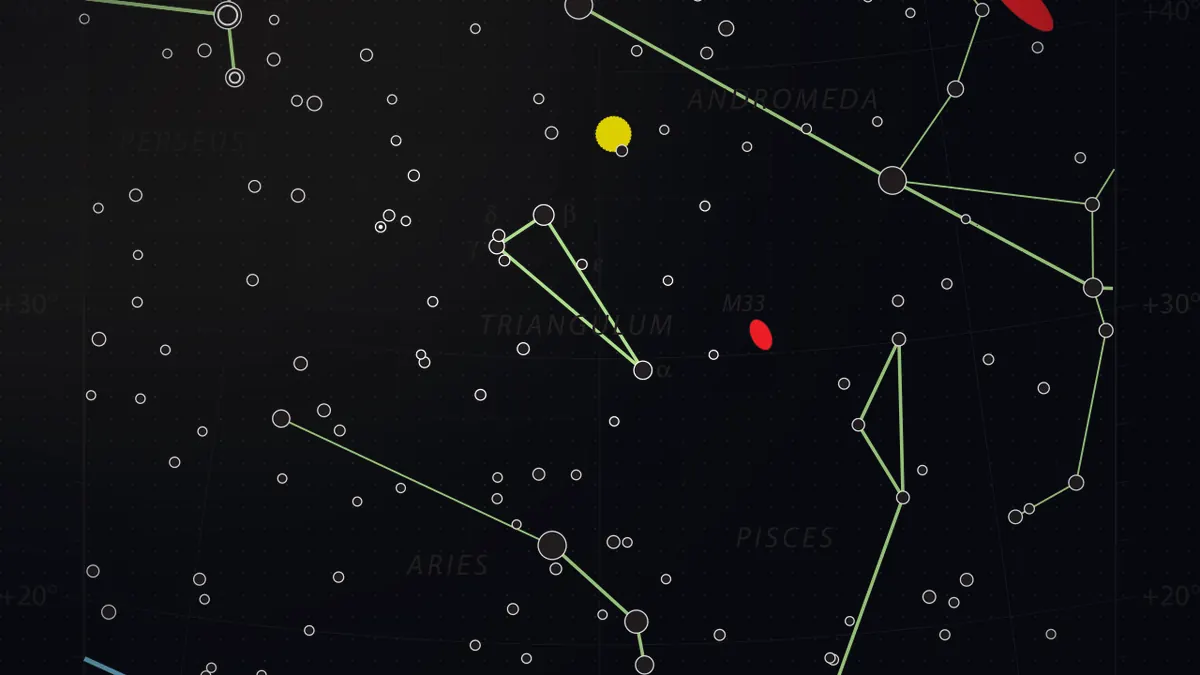
Triangulum is exactly what the name says: three stars in a thin triangle. It is one of the smallest and simplest constellations in the sky, and there is nothing else to its figure.
It punches far above its weight because of what lies inside it. M33, the Triangulum Galaxy, is the third-largest galaxy in our Local Group after Andromeda and the Milky Way, and under exceptional conditions it is visible to the naked eye, which would make it the most distant object some people have ever seen unaided.
Where to find Triangulum
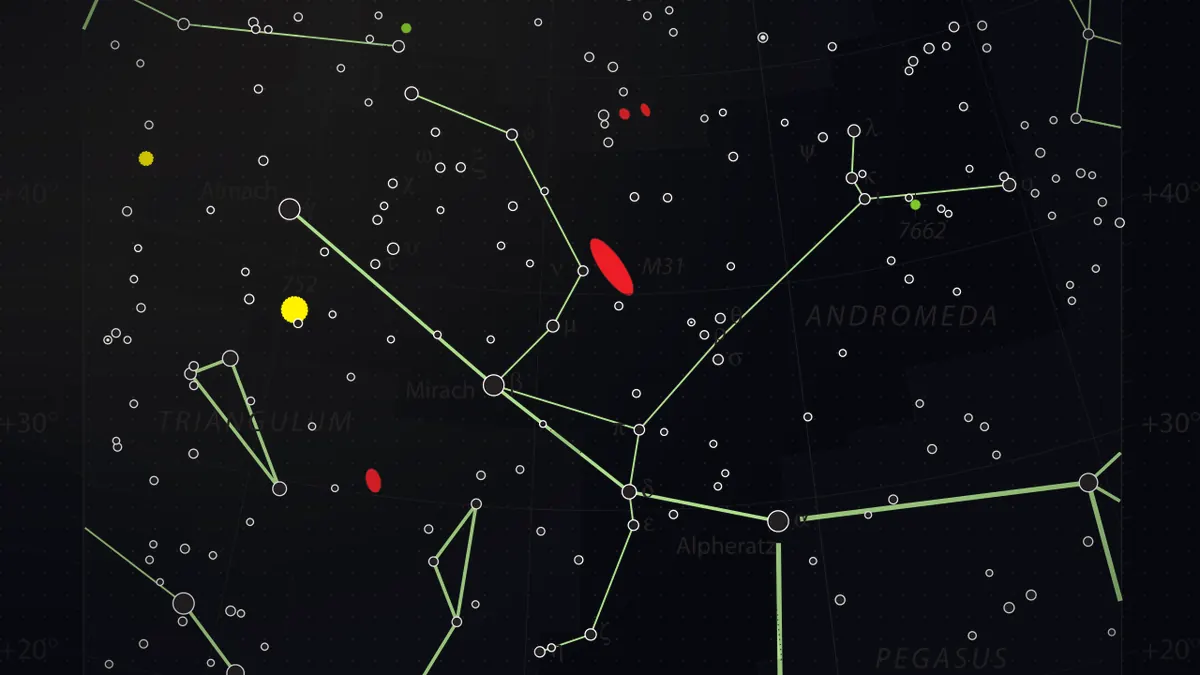
Triangulum sits between Andromeda and Aries, just south of the Andromeda star chain.
Find Mirach in Andromeda, the middle star of the bright chain. From Mirach, look south — away from Cassiopeia — and you will find a narrow, elongated triangle of three modest stars. That is the whole constellation.
Mirach is also the key to the galaxy. M31 lies one way from Mirach and M33 lies roughly the same distance the other way. It is one of the tidiest star-hops in the sky: one star, two galaxies, opposite directions.
In sky coordinates Triangulum sits at right ascension 1h 31m and declination +25.6°. Right ascension is the sky's version of longitude and declination its version of latitude, so those two numbers pin the constellation to one spot on the celestial sphere the way a map reference pins a town. It sits in the northern half of the sky, riding high for northern observers and low for southern ones. You can see it from anywhere north of latitude 53°S, including the whole northern hemisphere, and it sits highest after dark in December.
What Triangulum actually looks like
A long, thin triangle — more like a sliver than an equilateral shape. Three stars, nothing more, with the brightest at the narrow apex.
The Greeks called it Deltoton, after the capital letter delta, and the Romans sometimes associated it with the Nile delta or with the island of Sicily, which is roughly triangular. It is one of the very few constellations named purely for a geometric shape rather than a figure or an animal, and it is refreshingly honest for it.
The stars are around magnitude 3 to 4, so it is visible from a suburb but easily missed.
The stars of Triangulum
- Beta Trianguli (magnitude 3.0) — the brightest star, a white spectroscopic binary, despite carrying the Beta rather than Alpha designation.
- Mothallah (Alpha Trianguli) — a close binary at the triangle's apex. The name comes from the Arabic for 'the triangle'.
- Gamma Trianguli — a white main-sequence star with a surrounding debris disc.
That is genuinely the star list. Triangulum is a three-star constellation and there is no point padding it out. What matters here is not in the constellation at all, but far behind it.
The story behind the name
Triangulum has very little mythology, which fits a constellation named after a shape. The Greeks knew it as Deltoton for its resemblance to the letter delta, and Ptolemy included it among his 48.
The main associations are geographic rather than narrative: the Nile delta, or Sicily, whose triangular outline gave it the ancient name Trinacria. In some accounts Ceres, goddess of the harvest, asked Jupiter to place Sicily in the sky.
For a while in the seventeenth and eighteenth centuries there was a second constellation here: Triangulum Minus, a smaller triangle added by Hevelius beside the original. It did not survive the IAU's 1922 standardisation, which is why the modern Triangulum has no 'major' in its name despite the southern Triangulum Australe existing.
What else is hiding in Triangulum
One object, and it is a big one.
-
M33, the Triangulum Galaxy — a face-on spiral about 2.7 million light years away and roughly half the Milky Way's diameter. It is the third-largest member of our Local Group and is probably a satellite of Andromeda.
M33 is a famous test of sky quality. Its total brightness is high, but that light is spread over an area larger than the full Moon, giving it a very low surface brightness. Under a genuinely dark sky some observers see it with the naked eye; from a suburb it can be invisible even in a telescope. Use low magnification and a wide field: magnifying it spreads the light further and makes it worse, which catches out a lot of people.
-
NGC 604 — a colossal star-forming region inside M33, over forty times the size of the Orion Nebula. It is one of the largest known, and it is visible as a distinct knot within the galaxy in a decent telescope.
When and where to see it
Best placed in the evening sky in December, with the autumn months either side.
It is a northern constellation reaching to about 60°S, so most of the world can see it, with northern observers getting it high overhead.
Everything depends on darkness. The triangle itself is easy enough, but M33 is unforgiving: moonlight or light pollution erases it completely. On a moonless night at a dark site, try for it with the naked eye first using averted vision, then binoculars, then a low-power telescope. Seeing a galaxy 2.7 million light years away without any equipment at all is a genuine achievement, and this is one of only two realistic chances you get.
Triangulum at a glance
| Name | Triangulum |
| Abbreviation | Tri |
| Genitive form | Trianguli |
| Meaning | The Triangle |
| Family | Perseus family |
| First recorded | ancient (Ptolemy) |
| Right ascension | 1h 31m |
| Declination | +25.6° |
| Area | 132 square degrees (78th largest of 88) |
| Main stars in the figure | 3 |
| Stars brighter than magnitude 3 | 0 |
| Named Bayer / Flamsteed stars | 14 |
| Brightest star | β Tri (Alaybasan) (magnitude 3.00) |
| Messier objects | 1 |
| Meteor showers | None |
| Visible from | Anywhere north of latitude 53°S, including the whole northern hemisphere |
| Best seen at 9 pm in | December |
| Bordering constellations | Andromeda, Aries, Perseus, Pisces |
Where to go next
Its neighbours in the sky
Triangulum borders all of these, which makes them the natural next targets once you can pick it out: Andromeda, Aries, Perseus, Pisces.
The rest of the Perseus family
Triangulum belongs to the Perseus family: the northern sky's Andromeda myth, told across nine constellations. The others are: Andromeda, Auriga, Cassiopeia, Cepheus, Cetus, Lacerta, Pegasus, Perseus.
Start from the beginning
New to all this? The 88 constellations: a complete beginner's guide explains what a constellation actually is, how the sky is divided up, and lists all 88 with a link to each one.
Star chart: Triangulum IAU chart by IAU and Sky & Telescope magazine (Roger Sinnott & Rick Fienberg), used under CC BY 3.0. Observing data cross-checked against Wikipedia's Triangulum entry.