Almost everyone who looks at Orion has looked straight past Lepus. It sits immediately below the Hunter's feet, a compact scatter of moderately bright stars that most people never bother to name.
That is a shame, because Lepus quietly holds three things worth the detour: a globular cluster that has no business being in the winter sky, one of the reddest stars you can see through a telescope, and the star system where the first brown dwarf was confirmed.
Where to find Lepus
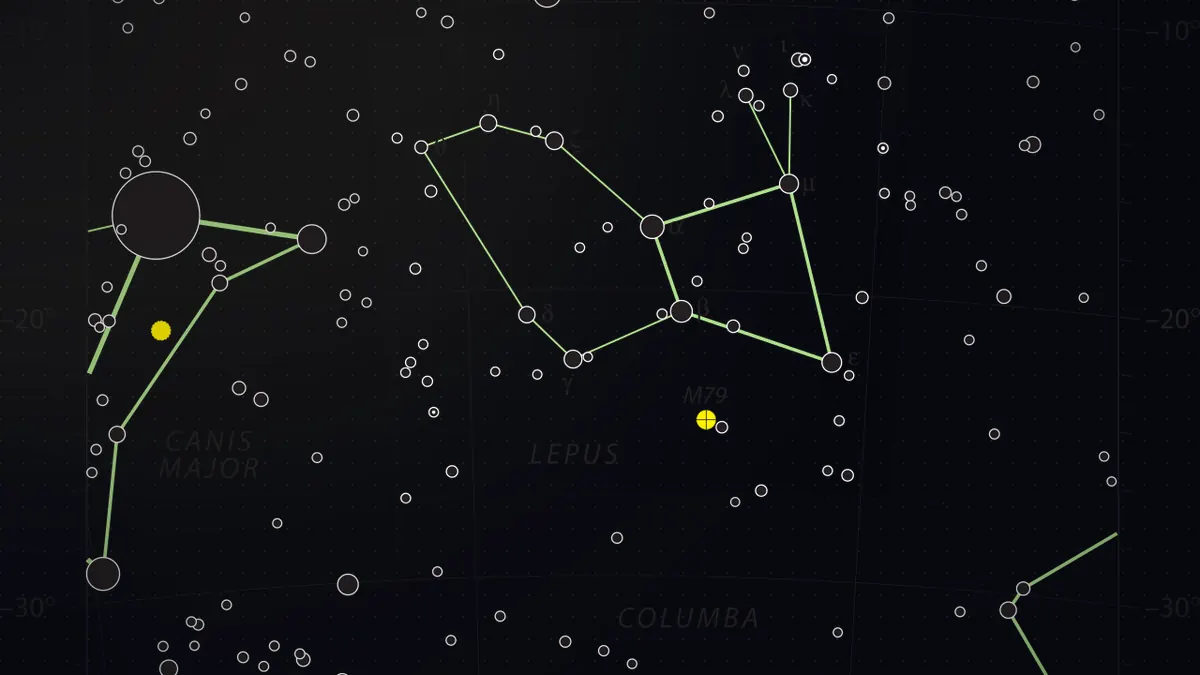
Find Rigel — the bright blue-white star at Orion's foot — and look just below it. The small quadrilateral of stars you find there is the body of the hare.
It helps to know what you are expecting: nothing in Lepus is dazzling. The brightest star sits at magnitude 2.6, comfortably visible from a suburb but easy to overlook when Orion is blazing away right above it. Give your eyes a minute to adjust and the shape appears quickly enough.
In sky coordinates Lepus sits at right ascension 4h 55m and declination −10.8°. Those two numbers work like a grid reference. Right ascension runs around the sky the way longitude runs around the Earth, and declination measures north and south the way latitude does. It sits in the southern half of the sky, high for southern observers and low on the horizon for northern ones. In practice that means you can find it from anywhere south of latitude 63°N, including the whole southern hemisphere; it rides highest in the evening sky in January.
What Lepus actually looks like
Four stars (Alpha, Beta, Gamma and Delta Leporis) form a lopsided quadrilateral that makes up the hare's body. Two more above it suggest the ears, pointing up towards Orion, and a short trail below marks the hind legs.
Arab astronomers saw the same quadrilateral differently and called it Arsh al-Jawza, 'the Throne of Jawza', and also 'the Camels Quenching their Thirst'. It is a good reminder that the animal you are told to see is only ever one option among many.
The stars of Lepus
- Arneb (Alpha Leporis, magnitude 2.58) — a white supergiant and the brightest star here. The name is simply Arabic for 'the hare'. It is a genuinely luminous star, thousands of times brighter than the Sun, but sits well over a thousand light years away.
- Nihal (Beta Leporis) — a yellow giant, second brightest, and a pleasant contrast to Arneb's white when you look at both together.
- R Leporis, better known as Hind's Crimson Star — a carbon star and one of the most intensely red objects visible in an amateur telescope. Its colour has been described as a drop of blood on a black field. It varies over roughly 14 months, and it is reddest when faintest, so it rewards patience.
- Gliese 229 — an unremarkable red dwarf with a remarkable companion. In 1995 astronomers confirmed Gliese 229B as the first genuine brown dwarf: too big to be a planet, too small to sustain hydrogen fusion and become a star.
The story behind the name
Unusually for an ancient constellation, Lepus is not really attached to a myth of its own. It is defined almost entirely by what is around it: the hare Orion is hunting, or the hare his dogs Canis Major and Canis Minor are chasing. The whole winter tableau (hunter, two dogs, prey) reads as a single scene.
There are threads elsewhere. The constellation has been linked to the Moon rabbit, a figure that appears independently across East Asian and Mesoamerican traditions. One Greek account explains its presence more practically: hares once bred so uncontrollably on the island of Leros that they ruined the harvest and the islanders had to drive them out, and the hare was placed in the sky as a caution about too much of a good thing.
What else is hiding in Lepus
- M79 — a globular cluster, and an oddity. Globulars cluster around the centre of the galaxy, so almost all of them appear in the summer sky towards Sagittarius. M79 sits in the opposite direction entirely, in the winter sky. The leading explanation is that it is not originally ours at all: it may have been pulled in from the Canis Major dwarf galaxy that our Milky Way is currently absorbing.
- IC 418, the Spirograph Nebula — a small, bright planetary nebula whose intricate patterning in Hubble images earned it the name.
- NGC 2017 — a tight little group of stars that resolves nicely at moderate magnification.
M79 is the one to aim for. It is faint but reachable in a small telescope, and knowing it may be an immigrant from another galaxy makes it a better view.
When and where to see it
Lepus is best in the evening sky in January, riding along with Orion through the northern winter and the southern summer.
It sits south of the celestial equator, so southern observers get it higher and cleaner. From mid-northern latitudes it stays fairly low, which means atmospheric haze and horizon light pollution can wash it out, from a city you may only pick up Arneb and Nihal.
The main shape is naked-eye under a reasonably dark sky. M79 and R Leporis both need a telescope, and R Leporis in particular is worth revisiting over several months to watch the colour deepen.
Lepus at a glance
| Name | Lepus |
| Abbreviation | Lep |
| Genitive form | Leporis |
| Meaning | the Hare |
| Family | Orion family |
| First recorded | ancient (Ptolemy) |
| Right ascension | 4h 55m |
| Declination | −10.8° |
| Area | 290 square degrees (51st largest of 88) |
| Main stars in the figure | 8 |
| Stars brighter than magnitude 3 | 2 |
| Named Bayer / Flamsteed stars | 20 |
| Brightest star | α Lep (Arneb) (magnitude 2.58) |
| Messier objects | 1 |
| Meteor showers | None |
| Visible from | Anywhere south of latitude 63°N, including the whole southern hemisphere |
| Best seen at 9 pm in | January |
| Bordering constellations | Caelum, Canis Major, Columba, Eridanus, Monoceros, Orion |
Where to go next
Its neighbours in the sky
Lepus borders all of these, which makes them the natural next targets once you can pick it out: Caelum, Canis Major, Columba, Eridanus, Monoceros, Orion.
The rest of the Orion family
Lepus belongs to the Orion family: the Hunter and the animals around him, the brightest patch of sky. The others are: Canis Major, Canis Minor, Monoceros, Orion.
Start from the beginning
If you are starting from scratch, the complete beginner's guide to the 88 constellations covers what a constellation actually is, how the sky is carved up, and links to every one of them.
Star chart: Lepus IAU chart by IAU and Sky & Telescope magazine (Roger Sinnott & Rick Fienberg), used under CC BY 3.0. Observing data cross-checked against Wikipedia's Lepus entry.