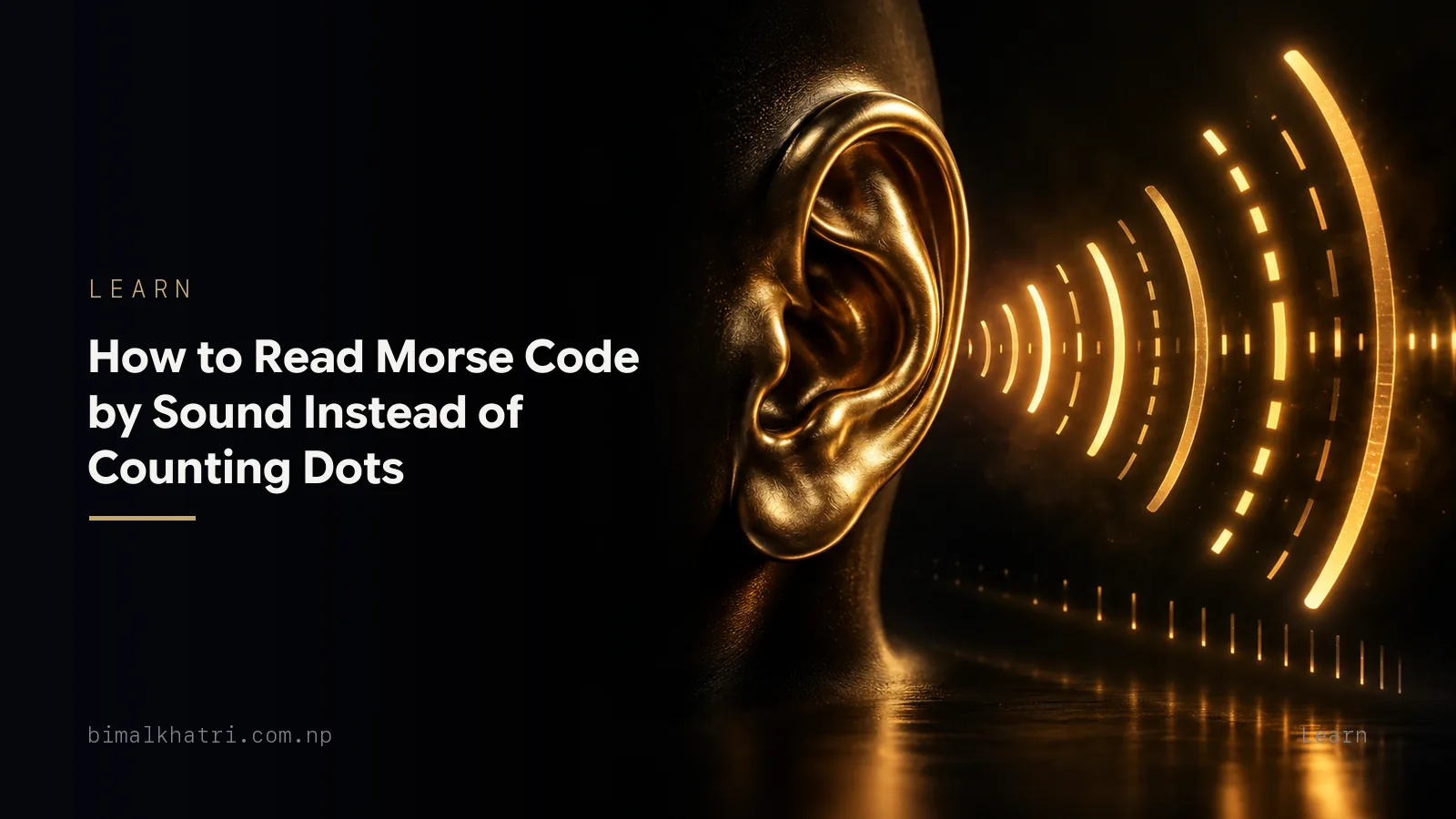
You stop counting dots by never counting them. Learn each character as a single sound with its own rhythm, the way you recognise a spoken word without spelling it, and listen at a speed where counting is not physically possible.
The speed part is not optional. At 20 words per minute the letter H ....
lasts 420 milliseconds and the pause before the next character is 180. That is
not enough time to count four beeps, look them up and write a letter. It is
plenty of time to hear one short buzz and know it is H.
So the goal is not to count faster. It is to trade counting for recognition. Here is what each character sounds like, which ones fool people, why the silence matters as much as the sound, and how to run a session that builds the habit.
Want to hear it, not just read it? MorseLab plays any text back as tone, flash or vibration, free and offline.
Why counting stops working
Everything in Morse is measured in units, where one unit is the length of a dot. A dash is 3 units. The gap inside a character is 1, between characters 3, and between words 7. The dot length in seconds is 1.2 ÷ WPM, so a 20 WPM dot is 60 ms and a 5 WPM dot is 240 ms.
Add the units up and you get how long each character actually occupies the air.
H .... is four dots and three internal gaps, so 7 units. K -.- is
3 + 1 + 1 + 1 + 3, so 9 units.
| Character | Code | Units | At 5 WPM | At 12 WPM | At 20 WPM |
|---|---|---|---|---|---|
| E | . | 1 | 240 ms | 100 ms | 60 ms |
| I | .. | 3 | 720 ms | 300 ms | 180 ms |
| S | ... | 5 | 1,200 ms | 500 ms | 300 ms |
| H | .... | 7 | 1,680 ms | 700 ms | 420 ms |
| K | -.- | 9 | 2,160 ms | 900 ms | 540 ms |
| Q | --.- | 13 | 3,120 ms | 1,300 ms | 780 ms |
| 0 | ----- | 19 | 4,560 ms | 1,900 ms | 1,140 ms |
| Gap between characters | 3 | 720 ms | 300 ms | 180 ms |
Read the last column. At 20 WPM you get 180 ms of silence to name a character before the next one arrives. Recognition fits in that. Counting is three steps, and three steps do not.
At 5 WPM counting works, which is exactly the trap. Beginners start slow, count successfully, feel like they are learning, and build a habit that collapses the moment the speed rises. Everything they trained has to be thrown away. That is why the standard advice is to keep the characters fast from day one and buy your thinking time somewhere else. There is more arithmetic in timing and WPM.
Say it the way operators say it
Written down, a dot is . and a dash is -. Letters are separated by a space
and words by /, so ... --- ... is S, O and S as three separate letters.
Spoken, a dot is a dit and a dash is a dah. When a dot runs into another
element, operators shorten it to di. So K -.- is "dah-di-dah" and B
-... is "dah-di-di-dit".
That is a transcription of the rhythm, with the stress falling on the dahs, and saying it aloud is the fastest way to stop seeing a picture and start hearing a shape. Say every character aloud from your first session, and say it while you write it.
The 26 letters as sounds
Read this column of spoken rhythms out loud rather than scanning it. The letters are grouped by length, because length is the first thing your ear notices.
| Letters | Code | Said aloud |
|---|---|---|
| E | . | dit |
| T | - | dah |
| A | .- | di-dah |
| I | .. | di-dit |
| M | -- | dah-dah |
| N | -. | dah-dit |
| D | -.. | dah-di-dit |
| G | --. | dah-dah-dit |
| K | -.- | dah-di-dah |
| O | --- | dah-dah-dah |
| R | .-. | di-dah-dit |
| S | ... | di-di-dit |
| U | ..- | di-di-dah |
| W | .-- | di-dah-dah |
| B | -... | dah-di-di-dit |
| C | -.-. | dah-di-dah-dit |
| F | ..-. | di-di-dah-dit |
| H | .... | di-di-di-dit |
| J | .--- | di-dah-dah-dah |
| L | .-.. | di-dah-di-dit |
| P | .--. | di-dah-dah-dit |
| Q | --.- | dah-dah-di-dah |
| V | ...- | di-di-di-dah |
| X | -..- | dah-di-di-dah |
| Y | -.-- | dah-di-dah-dah |
| Z | --.. | dah-dah-di-dit |
Fourteen of the twenty-six are three elements or fewer, and those fourteen cover most of written English. Learn them as sounds and you are already copying real words. The printed alphabet chart is for looking things up afterwards, not for studying.
Two ladders, and why one of them is dangerous
Four letters are nothing but dots and three are nothing but dashes. Add the digits 5 and 0 and you have two ladders. Paste this and listen to it:
. .. ... .... .....
- -- --- -----
The first line is E, I, S, H and the digit 5. The second is T, M, O and the digit 0. Nothing sits at four dashes; that pattern is not used in the international code.
These ladders are where counting feels most reasonable and does most damage. At 20 WPM, S is 300 ms of stuttered sound and H is 420 ms, a difference of 120 ms. You will never count that. You can hear a short buzz against a slightly longer one, the way you hear "pit" against "peat" without measuring anything.
Drill them as a group, in random order, until the four dot-letters are four different sounds rather than four counts:
. .. ... .... / .... ... .. . / ... . .... .. / .. .... . ...The pairs that catch every beginner
Six pairs of letters are exact reversals of each other. Your ear has to learn which way round the rhythm runs, and there is no shortcut except hearing them side by side.
| Pair | Code | Said aloud |
|---|---|---|
| A and N | .- and -. | di-dah, dah-dit |
| U and D | ..- and -.. | di-di-dah, dah-di-dit |
| V and B | ...- and -... | di-di-di-dah, dah-di-di-dit |
| W and G | .-- and --. | di-dah-dah, dah-dah-dit |
| L and F | .-.. and ..-. | di-dah-di-dit, di-di-dah-dit |
| Y and Q | -.-- and --.- | dah-di-dah-dah, dah-dah-di-dah |
Here they are as one drill. Each pair sits together as a word so the playback puts a longer pause between pairs:
.- -. / ..- -.. / ...- -... / .-- --. / .-.. ..-. / -.-- --.-Eleven characters read the same in both directions, which makes them easier:
E ., T -, I .., M --, S ..., O ---, H ...., K -.-, R .-.,
P .--. and X -..-. If you cannot tell which way a rhythm ran, checking
whether it is one of these eleven is often enough to resolve it.
The silence is part of the character
This is the idea that separates people who can copy from people who can only decode a written string. In Morse, the gaps are not punctuation between the real signal. They carry the same weight as the beeps.
Two examples make it obvious. The digit 5 is ....., five dots with 1-unit gaps
inside one character. The letters H and E are .... ., four dots, then a 3-unit
gap, then one dot. The beeps are identical. Only the length of one silence tells
them apart.
The same thing happens with prosigns, which are procedure signals sent as one
unbroken run with no letter gaps inside them. BT -...- is a break marker sent
as a single five-element character. B followed by T is -... -, the same beeps
with a 3-unit gap dropped in. Different signals.
The famous one is SOS. It is a prosign: ...---..., nine elements sent
continuously, with no gaps between the groups. Sent as three separate letters,
... --- ..., it is something else. The distinction is audible once you listen
for silences instead of beeps. And it does not stand for "Save Our Souls" or
"Save Our Ship": both are backronyms invented long after the signal was chosen
for being unmistakable and easy to send. The
full story is here, and there is more on procedure
signals in prosigns and Q-codes.
So listen to the gaps deliberately. Ask where the character ended, not just what beeps you heard. That habit is what lets you copy letters instead of noises.
Keep the characters fast, stretch the gaps
The obvious way to make listening easier is to slow everything down. It is also the one change that teaches the wrong thing, because a slow character has a different rhythm and you will have to unlearn it.
The fix is to leave the characters at full speed and stretch the silence around them. That is Farnsworth spacing. It is often written up as the rival of the Koch method, and that framing is simply wrong:
- Koch decides which characters you learn and when you add the next one: start with two at full target speed, add one more only at 90% accuracy, never slow the code down.
- Farnsworth decides how much silence sits between characters and words. The characters themselves are untouched.
They change different variables, so they combine, and the combination is the normal recommendation. Koch vs Farnsworth goes through it properly.
The arithmetic is worth seeing once. The reference word PARIS is exactly 50 units: 31 units of characters, 12 units of gaps between them, and a 7-unit word gap. Send the characters at 20 WPM and those 31 units take 31 × 60 ms, which is 1.86 seconds. If you want the text to arrive at 8 WPM, one word has to occupy 60 ÷ 8 = 7.5 seconds. The 5.64 seconds left over are silence, split in the same 3-to-7 shape as normal spacing.
| Setting | Value |
|---|---|
| Character speed | 20 WPM, 60 ms dot |
| Overall text speed | 8 WPM |
| Character time per word | 1.86 s |
| Silence to distribute | 5.64 s |
| Gap between characters | about 890 ms |
| Gap between words | about 2.08 s |
Nearly a second between letters is a lot of thinking time, and every letter still sounds exactly the way it will at 20 WPM. As you improve you take the padding out and nothing you learned changes.
A listening session that trains the ear
Twenty minutes done daily beats two hours on a Sunday. Morse is motor learning and it consolidates between sessions, so frequency matters more than length.
- Two minutes of warm-up. Characters you already own, no new material.
- Twelve minutes of copying. Your current set in random order. Pencil and paper, never a keyboard.
- Three minutes of sending. Say the rhythms aloud, or tap them.
- Three minutes of scoring. Count errors honestly and write down which two characters you actually missed.
Three rules make those twenty minutes count.
Write one character behind. Hear a character, start writing it while the next one is already playing. It feels wrong for about a week, then it becomes the thing that lets you copy at speed. If you wait until a character is finished before writing, you lose the next one.
Write letters, never dots. Scribbling -.- on paper and decoding it later
feels productive and trains the exact loop you are trying to kill.
Keep the tone the same every session. Same pitch, same volume, same source. Your ear is learning a pattern, and changing the sound of it adds work for nothing.
If you miss a character, do not stop and dig for it. Leave a dash on the paper as a placeholder for the missing letter and keep going. Stopping costs you the next three characters, and a gap you can fill from context later costs you nothing. More formats are in Morse code practice, and scoring yourself properly is covered in the quiz guide.
I built MorseLab because listening practice needs three things that are awkward to arrange by hand: a tone you can set to a fixed character speed with separate spacing, lessons that add one character at a time in Koch order, and something that scores you so 90% is a number rather than a feeling. It also decodes live Morse audio through the microphone, which is a blunt way to check whether the rhythm you just sent was the one you meant. It runs offline, so a bus with no signal is a practice session.
From letters to words
Once six or eight characters are solid, stop copying random letters and start copying words built from them. Words have their own rhythm, your brain begins predicting the end of them, and prediction is most of what fluency is.
Common short words become single shapes surprisingly fast:
- .... . / .- -. -.. / -.-- --- ..- / .- .-. . / -. --- - / ..-. --- .-.That is THE, AND, YOU, ARE, NOT, FOR. Play it a few dozen times and THE stops being three letters.
Then move to sentences, where the / word gaps are long enough to give you
somewhere to breathe:
.... . .- .-. / - .... . / ... .... .- .--. . / -. --- - / - .... . / -.. --- - ...That reads HEAR THE SHAPE NOT THE DOTS.
The last stage is head copy: hearing whole words without writing anything down. Nobody schedules it. It arrives one day when you notice you understood a short word before your pencil moved, and then it spreads. That is also the point at which operators on the air stop transcribing and start having a conversation.
When you cannot listen out loud
Sound is the main channel, and a steady tone is easy to pick out of noise, which is part of why the code still works at very low power. But you can train the same timing without making noise:
- A phone torch blinking the pattern trains the ratios with your eyes. See Morse with a flashlight.
- Vibration and tapping work at short range and are silent, which suits a shared room. Try tapping and vibration.
- Playing text back from a translator and reading the result with a decoder is a good way to check your own sending against something that does not flatter you.
Headphones and a real tone still beat all three. Use the others when sound is not an option.
Common mistakes
Counting elements. If you are counting, the code is too slow, not too fast. Raise the character speed and pad the gaps instead.
Slowing the characters down. A 5 WPM K is a different rhythm from a 20 WPM K. Learning the slow one costs you a month later.
Studying from the chart. The chart is a lookup table. Reading -.- and
thinking "dash dot dash, that is K" is the habit you are trying to avoid.
Writing dots and dashes on paper. Write the letter or write nothing.
Ignoring the gaps. Half the information in Morse is silence. If you only
listen to beeps, ..... and .... . are the same thing.
Practising once a week. Twenty minutes daily beats a long weekend session every time.
Believing a promised timeline. You can memorise the chart in a day. Copying by ear takes weeks of daily practice, and how many weeks depends on how many sessions you actually run. The honest version is here.
Questions people ask
How do you read Morse code by sound?
By recognising each character as one rhythm rather than a sequence of separate beeps. Say the rhythms aloud as dits and dahs, listen at a character speed too fast to count, and give yourself thinking time by stretching the gaps rather than slowing the characters.
How do I stop counting dots and dashes?
Raise the speed. Counting just about works at very slow speeds and falls apart as the speed rises, so the habit dies on its own once the characters arrive faster than arithmetic. Keep the code at a real speed and pad the silence between characters until you can keep up.
What speed should I listen at?
Set the characters to the speed you want to end up at, commonly 20 WPM, which is a 60 ms dot. Then set the overall text rate to whatever you can currently follow, even 5 or 8 WPM. Two separate settings, and only one of them changes as you improve.
Why do S and H sound so similar?
Because they differ only in length: S ... is 5 units and H .... is 7. At 20
WPM that is 300 ms against 420 ms. Stop trying to count the dots and learn the
two as different durations, drilled next to each other along with E and I.
How do I hear the space between letters?
The gap inside a character is 1 unit and the gap between characters is 3, so at
20 WPM that is 60 ms against 180 ms. Listen for that longer silence as an event
in its own right. The clearest exercise is the digit 5 ..... against the
letters H and E .... ., which have the same beeps and different silences.
Should I learn the sounds or the chart first?
Learn the sounds. Look at the chart when you are curious or when you want to write something down, but do the actual learning by ear from the first session, because listening is the skill and the chart is just a reference.
How long before I can copy by ear?
Weeks of daily practice for most people, and longer for many. There is no honest number, because it depends on sessions rather than calendar days. What is reliable is that short daily practice gets people there and occasional long sessions do not. The full plan is in how to learn Morse code.
Do I need a radio to practise listening?
No. A phone or a computer that can play a tone is enough, and nothing you need to learn requires transmitting. A licence only matters when you want to get on the air, which is a separate step you can take later.
Download it: MorseLab for iPhone and Android. Free, and the link picks the right store for you.
Keep reading
- How to Learn Morse Code — the full plan, from your first two characters to normal spacing.
- Morse Code Practice — drill formats that train ears rather than eyes.
- Koch vs Farnsworth — why the comparison is the wrong question.
- Timing and WPM — the 1:3:7 ratio and the PARIS standard in full.
- Morse Code Decoder — reading a beep back into text, and checking your own sending.