Learn Morse code by ear, not by eye. Start with two characters sent at full speed, add a third only once you can copy the first two almost perfectly, and practise fifteen minutes a day instead of two hours on a Sunday.
That is the whole plan. The rest of this page is how to run it: what speed to pick, which characters to start with, what to do when you stall, and the mistakes that waste the most time.
Settle one thing before you start. You can memorise the chart in an afternoon. You cannot learn to copy Morse by ear in an afternoon. They are two different skills, and the second one is the one that lets you actually use the code.
Try it with your ears. MorseLab plays any text back as tone, flash or vibration, free and offline.
Sound first, chart second
Morse is a rhythm. Each character is one short sound pattern, and a fluent operator hears the whole pattern at once, the way you hear a spoken word rather than spelling it out.
A printed chart teaches the opposite habit. You see -.-, you think "dash, dot,
dash, that must be K", and you write it down. That works at five words per
minute and falls apart around ten, because there is no longer time to count
anything. Every hour spent decoding shapes in your head is an hour you will
later spend unlearning it.
Use the alphabet chart as a lookup table when you are curious, and to write things down on paper. Do not use it as your study method.
Operators say the sounds aloud: a dot is a dit, a dash is a dah. K is "dah-di-dah". Say it that way in your head from your first session and the character stops being a picture.
How Morse is written in text
A dot is . and a dash is -. Letters are separated by a space, words by /.
So ... --- ... is S, O and S sent as three separate letters, and this is MORSE
CODE:
-- --- .-. ... . / -.-. --- -.. .That notation is for reading and copy-pasting. It is not what you should be studying from.
Step 1: Pick your target speed first
Speed is measured in words per minute against the reference word PARIS, which is exactly 50 units long once you include the word gap that follows it. Sending PARIS twenty times a minute is 20 WPM.
Everything in Morse is measured in units, where one unit is the length of a dot:
| Element | Units |
|---|---|
| Dot (dit) | 1 |
| Dash (dah) | 3 |
| Gap inside one character | 1 |
| Gap between characters | 3 |
| Gap between words | 7 |
A dash is not "a bit longer" than a dot. It is exactly three times as long, and that fixed ratio is what makes the code readable by ear at any speed.
The arithmetic is one line: dot length in seconds = 1.2 ÷ WPM.
| WPM | Dot | Dash | Word gap |
|---|---|---|---|
| 5 | 240 ms | 720 ms | 1,680 ms |
| 12 | 100 ms | 300 ms | 700 ms |
| 15 | 80 ms | 240 ms | 560 ms |
| 20 | 60 ms | 180 ms | 420 ms |
| 25 | 48 ms | 144 ms | 336 ms |
Pick the speed you want to end up at, not the speed you can manage today. Around 20 WPM is a sensible target for most people, and 15 WPM is fine if 20 feels brutal. Whatever you pick, the characters never get sent slower than that, from session one. There is more on this in the guide to timing and WPM.
Step 2: Start with two characters
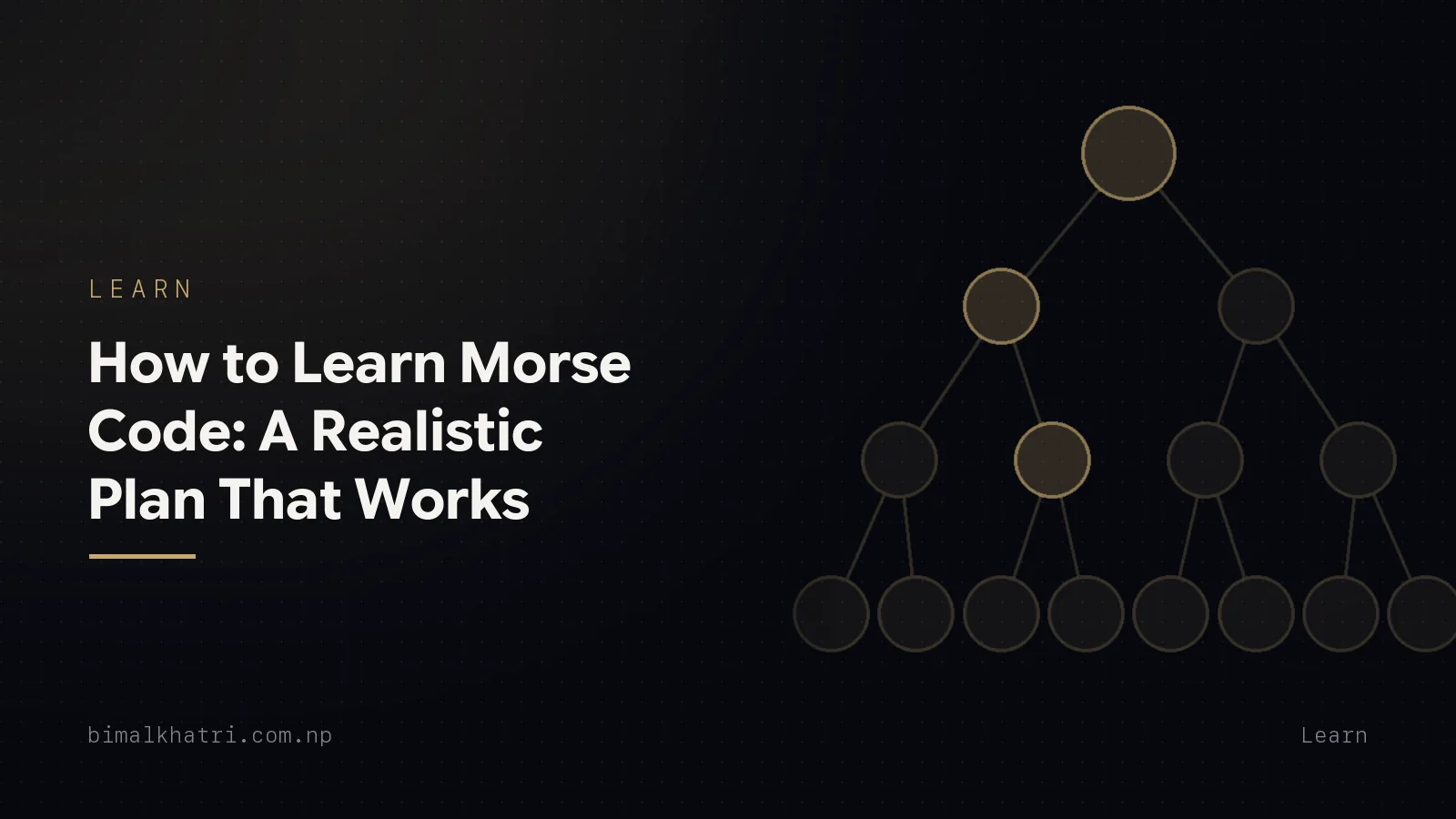
This is the Koch method, from Ludwig Koch, a German psychologist working in the 1930s. It is about which characters, in what order, and when to add the next one — nothing else.
The rules are short:
- Begin with exactly two characters, sent at your full target speed.
- Practise only those two until you copy them at 90% accuracy.
- Then add one more. Never two.
- The speed never drops. If you are struggling, you add characters more slowly, you do not slow the code down.
The traditional first pair is K and M:
| Character | Code | Said aloud |
|---|---|---|
| K | -.- | dah-di-dah |
| M | -- | dah-dah |
They are deliberately similar. Both open with a dash, so guessing by length does not work and you are forced to hear the shape.
Here is a lesson-one stream you can paste into a translator and play back:
-.- -- -.- -.- -- -.- -- -- -.- --Listen, write letters on paper, then check. Count the errors. Under one in ten, add the next character. Over one in ten, run it again tomorrow.
The next characters in the usual order:
| Order | Character | Code |
|---|---|---|
| 1 | K | -.- |
| 2 | M | -- |
| 3 | R | .-. |
| 4 | S | ... |
| 5 | U | ..- |
| 6 | A | .- |
| 7 | P | .--. |
| 8 | T | - |
The order is not alphabetical on purpose. It mixes confusable pairs early so that discrimination is trained rather than avoided.
Step 3: Stretch the gaps, not the characters
The second thing you will read about is the Farnsworth method, and almost every page online frames it as the rival to Koch. That framing is wrong, and knowing why will save you a lot of confusion.
- Koch changes which characters you learn and when. Speed stays at target.
- Farnsworth changes the spacing between characters and words. Each character is still sent at full speed; the silence around it is stretched.
They change different variables, so they combine, and the combination is the standard recommendation. "Koch or Farnsworth" is the wrong question: see Koch vs Farnsworth for the long version.
In practice: send the characters at your target (18 WPM, say, which is a 67 ms dot), but pad the gaps until the overall text rate is 5 WPM. The letter K sounds exactly as it will at speed. The gap after it stretches from 200 ms to about a second and a half, which is all the room you need to write it down.
As you improve, take the padding out. Shrink the gaps back toward the real 3 units between characters and 7 between words. The characters themselves never change, which is the entire point: you are never re-learning a sound you already know.
Step 4: Fifteen minutes a day beats two hours a week
Morse is motor learning, closer to a musical instrument than to vocabulary. It consolidates between sessions, so frequency matters far more than session length.
A session that works:
- 2 minutes. Warm up on characters you already own. No new material.
- 10 minutes. The current Koch set, in random order, written down on paper.
- 3 minutes. Score it honestly. Note which two characters you actually miss.
Two of those a day is better than one of forty minutes. If you miss a day, do not make it up with a double session: just do the next one.
Write with a pencil, not a keyboard, and write one character behind. Hear a character, start writing it while the next one is already playing. That lag feels wrong for about a week and then becomes the thing that lets you copy at speed. More drill formats are in Morse code practice.
Step 5: Copy real words as soon as you can
Once you have six to eight characters, stop copying random letters and start copying words made from them. Words carry rhythm and context, and your brain starts predicting, which is what fluency actually is.
With K, M, R, S, U, A, P and T you already have plenty:
.--. .- .-. -.- / ... - .- .-. / -- ..- ... - / ... -- .- .-. -That is PARK STAR MUST SMART. Notice the / between words: a 7-unit gap,
long enough to be obvious once you stop counting.
I built MorseLab around exactly this progression, because I got tired of drilling from a paper chart and a metronome: the Koch lessons add one character at a time at full speed, the spacing is adjustable, and the drills, games and quizzes score you so you know when 90% is real rather than a feeling. It runs offline, so a bus with no signal is a practice session.
Step 6: Add the parts nobody drills
Letters are the easy half. What separates someone who has "done a course" from someone who can copy real traffic is everything else.
Digits. Five elements every time, and they follow a pattern. 1 to 5 add dashes from the right, 6 to 0 mirror it with dots:
.---- ..--- ...-- ....- .....
-.... --... ---.. ----. -----
Punctuation. Sixteen marks are in the standard. In practice you need the
full stop .-.-.-, the comma --..--, the question mark ..--.. and the
slash -..-. first. The rest can wait. There is a full breakdown in
numbers and punctuation.
Prosigns. These are procedure signals sent as one unbroken run with no
letter gaps inside them: AR .-.-. ends a message, BT -...- marks a break,
SK ...-.- ends a contact, and eight dots ........ means "ignore my last
word". Learn the error signal early. You will need it.
SOS. It belongs here rather than with the letters, because it is a prosign
too: ...---..., sent as one continuous nine-element run with no letter gaps
inside it. Sent as the three separate letters ... --- ... it is a different
signal. And it does not stand for "Save Our Souls" or "Save Our Ship": those
are backronyms invented after the fact. It was chosen because the pattern is
unmistakable and easy to send. The full story is here.
A realistic timeline
No honest plan gives you dates, because the variable is how many sessions you run, not how many weeks pass. What a plan can give you is a finish line for each stage.
| Stage | What you can do | Move on when |
|---|---|---|
| The chart | Look up any letter and write it as dots and dashes | You can write a short word without checking. One afternoon |
| First pair | Copy K and M by ear at full character speed | 9 out of 10 correct across 50 characters |
| Eight characters | Copy short words with stretched spacing | You write without pausing to think per character |
| All 26 letters | Copy plain English at a slow overall rate | A full sentence with no gaps in your writing |
| Digits, punctuation, prosigns | Copy callsigns, times and real messages | Numbers stop making you flinch |
| Normal spacing | Farnsworth padding removed, 3 and 7 units | You copy at your character speed |
| Head copy | Hear words instead of letters, pencil down | You stop writing because you no longer need to |
Getting to that last row takes weeks of daily practice for most people, and longer for many. Anyone promising a number is guessing. What is reliably true is that people who practise briefly every day get there and people who binge occasionally do not.
Practising when you cannot make noise
Sound is the main channel, but it is not the only one, and the alternatives are genuinely useful when you are on a bus or sharing a room.
- Light. A phone torch blinking dots and dashes is a real signalling method, and it trains the same timing. See Morse with a flashlight.
- Touch. Vibration and tapping work at short range and are silent. Try tapping and vibration.
- Decoding. Pointing a microphone at a beeping signal and reading the text back is a good way to check your own sending. That is what a decoder does.
- Testing. Score yourself deliberately rather than by feel with a quiz.
Your own name is a good first sending exercise, because you will repeat it thousands of times if you ever get on the air: write your name in Morse.
Common mistakes
Studying the chart instead of the sound. The single biggest one. The chart is a reference, not a course.
Slowing the characters down. Slow characters teach a rhythm that does not exist at speed. Stretch the gaps instead. That is the whole reason Farnsworth spacing exists.
Counting dots. If you catch yourself counting, the code is too slow, not too fast. Speed the characters up and pad the spacing.
Adding characters too fast. 90% accuracy is the gate. Adding a ninth character while the seventh is still shaky does not save time.
Writing dots and dashes on paper, then decoding later. It feels productive and it builds the wrong loop. Write letters.
Practising once a week. Two hours on a Sunday loses to fifteen minutes a day, because the consolidation happens between sessions.
Treating Koch and Farnsworth as a choice. They are different variables. Use both.
Believing the "learn it in a day" pages. You can learn the chart that fast. Copying by ear is a different thing, and the honest answer is here.
Questions people ask
How long does it take to learn Morse code?
Memorising the chart takes an afternoon. Copying by ear at a useful speed takes weeks of daily practice, and how many weeks depends almost entirely on how consistent you are. Fifteen minutes every day will beat any amount of weekend cramming.
Can I learn Morse code in a day?
You can learn what every character looks like in a day. You cannot learn to hear them in a day, because that is motor learning and it needs sleep between sessions. Anyone selling a one-day fluency claim is describing the chart, not the skill.
What speed should I start at?
Start with the characters at the speed you want to finish at, commonly 20 WPM, which is a 60 ms dot. Make it manageable by stretching the gaps between characters rather than slowing the characters themselves.
Should I use the Koch method or the Farnsworth method?
Both. Koch decides which characters you learn and when you add the next one. Farnsworth decides how much silence sits between them. They control different things, so they stack.
Do I have to learn the alphabet chart first?
No, and it is better if you do not sit and memorise it. Look characters up when you want to, but do your actual learning by ear from the first session. The chart is most useful afterwards, for writing Morse down.
How many characters should I add per session?
At most one, and only after you copy the current set at 90% accuracy. Some days that means adding none. That is the method working, not failing.
Do I need a radio or a licence to learn?
No. Learning and practising need nothing but a way to make a sound, a light or a buzz. A licence is only needed to transmit on amateur bands, which is a separate step you can take later if you want to get on the air with CW.
Can children learn it the same way?
The method is the same but the sessions have to be shorter and framed as games. Signalling with a torch across a dark garden teaches timing better than any drill sheet. There is a version of this plan for kids and scouts.
Get it: MorseLab — free on iPhone and Android. The link opens your own app store.
Keep reading
- Can You Learn Morse Code in a Day? — the honest answer, with what is genuinely possible in 24 hours.
- Koch vs Farnsworth — why the comparison is the wrong question.
- Reading Morse by Sound — how to stop counting and start hearing.
- Morse Code Practice — drill formats that train ears rather than eyes.
- Timing and WPM — the 1:3:7 ratio and the PARIS standard in full.