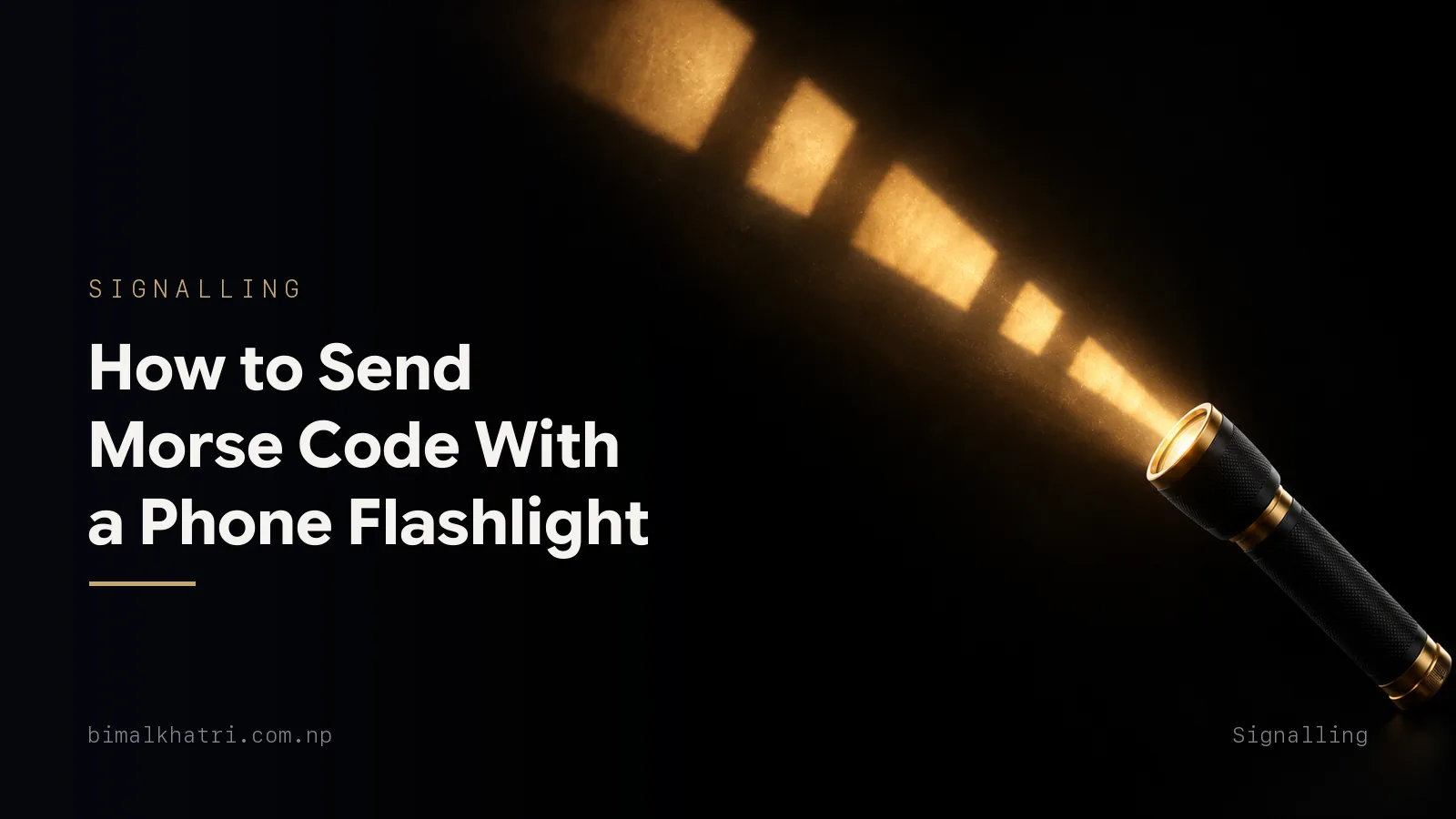
A short flash is a dot. A flash three times as long is a dash. The light is off for one dot's length between flashes inside a letter, three dot lengths between letters, and seven between words. That is the whole method, and it is the same code you would send as a tone or a buzz.
The only real decision is how long a dot should be. Pick one second. A one-second dot makes the dash three seconds, and you can hold both without a metronome. It works out at 1.2 words per minute, which is slow, and slow is correct when a stranger across a valley is trying to decide whether your window is blinking on purpose.
Everything after that is technique: whether to tap the torch button, cover the lens with your hand, or use the whole screen as the lamp. That depends on your phone and your distance, and it is where the practical difference lives.
Want to hear it, not just read it? MorseLab plays any text back as tone, flash or vibration, free and offline.
The four lengths, and nothing else
Morse has two marks: a dot . and a dash -. Operators say them aloud as "dit"
and "dah", which is closer to how they sound. Written down, letters are
separated by a single space and words by a slash, so .... . .-.. .--. / -- .
is HELP ME. Type them with a full stop and a hyphen from your keyboard. A
middot or an em dash out of a word processor looks identical and breaks in every
translator.
Everything is measured in units, where one unit is the length of a dot.
| Element | Light | Units | At a one-second dot |
|---|---|---|---|
| Dot | on | 1 | 1 s |
| Dash | on | 3 | 3 s |
| Gap between flashes inside a letter | off | 1 | 1 s |
| Gap between letters | off | 3 | 3 s |
| Gap between words | off | 7 | 7 s |
A dash is not "a bit longer" than a dot. It is exactly three times as long. Hold that ratio and any speed reads; lose it and no speed does.
The half people forget is the dark. The gaps are not pauses for breath, they are part of the message. A light that goes on and off at one steady rate carries no information at all, however long you keep it up. What a watcher reads is the difference between short and long, and the difference between a small gap and a big one. Morse code timing and WPM works the ratio through in full.
Choosing a dot length you can hold
Speed is measured in words per minute against the reference word PARIS, which including the gap that follows it is exactly 50 units long. One formula covers all of it:
Dot length in seconds = 1.2 ÷ WPM.
Turned round for hand sending: your speed is 1.2 divided by your dot in seconds.
| Dot | Dash | Letter gap | Word gap | Speed |
|---|---|---|---|---|
| 1 s | 3 s | 3 s | 7 s | 1.2 WPM |
| 0.5 s | 1.5 s | 1.5 s | 3.5 s | 2.4 WPM |
| 0.25 s | 0.75 s | 0.75 s | 1.75 s | 4.8 WPM |
| 0.12 s | 0.36 s | 0.36 s | 0.84 s | 10 WPM |
By hand, the bottom two rows are fiction. A phone torch is switched by software, not by a mechanical contact, and the delay between your finger and the light is small but real and different on every phone. Under about half a second per dot, your dots and your dashes start to blur into each other and the receiver gets nothing. Test yours: film the light with a second phone and watch it back.
For signalling to a person, a one-second dot is the right answer almost every time. Nobody is judging your speed. They are judging whether the pattern is deliberate.
SOS, flash by flash
SOS is ...---... — three dots, three dashes, three dots, sent as one unbroken
run with no letter gaps inside it. It is a prosign, not the three letters S, O
and S, and it does not stand for "Save Our Souls" or anything else. Those are
backronyms fitted to it afterwards. The pattern was chosen because it is
unmistakable and easy to send.
Copy this:
...---...With a one-second dot, that is exactly this sequence, and it takes 23 seconds:
- On 1 s, off 1 s, on 1 s, off 1 s, on 1 s. Three dots.
- Off 1 s.
- On 3 s, off 1 s, on 3 s, off 1 s, on 3 s. Three dashes.
- Off 1 s.
- On 1 s, off 1 s, on 1 s, off 1 s, on 1 s. Three dots.
Then stop. Leave the light off long enough that the pause is obviously bigger than anything inside the signal (seven seconds of stillness, a full word gap, does it at this speed), and send it again. Keep repeating for as long as there is any chance of being seen. One SOS sent once is a coincidence. The same 23 seconds repeating on a loop is a person.
Do not open wider gaps between the groups. ... --- ... with three-unit letter
gaps is the letters S, O and S, which is a different transmission. On paper the
spaced version is easier to read and most charts print it that way, so both
forms are everywhere. SOS in Morse code goes through
the difference and the myth in detail.
What a longer message actually costs
Spelling things out by light is slower than people expect, because a message is mostly gaps. Count the units and you can price any message before you start.
| Message | Code | Units | 1 s dot | 0.5 s dot | 0.25 s dot |
|---|---|---|---|---|---|
| SOS | ...---... | 23 | 23 s | 11.5 s | 5.8 s |
| OK | --- -.- | 23 | 23 s | 11.5 s | 5.8 s |
| NO | -. --- | 19 | 19 s | 9.5 s | 4.8 s |
| YES | -.-- . ... | 25 | 25 s | 12.5 s | 6.3 s |
| HELP | .... . .-.. .--. | 37 | 37 s | 18.5 s | 9.3 s |
| HELP ME | .... . .-.. .--. / -- . | 55 | 55 s | 27.5 s | 13.8 s |
That table is the argument for SOS. HELP ME takes nearly a minute at hand speed, needs the watcher to know the alphabet, and gives them six chances to lose the thread. SOS takes 23 seconds and is recognised by people who have never learned a character of Morse in their lives.
Save the spelling for when you have already been noticed and want to say something. Ready-made ones worth having:
--- -.-.-- .- - . .-..... . .-.. .--. / -- .Those are OK, WATER and HELP ME. More of them are collected in hello, help and thank you in Morse code.
Torch, screen flash, or your hand over the lens
Three ways to make a phone blink, and they are not interchangeable.
| Method | Beam | Best at | Cost |
|---|---|---|---|
| Torch LED | Narrow and bright | Distance, aiming at one point | Heaviest on battery |
| Full white screen | Wide and dim | Close range, indoors, showing where you are | Moderate |
| Torch on, hand over the lens | Whatever the torch gives | Clean, fast, controllable edges | You must hold the phone steady |
The third one is the trick worth knowing. Switch the torch on and leave it on, then open and close your other hand over the lens. Your hand is faster and more precise than the software toggle, you get a hard edge at both ends of every flash, and you are not asking the phone to switch a bright LED hundreds of times. Sending Morse from behind glass, from inside a car, or with cold fingers, this is the method that works.
The screen flash is underrated for the opposite job. It is dimmer, but it is a wide soft glow rather than a beam, so it lights up your face, your window or the wall behind you. Close up, in a stairwell or a collapsed room, being visible matters more than being bright, and a wide dim source beats a narrow hard one.
I built MorseLab because the timing is the part a hand cannot
hold. You type the text, pick a speed, and it drives the flashlight or the whole
screen at a correct ratio, so the dots and dashes stay in proportion when you
are cold, tired or frightened. The SOS beacon repeats ...---... on its own
without you counting anything. It also plays as a tone or vibration, translates
both ways, and teaches the code with Koch-method lessons. It runs offline with
no account, which is the only condition that matters if you ever need it
somewhere without a signal.
Getting seen at all
Aim matters more than brightness. A phone torch is a bare LED with almost no reflector behind it, so the beam spreads quickly and gets weak fast. Point it at the person, the road or the ridge you want to reach, and hold it there. Waving it around loses more than it gains.
A light is detectable much further away than the distance at which it lights anything up. In real darkness, with a clear line of sight, your torch is useless for seeing but visible from a long way off. That asymmetry is the whole reason light signalling works.
Some things that help, in rough order of value:
- Get high, get clear. One obstruction between you and the watcher and nothing else you do matters.
- Blink, do not shine. A steady light in a landscape with any other lights in it reads as a house or a car. A repeating pattern reads as a person.
- Aim from a rest. Prop the phone or brace your wrist. A wobbling beam at distance flickers on its own and hides your gaps.
- Repeat on a rhythm. Same message, same speed, same pause between repeats. Regularity is what marks it as intentional.
- In daylight, stop. A phone torch is close to invisible in sunlight. Use sound, a mirror, or bright cloth instead, and save the battery for dark.
Do not shine it into anyone's eyes at close range, including your own. A modern phone torch is genuinely dazzling, and dazzling the person looking for you is not a good outcome.
Reading a light back
Copying flashes is harder than sending them, for one reason: you have to watch the dark as carefully as the light.
Write dots and dashes as you see them, not letters. Trying to convert in your
head while the sender is still going is how people lose the message. Keep a
single line of . and - on paper, mark the letter gaps with a space and the
word gaps with a slash, and translate afterwards, with the alphabet
chart beside you.
If you lose the thread, do not chase it. Wait for the next repeat. Anyone signalling seriously will send the same message again, and a clean copy of the second attempt beats a mangled reconstruction of the first.
Two conventions worth knowing if you are answering. .-.-. is AR, end of
message. Eight dots in a row, ........, is the error signal: disregard the last
word, I am starting it again. Both are prosigns, sent as one run without letter
gaps, and both are useful even between two people with a torch each.
There is a shortcut for reading a light you cannot keep up with: record it. Point a camera at the source, film the whole transmission, and play it back slowly. The pattern that was too fast live is easy to count at half speed, and you can watch it more than once.
Numbers, names and other slow things
Digits are five elements each, every time, which makes them long. The pattern is easy: 1 to 5 add dashes from the right, and 6 to 0 mirror it, adding dots from the right.
| Digit | Code | Units | Digit | Code | Units |
|---|---|---|---|---|---|
| 1 | .---- | 17 | 6 | -.... | 11 |
| 2 | ..--- | 15 | 7 | --... | 13 |
| 3 | ...-- | 13 | 8 | ---.. | 15 |
| 4 | ....- | 11 | 9 | ----. | 17 |
| 5 | ..... | 9 | 0 | ----- | 19 |
A zero is 19 units and a five is 9, so by torch at a one-second dot they take 19 seconds and 9 seconds. Sending a six-digit number that way comes to about 100 units, which is a minute and a half of standing still with your arm up. If a number has to go, send it twice and expect to send it a third time.
Names are the other common ask, usually for a photo or a tattoo rather than a transmission, and light is a fine way to test one before it becomes permanent. How to write your name in Morse code covers the letter-by-letter part.
Common mistakes
The dash is too short. This is the one that ruins nearly every homemade light signal. A dash that is only a little longer than a dot turns your message into a row of identical blinks. Three times as long, and make it obvious.
No gaps between letters. People run letters together because it feels faster. It is not faster, it is unreadable. Three units of dark between letters, seven between words, counted the same way as the flashes.
Sending SOS as three letters. ...---... is one unbroken run. Putting
letter gaps in it makes it S, O, S, which is not the distress prosign.
Sending once and waiting. A single 23-second signal in a dark landscape will be missed. Repeat it, on a rhythm, for as long as you can.
Speeding up when nobody answers. Faster is not louder. If you are not being read, slow down and make the dash longer.
Flattening the battery. The torch is one of the hungriest things on a phone. If that phone is also how you would call for help the moment a signal appears, do not leave a beacon running unattended overnight. Signal in bursts, and check your battery between them.
Using it instead of a phone call. If you have any signal at all, call or text first. Light is what you use when the network is not there.
Questions people ask
How do I send Morse code with a phone flashlight?
Short flash for a dot, a flash three times as long for a dash, light off for one dot's length between flashes inside a letter, three between letters and seven between words. Use a one-second dot to start. Type the message, work out the dots and dashes, and send it slowly. Speed helps nobody here.
How do I send SOS with a flashlight?
Three short flashes, three long ones, three short ones, with no extra gap between the groups. At a one-second dot the whole thing takes 23 seconds. Pause for seven seconds, a full word gap, and send it again, over and over.
How long should each flash be?
Whatever you can hold steadily, as long as the dash is exactly three times the dot. One second and three seconds is the easiest pair to keep honest by hand. In formal terms your dot in seconds is 1.2 divided by your speed in words per minute, so a one-second dot is 1.2 WPM.
Is the screen flash better than the torch?
For distance, no: the torch is far brighter and more directional. For close range, indoors, or making yourself visible rather than reaching somebody far away, the full white screen is often better because it is wide and soft. Many phones can do either.
Can my phone flash Morse code automatically?
Yes, with an app that drives the torch. That removes the timing problem, which is the part people get wrong, and it lets you send at a speed no hand can hold. It also keeps a beacon repeating while you use your hands for something else.
Can an app read a blinking light back into text?
Not the way it reads sound. Decoder apps listen for a beep through the microphone; watching a light through a camera lens is a different job, and reading a flash is still a human one. The practical workaround is to film the light and replay it slowly.
How far away can a phone flashlight be seen?
In real darkness with a clear line of sight, much further than it lights anything up, which is the useful part. Haze, rain and any obstruction cut it hard, and in daylight it is close to useless. Height and a clear line matter more than brightness.
Will anyone actually recognise the signal?
...---... is the one pattern a stranger might identify with no chart in front
of them. Anything else you spell out needs a receiver who knows the alphabet.
That is why the answer to "what should I send" is almost always SOS first, and
words afterwards once somebody is watching.
Does this work the same with vibration or tapping?
Yes. The code and the ratio are identical, only the medium changes. Tapping is the awkward one because a knock has no length, so people use two different sounds instead of two lengths. Sending Morse by tapping, knocking and vibration covers it.
Get it: MorseLab, free on iPhone and Android. The link opens your own store.
Keep reading
- SOS in Morse Code: The Signal, the Spacing, and the Myth
- Sending Morse Code by Tapping, Knocking and Vibration
- Morse Code Timing and WPM: The 1:3:7 Ratio and the PARIS Standard
- The Morse Code Alphabet Chart: Every Letter, Number and Punctuation Mark
- Hello, Help and Thank You in Morse Code: Phrases You Can Copy