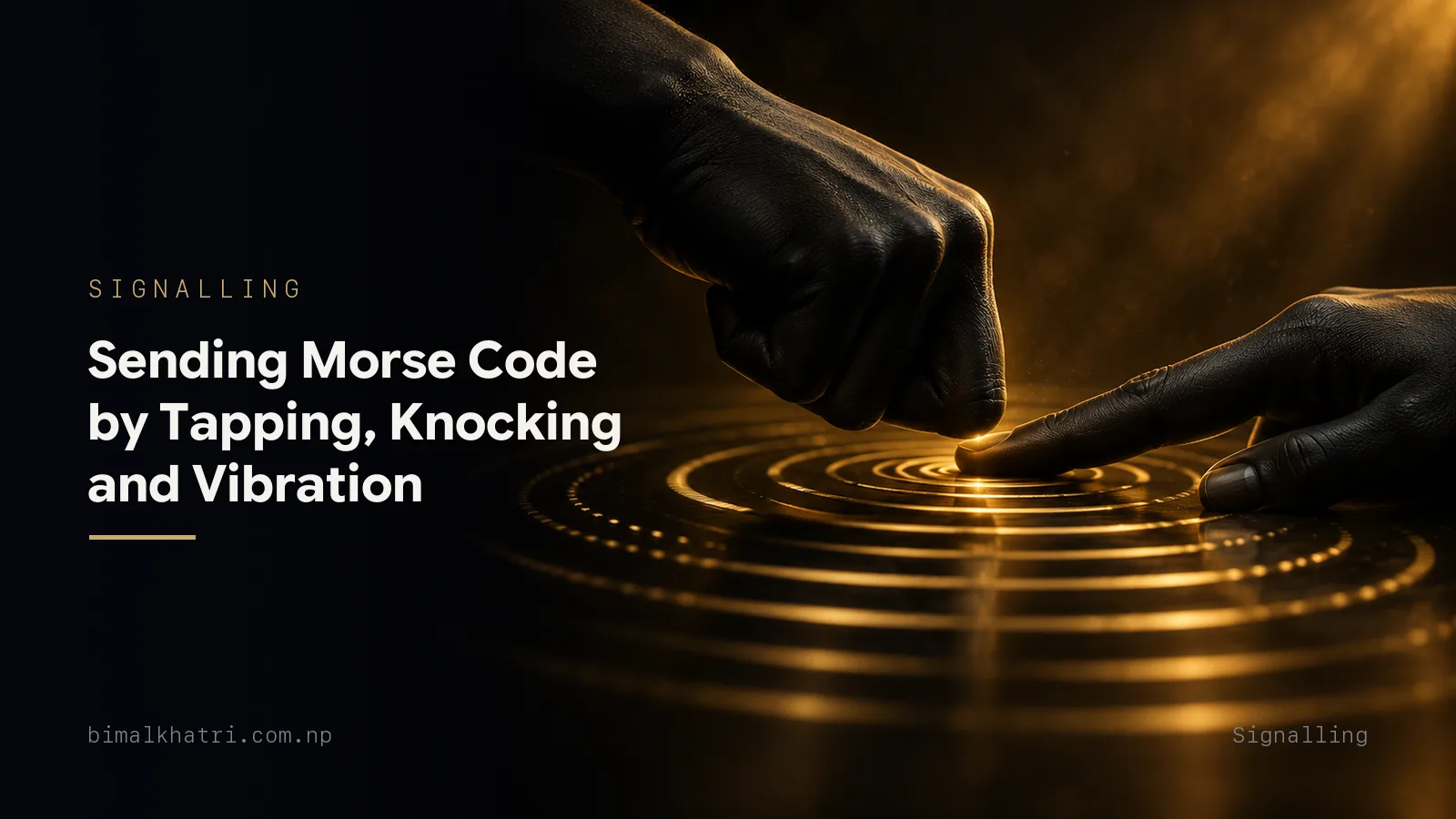
You can send Morse code by tapping, and the code itself does not change. A dot is still a dot and a dash is still a dash. What changes is how you make the two different, because a knock is a hit. It starts and stops in the same instant, so you cannot hold one three times as long and expect anyone to notice.
So tapping needs a second signal. Use a fingertip for the dot and a knuckle for the dash, or a tap for the dot and a fingernail dragged across the surface for the dash. Pick one pair, tell the other person which is which, and make the gaps between characters long and obvious.
Vibration is the easy case. A buzz does have a length, so a phone can send the real timing (short buzz, long buzz, and silences in the correct proportions), and you read it with your hand instead of your ears.
Want the sound? MorseLab will play any text back as tone, flash or vibration, free and offline.
Why a knock cannot be a dash
Everything in Morse is measured in units, where one unit is the length of a dot. A dash is 3 units. The gap between elements inside one character is 1, the gap between characters is 3, and the gap between words is 7. The whole code is that one ratio: 1 : 3 : 1 : 3 : 7.
A tone can do it easily. Hold a beep for 240 milliseconds, then hold the next one for 720, and anybody can hear which was which. A knock cannot. Hitting a table harder makes it louder, not longer. There is no such thing as a slow knock. The sound is finished before you can stretch it.
That is why every method that actually works replaces length with something else the listener can tell apart:
- two different sounds, one for the dot and one for the dash
- a hit for the dot and a sustained noise for the dash
- a touch for the dot and a press held down for the dash
Written down, nothing changes. A dot is . and a dash is -, letters are
separated by a space and words by /, so .... .. is HI as two letters. The
chart is the same one you would use for sound or light, and it is set out in
full in the alphabet chart.
Four ways to make a dash out of a tap
| Method | Dot | Dash | Best for | Weak point |
|---|---|---|---|---|
| Soft and hard | fingertip pad | knuckle | tables, doors, pipes, walls | needs a hard surface, and the two hits must really sound different |
| Tap and scrape | short tap | fingernail dragged for three counts | a desk, a metal rail, a window | a scrape is quiet, and thick walls swallow it |
| Touch and hold | quick touch | press held for three counts | skin, a phone screen, a button, a switch | no use at all if the other person can only hear you |
| One tap and two | one tap | two fast taps | any surface, nothing to agree in advance | the two taps can read as two dots unless the gaps are exaggerated |
The first two are the ones to learn. Soft and hard is the fastest to send and the easiest to hear through a wall. Tap and scrape is the most honest, because the scrape genuinely lasts longer, which means the rhythm you send is the real Morse rhythm rather than a substitution.
Touch and hold is the best of all of them when you can reach the other person, and it is what your phone is doing when it vibrates: a short buzz and a long buzz, exactly as the standard describes.
The double tap is the one to avoid unless you have no choice. A dash made of two
taps competes with the letter I .., which is genuinely two dots, and the only
thing separating them is how long the gap between the taps was. That is a lot to
ask of a stranger in a noisy corridor.
Whichever pair you choose, agree it before you start and never switch halfway. Switching to be "clearer" is what breaks a tapped message: the receiver is still decoding the pair you began with.
The timing still has to be right
Slowing down does not let you off the ratio. If the dot is 400 ms then the dash is 1,200 and the gap between characters is 1,200 as well, and if you fudge those the message turns into an unbroken run of taps.
Dot length in seconds is 1.2 divided by the speed in words per minute. Taps are slow by nature, so 3 to 8 WPM is the realistic range. Here is the arithmetic for three speeds you might actually use.
| Element | Units | 3 WPM | 5 WPM | 8 WPM |
|---|---|---|---|---|
| Dot | 1 | 400 ms | 240 ms | 150 ms |
| Dash | 3 | 1,200 ms | 720 ms | 450 ms |
| Gap inside a character | 1 | 400 ms | 240 ms | 150 ms |
| Gap between characters | 3 | 1,200 ms | 720 ms | 450 ms |
| Gap between words | 7 | 2,800 ms | 1,680 ms | 1,050 ms |
You are not going to time yourself with a stopwatch, so count instead. Count "one" for a dot and "one two three" for a dash at a steady pace, and use the same count for the gaps. At a comfortable counting speed of roughly one number every 400 ms you are sending at about 3 WPM, which is slow enough for someone who has never heard Morse before.
There is one legitimate cheat. You may stretch the gaps between characters and words further than 3 and 7 units without touching the characters themselves. That is Farnsworth spacing, and it is the single most useful adjustment for tapping, because it gives the person on the other side time to write a letter down before the next one starts. It is often set against the Koch method as if you had to choose, which is a misunderstanding: Koch decides which characters you learn and in what order, at full speed from the start, while Farnsworth decides how much silence sits between them. They change different things, so they work together. The longer comparison covers why the "which is better" question has no answer, and the full timing arithmetic is worked out separately.
Copying a message someone taps to you
Do not try to hear whole letters at this speed. Tapping is slow enough that counting works, so use it.
- Write raw dots and dashes as they arrive, nothing else.
- Leave a bigger space on the paper whenever the taps stop for a long moment.
- Decode at the end, once the message is finished.
This is the opposite of how you learn to copy Morse by ear at speed, where counting is a habit that has to be broken. At 3 WPM there is a 1.2 second hole between characters, and you should use it.
If you send a wrong letter, send the error prosign: eight dots, run together with no gaps between them:
........Then send the whole word again. It is a real procedure signal, it is unmistakable when tapped, and no letter or number is eight dots, so it cannot be confused with anything else.
Tapping SOS
SOS is the one pattern worth knowing before anything else, and the one most often written down wrong. It is a prosign, which means it is sent as a single unbroken run of nine elements with no letter gaps inside it:
...---...Not this, which is the three separate letters S, O and S:
... --- ...Tapped, that means three quick taps, three heavy taps, three quick taps, all running together at the same steady pace, then a clear pause, then the whole thing again. Do not pause between the groups. The unbroken run is what makes it recognisable.
At 5 WPM the prosign is 23 units long, so 5.5 seconds. Sent as three separate letters it is 27 units, or 6.5 seconds, because the two gaps inside it grow from 1 unit to 3. That second version is a different signal, and it is the one you will usually see written down.
SOS was chosen because the shape is unmistakable and easy to send. It does not stand for "Save Our Souls" or "Save Our Ship": both of those were invented afterwards to explain the letters. The full story goes into where it came from.
One practical note. If you are knocking on a wall to be found, the pattern matters more than perfect Morse, because a repeating, deliberate rhythm is what tells a listener that a person is making it rather than a building. Send the same nine taps, the same way, with the same pause, over and over. A regular pattern is what gets noticed.
Vibration: where Morse works properly again
A vibration motor can be switched on and off, which means it can produce a real short and a real long. The ratio needs no substitution at all, and the message arrives through skin rather than sound, so it works in a pocket, in the dark, in a loud room, or when you cannot look at a screen.
Two things go wrong in practice.
A motor takes a moment to start and to stop. At fast speeds a 60 ms dot never reaches full strength before it is cut off, and the trailing buzz runs into the next element. Keep vibration slow. Around 5 WPM — a 240 ms dot and a 720 ms dash — is comfortable to feel, and going much above 10 WPM turns the whole message into a blur.
The second problem is that people forget the silences are part of the code. A buzz followed by nothing feels like the message has stopped, so the natural instinct is to shorten the gaps. Do not. The gap between characters is 3 units and between words 7, and if you cut them the receiver gets one long word of dots and dashes with no letter boundaries in it.
I built MorseLab partly for this, because feeling the rhythm is much faster than reading about it. Type a word, play it back as vibration, and hold the phone in your hand while you tap the same word out on a table with the other one. Once your hand knows the difference between a 1-unit gap and a 3-unit gap, tapping stops being guesswork. The app plays the same message as a tone, a flashlight blink or a full-screen flash as well, and it has an SOS beacon that repeats the pattern on its own.
Vibration is also how Morse survives on modern phones as an accessibility feature: Morse input exists as a switch-access method on the mainstream mobile platforms, so someone who can make one reliable movement can type with a short press and a long press. That is the same touch-and-hold pair from the table above, doing a real job. More of that in is Morse code still used.
Tapping on a hand or an arm
Sending to a person you can touch is easier than sending through a wall, because touch gives you back the long signal a knock cannot make.
Use one fingertip. A quick tap is the dot. A press held down for three counts is the dash. Lift your finger clear between elements so the gaps are felt as absence, not as a lighter press. Choose one spot — the back of the hand or the inside of the forearm works well — and stay there, because moving around adds information the receiver has to ignore.
Alternatively, tap for the dot and stroke for the dash: drag your fingertip a few centimetres for the count of three. It is more distinct than a press and easier for a beginner to read.
Between characters, rest your hand flat and still for the full 3 counts. Between words, lift your hand off entirely for 7. The lift is the clearest word gap there is.
The "tap code" is a different code
If someone tells you prisoners communicated by tapping on cell walls, they may not mean Morse at all. There is a separate system usually called the tap code, built on a 5 by 5 grid of the alphabet with C and K sharing a square. You send a letter as two bursts of taps: the row, a pause, then the column. So a letter in row 2, column 4 is two taps, pause, four taps.
It exists because it solves exactly the problem this page opened with. Every signal is a plain knock, so nothing has to be long, and nothing has to sound different from anything else. The cost is that it takes far more taps per letter and you must memorise the grid.
It is not Morse and the two do not mix. If you agree to tap with someone, say which one you mean.
Words to practise
Start with characters made of few elements, because they are quick to tap and quick to count. Copy this and send it slowly:
. - .- -. .. --That is E, T, A, N, I and M. Now real words built only from those six:
.- - / - . .- / -- . .- - / -. .- -- . / -- .. -. .AT, TEA, MEAT, NAME, MINE. Then the messages people actually tap:
.... . .-.. .--.HELP. At 5 WPM that word is 37 units, so just under 9 seconds of tapping.
.- .-. . / -.-- --- ..- / --- -.-ARE YOU OK.
.. / .- -- / .... . .-. .I AM HERE.
--- .--. . -. / - .... . / -.. --- --- .-.OPEN THE DOOR. More ready-made ones are collected in common words in Morse code.
Common mistakes
Sending a dash as a longer knock. It does not exist. Change the sound, the contact or the length of contact, not the force.
Swapping methods mid-message. Soft-and-hard for one word and double-taps for the next is unreadable. Agree one pair and keep it.
Cutting the gaps. The silences carry as much information as the taps. If the gap between characters is not clearly three times the gap inside a character, nothing can be decoded, however clean your dots were.
Speeding up because it feels slow. Tapped Morse is slow. Sending at 3 WPM that arrives is better than sending at 10 that does not.
Treating SOS as three letters. It is one unbroken prosign, ...---....
Pausing between the groups makes it a different signal.
Expecting to read taps by ear straight away. You can memorise the chart in a day. Recognising characters without counting takes weeks of daily practice, and no honest page will give you a number. The realistic version is worth reading before you promise anyone anything.
Questions people ask
How do you tap Morse code?
Use two clearly different taps: a fingertip for the dot and a knuckle for the dash, or a tap for the dot and a fingernail scrape for the dash. Keep the rhythm steady, leave three counts of silence between characters and seven between words, and send slowly, around 3 to 5 words per minute.
How do you tap SOS?
Three quick taps, three heavy taps, three quick taps, with no pause between the
groups, then a clear silence, then repeat. It is one unbroken prosign,
...---..., not the three letters ... --- ....
Can you send Morse code by vibration?
Yes, and it is the most accurate way to do it without sound, because a buzz can genuinely be short or long. Keep it slow — a 240 ms dot at 5 words per minute feels right — because a vibration motor takes a moment to start and stop and fast dots blur together.
What is the difference between the tap code and Morse code?
The tap code is a separate system that sends each letter as a row number and a column number on a 5 by 5 grid, using nothing but plain equal taps. Morse uses dots and dashes and needs two distinguishable signals. They are not compatible.
How fast should I tap Morse code?
Between 3 and 8 words per minute. That gives a dot of 400 ms down to 150 ms. Slower is fine and often better, especially through a wall, where the surface blurs everything.
How do you tap Morse code on someone's hand?
Tap once for a dot and hold your finger down for a count of three for a dash, or tap for the dot and stroke a few centimetres for the dash. Lift your hand fully between words. Stay on one spot on the skin so the receiver only has to track timing.
Can I use tapping to learn Morse code?
It helps with sending and it does very little for receiving. Tapping trains your hand to produce the 1 : 3 : 1 : 3 : 7 rhythm, which is real progress, but reading Morse at any useful speed is an ear skill. Pair it with listening practice from the start: how to learn Morse code sets out the order.
Do I need an app to tap Morse code?
No. Your hand and a table are enough, and so is the chart. An app helps in two places: it plays a message back as vibration so you can feel correct timing rather than guess it, and it decodes a tone so you can check what you actually sent. If you would rather signal with light, the flashlight method covers that separately.
Get the app: MorseLab, free and offline, on iPhone and Android.
Keep reading
- Morse Code Flashlight — the same signalling problem, solved with light instead of sound.
- SOS in Morse Code — the prosign, the spacing, and the myth about what it stands for.
- Timing and WPM — the 1:3:7 ratio and the PARIS standard in full.
- Common Words in Morse Code — ready-made strings you can copy and send.
- Morse Code for Kids and Scouts — tapping games that teach the rhythm without a lesson.