Morse code writes every letter, number and punctuation mark as a pattern of two signals: a short one, the dot, and a long one, the dash. There are 26 letters, ten digits, and a set of punctuation marks and symbols. That is the whole system. Learn the patterns and you can write anything in it.
Everything below is International Morse code, the version set out in ITU-R Recommendation M.1677-1. An older "American" or railroad Morse also existed, with gaps inside some characters, and it is obsolete. When someone says "Morse code" today, they mean this chart.
Two conventions first. Written down, letters inside a word are separated by a
single space and words are separated by a slash, so .... .. / - .... . .-. .
is HI THERE. And always write Morse with a real full stop and a real hyphen.
Charts that use a middot or a typographic dash look tidier and break the moment
you copy and paste them, which is the one thing everybody does with a Morse
chart.
Reading it is not the same as hearing it. MorseLab plays any text back as a tone, a flash or a vibration, free and offline.
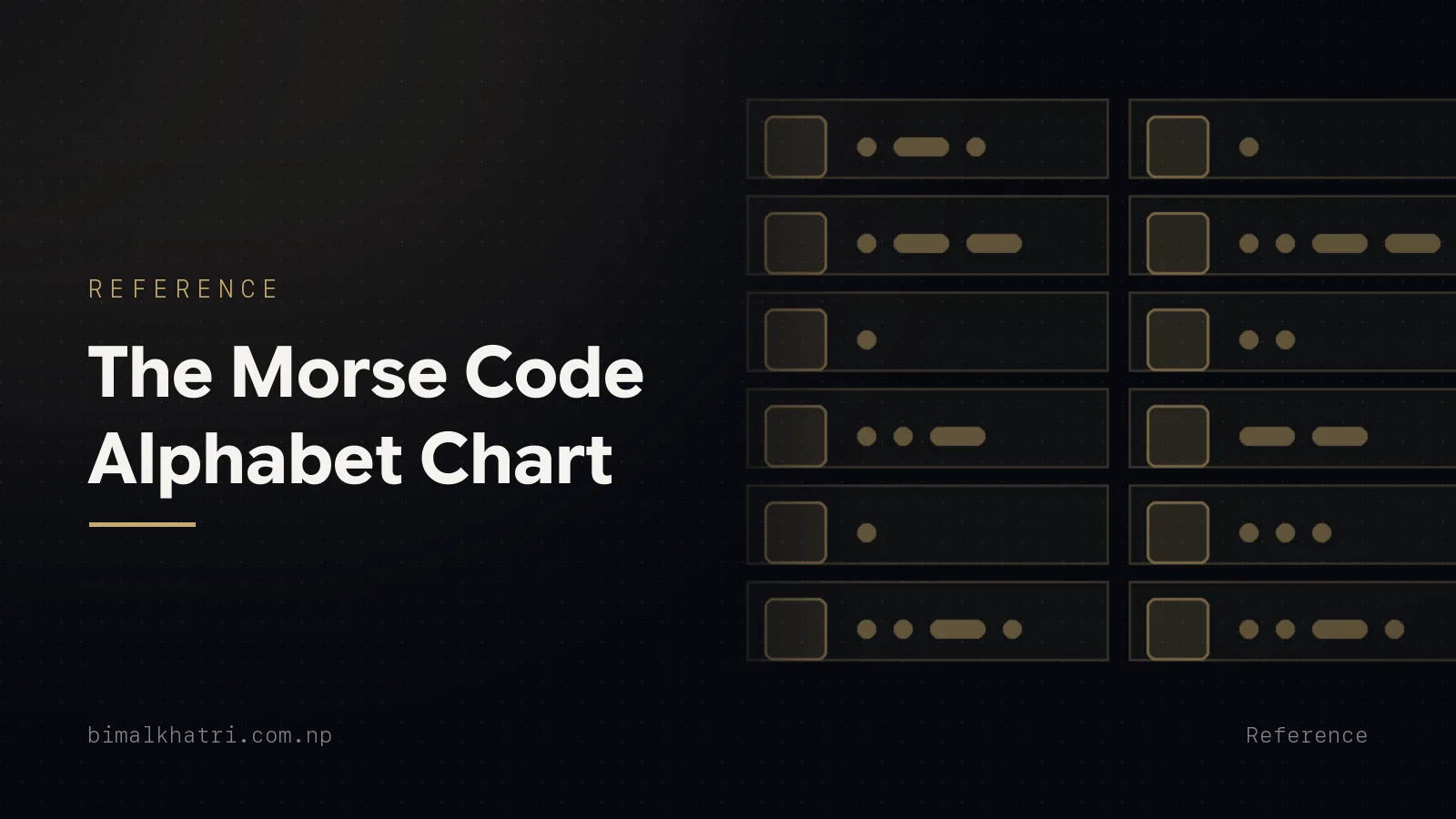
The Morse code alphabet, A to Z
| Letter | Code | Said aloud |
|---|---|---|
| A | .- | di-dah |
| B | -... | dah-di-di-dit |
| C | -.-. | dah-di-dah-dit |
| D | -.. | dah-di-dit |
| E | . | dit |
| F | ..-. | di-di-dah-dit |
| G | --. | dah-dah-dit |
| H | .... | di-di-di-dit |
| I | .. | di-dit |
| J | .--- | di-dah-dah-dah |
| K | -.- | dah-di-dah |
| L | .-.. | di-dah-di-dit |
| M | -- | dah-dah |
| N | -. | dah-dit |
| O | --- | dah-dah-dah |
| P | .--. | di-dah-dah-dit |
| Q | --.- | dah-dah-di-dah |
| R | .-. | di-dah-dit |
| S | ... | di-di-dit |
| T | - | dah |
| U | ..- | di-di-dah |
| V | ...- | di-di-di-dah |
| W | .-- | di-dah-dah |
| X | -..- | dah-di-di-dah |
| Y | -.-- | dah-di-dah-dah |
| Z | --.. | dah-dah-di-dit |
Nobody who sends Morse says "dot dot dash" out loud. They say dit and dah, because those two syllables have the same rhythm as the signals do. The right-hand column is how each letter is actually spoken, and saying it aloud is the quickest way to stop picturing Morse and start hearing it.
Here is the same alphabet in a plain block, laid out so you can copy it into a note or print it:
A .-      N -.
B -...    O ---
C -.-.    P .--.
D -..     Q --.-
E .       R .-.
F ..-.    S ...
G --.     T -
H ....    U ..-
I ..      V ...-
J .---    W .--
K -.-     X -..-
L .-..    Y -.--
M --      Z --..
Every letter fits into four signals
The chart looks like 26 things to memorise. It is smaller than that, because the letters sort themselves by length.
| Signals | Letters |
|---|---|
| 1 | E ., T - |
| 2 | A .-, I .., M --, N -. |
| 3 | D -.., G --., K -.-, O ---, R .-., S ..., U ..-, W .-- |
| 4 | B, C, F, H, J, L, P, Q, V, X, Y, Z |
Two letters, then four, then eight, then twelve. With one, two, three or four signals there are only 2 plus 4 plus 8 plus 16, or 30, possible patterns, and the alphabet uses 26 of them. Nothing in the letters is longer than four.
E is a single dot and T is a single dash, which is worth noticing: the two letters English uses most often are the two fastest to send. That is also why real text moves faster than a glance at the chart suggests.
Mirror pairs and opposites
Several letters are the same pattern read backwards. Learning them in pairs is less work than learning them one at a time.
| Letter | Code | Reversed | Letter |
|---|---|---|---|
| A | .- | -. | N |
| B | -... | ...- | V |
| D | -.. | ..- | U |
| F | ..-. | .-.. | L |
| G | --. | .-- | W |
| Q | --.- | -.-- | Y |
Another set swaps dots for dashes instead. E . and T - are opposites, so
are I .. and M --, S ... and O ---, and R .-. and K -.-. And a few
letters read the same in both directions: K -.-, R .-., P .--. and X
-..- are all their own mirror image.
The numbers 0 to 9
Digits are the easiest part of the chart, because they follow a rule. Every digit is exactly five signals long, and the pattern walks in one direction and then mirrors.
| Digit | Code | Digit | Code |
|---|---|---|---|
| 1 | .---- | 6 | -.... |
| 2 | ..--- | 7 | --... |
| 3 | ...-- | 8 | ---.. |
| 4 | ....- | 9 | ----. |
| 5 | ..... | 0 | ----- |
Start at 1 and count up: one dot then four dashes, two dots then three dashes, and so on until 5 is five dots. Then 6 starts the mirror, one dash and four dots, and it runs the same way until 0 is five dashes. If you can count to five, you know all ten digits.
1 .----    6 -....
2 ..---    7 --...
3 ...--    8 ---..
4 ....-    9 ----.
5 .....    0 -----
Punctuation and symbols
This is where charts on the web disagree with each other. The ITU standard defines sixteen punctuation marks. Most printed charts add a couple more, usually the exclamation mark and the dollar sign, because people ask for them. Everything in general use is here.
| Mark | Code | Mark | Code |
|---|---|---|---|
Full stop . | .-.-.- | Comma , | --..-- |
Question mark ? | ..--.. | Apostrophe ' | .----. |
Exclamation ! | -.-.-- | Slash / | -..-. |
Open bracket ( | -.--. | Close bracket ) | -.--.- |
Ampersand & | .-... | Colon : | ---... |
Semicolon ; | -.-.-. | Equals = | -...- |
Plus + | .-.-. | Hyphen - | -....- |
Underscore _ | ..--.- | Quote " | .-..-. |
Dollar $ | ...-..- | At @ | .--.-. |
.  .-.-.-      ,  --..--
?  ..--..      '  .----.
!  -.-.--      /  -..-.
(  -.--.       )  -.--.-
&  .-...       :  ---...
;  -.-.-.      =  -...-
+  .-.-.       -  -....-
_  ..--.-      "  .-..-.
$  ...-..-     @  .--.-.
Punctuation is the part of the chart nobody memorises, and there is no reason
to. Look it up when you need it. The question mark ..--.. is the one worth
keeping, because it is the mark you will actually meet in a real exchange.
There is more on why the digits and marks are shaped this way in the
numbers and punctuation guide.
Prosigns: patterns that are not letters
A prosign is a procedure signal. It is sent as one unbroken string, with no letter gaps inside it, which is what separates it from the letters it looks like.
| Prosign | Code | Meaning |
|---|---|---|
| SOS | ...---... | Distress |
| AR | .-.-. | End of message |
| SK | ...-.- | End of contact |
| BT | -...- | Break, new paragraph |
| KN | -.--. | Go ahead, named station only |
| Error | ........ | Eight dots, disregard the last word |
Two things people get wrong here. The first is SOS. It is a prosign, not three
letters, and it is sent straight through as ...---... with no letter gap
between the groups. It also does not stand for "Save Our Souls" or "Save Our
Ship"; those are backronyms invented afterwards. It was chosen because the
pattern is unmistakable and easy to send. The full story is in the
SOS explainer.
The second is that some prosigns share a pattern with a punctuation mark. AR is the same as the plus sign, BT the same as equals, KN the same as an open bracket. That is not an error in the chart. Context tells them apart, not sound. Prosigns, Q-codes and the NATO phonetic alphabet are covered in the shorthand guide.
The chart cannot show you the timing
A chart tells you the pattern. It does not tell you the lengths, and the lengths are half of Morse. Everything is measured in units, where one unit is the length of a dot.
| Element | Units |
|---|---|
| Dot | 1 |
| Dash | 3 |
| Gap between signals inside a character | 1 |
| Gap between characters | 3 |
| Gap between words | 7 |
So the ratio is 1 : 3 : 1 : 3 : 7. A dash is not "a bit longer" than a dot. It is exactly three times as long, and holding that ratio is what makes a message readable by ear at any speed.
Speed is measured in words per minute against the reference word PARIS, which was picked because it is exactly 50 units long once you include the word gap after it. You can check that against the chart:
| Part | Units |
|---|---|
P .--. | 11 |
| character gap | 3 |
A .- | 5 |
| character gap | 3 |
R .-. | 7 |
| character gap | 3 |
I .. | 3 |
| character gap | 3 |
S ... | 5 |
| word gap | 7 |
| Total | 50 |
From there, the length of a dot in seconds is 1.2 divided by the speed in words per minute.
| Speed | Dot length |
|---|---|
| 5 WPM | 240 ms |
| 12 WPM | 100 ms |
| 20 WPM | 60 ms |
| 25 WPM | 48 ms |
Here is what that means for a real signal. Sent properly, SOS is 3 dots, 3 dashes and 3 dots with eight one-unit gaps: 3 plus 9 plus 3 plus 8, which is 23 units. At 20 WPM that is 1.38 seconds. Sent wrongly, as the three separate letters S, O and S, the two extra character gaps push it to 27 units, or 1.62 seconds. Same signals, different message.
This is the gap a printed chart cannot cross, and it is why I built MorseLab: it carries this same chart along with the prosigns, the Q-codes and the NATO alphabet, and it plays any character or message back as a tone, a screen flash, a flashlight blink or a vibration at a speed you choose. More on speed and spacing in the timing and WPM guide.
Another way to read the chart: the Morse tree
The flat table is not the only way to organise the code. Start at nothing and branch: go left on a dot, right on a dash. Every letter sits at the point where its signals run out.
              start
         .              -
         E              T
      .     -        .     -
      I     A        N     M
     . -   . -      . -   . -
     S U   R W      D K   G O
Read down any path and you get the code. Dot, dot, dot lands on S .... Dash,
dot, dash lands on K -.-. The tree is useful when you are decoding by hand,
because you never have to scan a table: you just follow each signal as it
arrives. It is the same information as the chart, shaped for the way the code
is received rather than the way it is written.
The same tree turns up in computer science. Huffman coding builds one too, but keeps every letter on a leaf, so a message decodes without any gaps at all.
Common mistakes
Treating the space as decoration. The gaps carry meaning. -.-. in one
piece is C. Split it with a character gap and it becomes -. -., which is N
N. ...- is V; ... - is S T. If you send the letters right and the spacing
wrong, you have sent a different message.
Copying a chart that uses middots or long dashes. They look better on a page and they break every translator you paste them into. Dots and hyphens only.
Reaching for the chart while listening. A chart is for looking things up, not for copying live signals. Nobody reads Morse by matching what they heard against a table; the letters are learned as single sounds. That is a different skill, and it takes weeks of short daily sessions rather than one afternoon. You can memorise this page in a day. That question is answered honestly in can you learn Morse code in a day.
Confusing the NATO alphabet with Morse. Alfa, Bravo, Charlie is a way of saying letters clearly over a voice channel. It has nothing to do with dots and dashes, and the two get mixed up constantly.
Expecting lower case. There is one code per letter, so Morse has no capitals and no small letters. Charts are printed in capitals out of habit.
Questions people ask
What is the full Morse code alphabet?
Twenty-six letters, from A .- to Z --.., plus the ten digits and the
punctuation marks above. The whole International code is on this page. Nothing
in the letters is longer than four signals, and every digit is exactly five.
How do I write my name in Morse code?
Look up each letter, put a single space between letters, and a slash between
words. BEN is -... . -.. MARIA is -- .- .-. .. .-. There is a longer
walkthrough, including double letters and long names, in
write your name in Morse code.
Why are all the numbers five signals long?
Because that keeps them distinct from the letters, which stop at four. It also makes them predictable: from 1 to 5 each step turns another dash into a dot from the left, and from 6 to 0 each step turns another dot into a dash.
Is there a space between letters in Morse code?
Yes, and it is part of the code. Between letters the gap is three units long, the same length as a dash. Between words it is seven. Written down, those become a space and a slash.
What does SOS look like in Morse code?
...---..., sent as one continuous run with no letter gaps between the
groups. Three dots, three dashes, three dots. Written as three separate
letters it is a different signal.
Can I memorise the whole chart in one day?
The chart, yes. Most people can hold 26 letters for a day with focused drilling. Reading Morse by ear at speed is another matter and takes weeks of daily practice. Do not trust any page that promises otherwise.
Does Morse code work in other languages?
The chart covers the 26 Latin letters, so it handles English, Indonesian, Spanish, Filipino and anything else written in that alphabet. Characters outside those 26, accented letters among them, are not part of the international standard, so plan to send the plain letter instead.
What is the fastest way to memorise the alphabet?
Learn it by sound, not by shape, and learn a few characters at a time rather than all 26. Start with the one and two signal letters, use the mirror pairs above, and say every character as dit and dah instead of dot and dash. The method is set out in how to learn Morse code.
Get the app: MorseLab, free and offline, on iPhone and Android.
Keep reading
- Sandi morse untuk Pramuka — the same code in Indonesian, written for scouts.
- Morse code numbers and punctuation
- How to learn Morse code: a realistic plan
- How to read Morse code by sound
- Morse code timing, WPM and the PARIS standard
- How a Morse code translator works