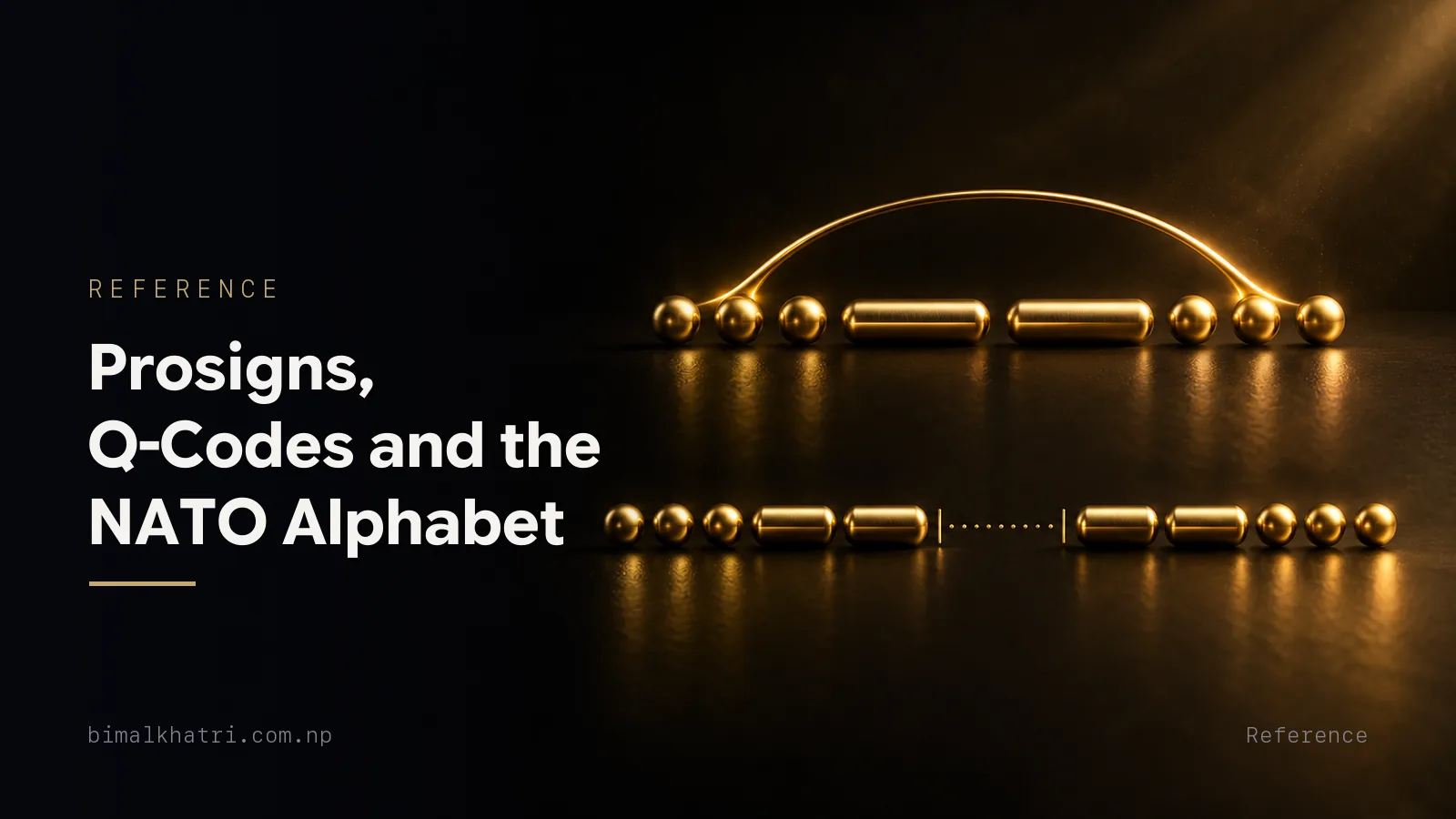
Prosigns are Morse patterns that mean an instruction rather than a letter. Q-codes are three-letter codes beginning with Q, each standing for a whole sentence. The NATO phonetic alphabet is not Morse at all: it is a list of spoken words used to spell letters aloud.
Three systems, three jobs, and they get mixed up constantly. A prosign is sent in Morse with no letter gaps inside it. A Q-code is sent as three ordinary Morse letters with normal gaps. The NATO alphabet is spoken with your voice and never sent as dots and dashes at all.
All three exist for the same reason. Morse is slow, radio conditions are bad, and an operator would rather send five elements than fifty. Learning them is less about memorising a list than about knowing which of the three you are looking at.
Want the sound? MorseLab will play any text back as tone, flash or vibration, free and offline.
Reading the code on this page
Morse has two marks: a dot . and a dash -. Operators say them aloud as "dit"
and "dah", which is much closer to what they sound like.
Inside a written string, letters are separated by a single space and words by a
slash. So --.- - .... is the three letters Q, T, H, while
.... . .-.. .--. / -- . is HELP ME.
Use the full stop and the hyphen from your keyboard, nothing else. A middot, a bullet or an em dash out of a word processor looks correct on screen and breaks the moment somebody pastes it into a translator, which is exactly what people do with a Morse string.
One rule carries the whole of this page: a prosign has no spaces inside it. Everything else follows from that.
Prosigns: one signal that looks like two letters
A prosign is a procedure signal. It tells the other operator what is happening to the message rather than adding a word to it: this message is finished, I am starting a new paragraph, ignore what I just sent.
The pattern is written as two letters run together, because that is the easiest way to name it on paper. It is not sent as two letters. There is no 3-unit letter gap in the middle.
| Prosign | Code | Meaning |
|---|---|---|
| SOS | ...---... | Distress |
| AR | .-.-. | End of message |
| SK | ...-.- | End of contact |
| BT | -...- | Break, new paragraph |
| KN | -.--. | Go ahead, named station only |
| Error | ........ | Eight dots: disregard the last word |
In printed radio material a prosign is shown as the letters with a single bar
drawn over all of them. The bar means precisely one thing: run them together. In
plain text, where an overbar is awkward to type, people write them inside angle
brackets instead, as <AR> and <SK>.
Copy these and play them back one at a time. They are short enough that the difference between a prosign and two letters is audible immediately.
.-.-.
...-.-
-...-
-.--.
...---...
........
The gap is what you are actually saving
Run the arithmetic and the reason prosigns exist stops being abstract. Everything in Morse is measured in units, where one unit is the length of a dot, a dash is 3, the gap between elements inside a character is 1, the gap between characters is 3 and the gap between words is 7.
| Prosign | Sent unbroken | Units | Sent as letters | Units |
|---|---|---|---|---|
| AR | .-.-. | 13 | .- .-. | 15 |
| BT | -...- | 13 | -... - | 15 |
| SK | ...-.- | 15 | ... -.- | 17 |
| KN | -.--. | 15 | -.- -. | 17 |
| SOS | ...---... | 23 | ... --- ... | 27 |
Two units, every time, because one 3-unit letter gap has become a 1-unit element gap. SOS saves four because it has two internal joins instead of one.
Two units is nothing. That is not why prosigns are joined. They are joined so
they cannot be mistaken for text. .-.-. arriving as one unbroken run is a
procedure marker; .- .-. arriving with a letter gap is somebody sending the
letters A and R in the middle of a word. The receiving operator does not have to
guess which, and that certainty is the whole point.
How long a prosign takes
Speed is measured in words per minute against the reference word PARIS, which including the word gap after it is exactly 50 units long. From that comes the only formula worth memorising:
Dot length in seconds = 1.2 ÷ WPM.
| Prosign | Units | 5 WPM (240 ms dot) | 12 WPM (100 ms dot) | 20 WPM (60 ms dot) |
|---|---|---|---|---|
| AR | 13 | 3,120 ms | 1,300 ms | 780 ms |
| BT | 13 | 3,120 ms | 1,300 ms | 780 ms |
| SK | 15 | 3,600 ms | 1,500 ms | 900 ms |
| KN | 15 | 3,600 ms | 1,500 ms | 900 ms |
| Error | 15 | 3,600 ms | 1,500 ms | 900 ms |
| SOS | 23 | 5,520 ms | 2,300 ms | 1,380 ms |
At 20 WPM every one of them lands under a second except SOS, which runs to 1,380 ms because it is nine elements long. The full working on units and speed is in Morse code timing and WPM.
Three prosigns are also punctuation marks
This is the part that confuses people reading a decoder's output, and it is not a bug in the chart.
| Code | As a punctuation mark | As a prosign |
|---|---|---|
.-.-. | + plus | AR, end of message |
-...- | = equals | BT, break |
-.--. | ( opening bracket | KN, go ahead |
The patterns are identical. Nothing in the sound tells them apart, so context
does. A decoder given -...- in the middle of an equation will print an equals
sign, and it is not wrong to. A human operator hearing it between two blocks of
text reads it as a paragraph break.
One near miss is worth watching for. AR is .-.-. with five elements. The full
stop is .-.-.- with six. One extra dash is the whole difference between "end
of message" and a sentence ending, which is a good argument for learning the
punctuation marks and the prosigns from
the same page.
The error signal, and why it is eight dots
The error prosign is eight dots sent as one run, ......... It means: forget the
last word, here it comes again.
Eight is not an arbitrary number. Among the characters in the international
standard, letters run to four elements at most, digits are always five, the
longest punctuation mark is the dollar sign ...-..- at seven, and SOS is nine.
Nothing else is eight. So an unbroken run of eight dots cannot be anything
except the error signal.
It is also the one prosign a beginner will actually need, because everybody sends the wrong letter. Here is a correction in full: HELO, the error signal, then HELP sent properly.
.... . .-.. --- ........ .... . .-.. .--.Send the eight dots evenly, with a 1-unit gap between them. Let one gap stretch
to a 3-unit letter gap and the run splits into two H's, .... ...., so the
correction becomes another mistake.
Q-codes: three letters carrying a whole sentence
Q-codes work in the opposite direction. They are not special patterns. They are ordinary letters, sent with ordinary gaps, and all the compression happens in the meaning. Three letters stand in for a sentence both operators already agree on.
| Q-code | Morse | Meaning | Units |
|---|---|---|---|
| QTH | --.- - .... | My location is | 29 |
| QSL | --.- ... .-.. | I acknowledge; message received | 33 |
| QRZ | --.- .-. --.. | Who is calling me | 37 |
| QSY | --.- ... -.-- | Change to another frequency | 37 |
Every one of them begins with Q, which is what makes the system work. Q is rare enough in ordinary English text that a Q arriving at the start of a group is a strong signal that a code, not a word, is on its way.
The same three letters ask the question and give the answer. The question mark
..--.. is what switches between them. Send --.- - .... and you are telling
somebody where you are. Send it with a question mark on the end and you are
asking where they are.
--.- - .... ..--..And the reply, with the AR prosign closing the message:
--.- - .... / - --- -.- -.-- --- .-.-.That is QTH, then TOKYO, then end of message.
What the shorthand is worth
Count the units against the English the code replaces, and the compression stops being a matter of taste.
| Q-code | Units | Spelled out in full | Units |
|---|---|---|---|
| QTH | 29 | MY LOCATION IS | 127 |
| QSL | 33 | MESSAGE RECEIVED | 119 |
| QRZ | 37 | WHO IS CALLING ME | 145 |
| QSY | 37 | CHANGE FREQUENCY | 151 |
At 20 words per minute a dot is 60 ms, so QTH takes 1,740 ms and MY LOCATION IS takes 7,620 ms. Four times the airtime for the same information, on a channel where the signal may fade at any moment. That is why the codes survived long after the telegraph traffic that produced them.
There are hundreds of Q-codes in the published lists. Nobody memorises them all. Operators learn the ones that come up in real contacts and look up the rest, which is a sane approach to any reference list.
I built MorseLab partly because this is reference material, and reference material is useless in a browser tab you do not have open on a hilltop. Its reference section keeps the international chart, the prosigns, the Q-codes and the NATO phonetic alphabet together, along with an interactive Morse tree that lets you walk the code by branching on dot or dash instead of scanning a flat table. It works offline with no account, which is the condition that matters for anything you look up in the field.
More on how these codes are used in a live contact is in Morse code for ham radio, and more short sendable phrases are in common words in Morse code.
The NATO phonetic alphabet is not Morse
Alfa, Bravo, Charlie. This is a spoken alphabet. You say it out loud, over a voice radio or a bad phone line, to make sure the listener hears D rather than B, M rather than N, or S rather than F.
It solves the same problem Morse solves, in a different medium. Morse fixes it with distinct rhythms; the phonetic alphabet fixes it with distinct words. The two are used together in radio because a station calls in Morse and confirms by voice, or the other way round. They are not translations of each other.
| Letter | Spoken as | Morse |
|---|---|---|
| A | Alfa | .- |
| B | Bravo | -... |
| C | Charlie | -.-. |
| D | Delta | -.. |
| E | Echo | . |
| F | Foxtrot | ..-. |
| G | Golf | --. |
| H | Hotel | .... |
| I | India | .. |
| J | Juliett | .--- |
| K | Kilo | -.- |
| L | Lima | .-.. |
| M | Mike | -- |
| N | November | -. |
| O | Oscar | --- |
| P | Papa | .--. |
| Q | Quebec | --.- |
| R | Romeo | .-. |
| S | Sierra | ... |
| T | Tango | - |
| U | Uniform | ..- |
| V | Victor | ...- |
| W | Whiskey | .-- |
| X | X-ray | -..- |
| Y | Yankee | -.-- |
| Z | Zulu | --.. |
Two spellings in that list are deliberate and often corrected by people who think they are typos. Alfa is written with an f, not "Alpha", so that a speaker who does not read "ph" as an f sound still says it correctly. Juliett carries a second t so that a French speaker does not drop a silent final one. The list was built to survive being read by people who do not share a first language, which is also why the words are long, stressed differently, and share almost no sounds.
Which one you actually need
| What you want to do | Use | Medium |
|---|---|---|
| Mark the end of your message | AR prosign | Morse |
| Start a new paragraph mid-message | BT prosign | Morse |
| Close the contact for good | SK prosign | Morse |
| Cancel a word you sent wrong | Error, eight dots | Morse |
| Signal distress with a light or a tone | SOS prosign | Morse |
| Ask where the other station is | QTH with a question mark | Morse or voice |
| Confirm you received a message | QSL | Morse or voice |
| Spell a name over a bad phone line | NATO alphabet | Voice only |
If you are learning Morse rather than operating a radio, the honest priority order is: SOS first, because a stranger might need to recognise it; then AR and BT, because they appear in any practice text you download; then the error signal, because you will need it in your first session. The Q-codes can wait until you have somebody to send them to.
Common mistakes
Sending a prosign as two letters. A 3-unit letter gap in the middle turns AR into the letters A and R. Run the elements together with 1-unit gaps only.
Treating SOS as an abbreviation. It stands for nothing. "Save Our Souls" and "Save Our Ship" are backronyms attached afterwards, and the belief that it is initials is exactly what makes people send it as three separate letters. The detail is in SOS in Morse code.
Assuming a decoder will label prosigns. Software prints the punctuation mark
that matches the pattern, so AR comes out as + and BT as =. That is the
correct output for what arrived, and you supply the context.
Confusing AR with a full stop. .-.-. is AR. .-.-.- is a full stop. One
dash apart.
Calling the NATO alphabet Morse code. Alfa, Bravo, Charlie is spoken. It has no dots and dashes and cannot be sent with a key, a torch or a buzzer.
Sending a Q-code without gaps. Q-codes are three normal letters. Joining them makes an unbroken pattern that means nothing at all.
Sending the error signal unevenly. Eight even dots. Let a gap drift out to letter length and they read as two H's, which is a new mistake on top of the old one.
Learning all the Q-codes first. There are hundreds and you will use a handful. Learn the ones that appear in the contacts you actually make.
Questions people ask
What is a prosign in Morse code?
A procedure signal: a Morse pattern that means an instruction rather than a
letter. It is written as two letters run together, such as AR or SK, and sent as
one unbroken string with no letter gap inside it. AR is .-.-., SK is
...-.-, BT is -...-.
What is the difference between a prosign and a Q-code?
Spacing and purpose. A prosign is one joined Morse pattern that marks the state
of the message. A Q-code is three ordinary letters, sent with normal gaps, that
stands in for a whole sentence. QTH is --.- - ...., exactly as you would send
any three letters.
What does QTH mean?
My location is. Sent with a question mark after it, --.- - .... ..--.., it
asks the other station where they are. QSL means the message was received, QRZ
asks who is calling, and QSY means change to another frequency.
Is the NATO alphabet the same as Morse code?
No. The NATO phonetic alphabet is a set of spoken words for letters, used over voice, and has no dots or dashes in it. Morse is a code of timed sounds, lights or vibrations. Radio operators use both because they work in different media.
Why is it spelled Alfa and Juliett?
So the pronunciation survives across languages. Written "Alpha", a speaker whose language does not sound "ph" as an f may say it differently; Juliett takes a second t so a French speaker does not drop the final one. The whole list is built for people who do not share a first language.
Why do AR and the plus sign have the same code?
Because they do, and the standard allows it. AR .-.-. is also +, BT -...-
is also =, and KN -.--. is also the opening bracket (. There is no audible
difference. Context decides which one is meant.
How do I cancel a mistake in Morse?
Send eight dots as one even run, ........, then send the whole word again. It
means disregard the last word. Keep the dots evenly spaced or they will be read
as the letters H H.
Do I need prosigns and Q-codes to learn Morse code?
No. Learn the letters and digits first, then SOS, then AR and BT because they turn up in practice texts. Q-codes matter once you are having real contacts. How to read Morse by sound covers the part that takes actual practice.
Get it: MorseLab, free on iPhone and Android. The link opens your own store.
Keep reading
- SOS in Morse Code: The Signal, the Spacing, and the Myth
- The Morse Code Alphabet Chart: Every Letter, Number and Punctuation Mark
- Morse Code Numbers and Punctuation, and the Pattern That Makes Digits Easy
- Morse Code for Ham Radio: A Beginner's Guide to CW
- Morse Code Timing and WPM: The 1:3:7 Ratio and the PARIS Standard