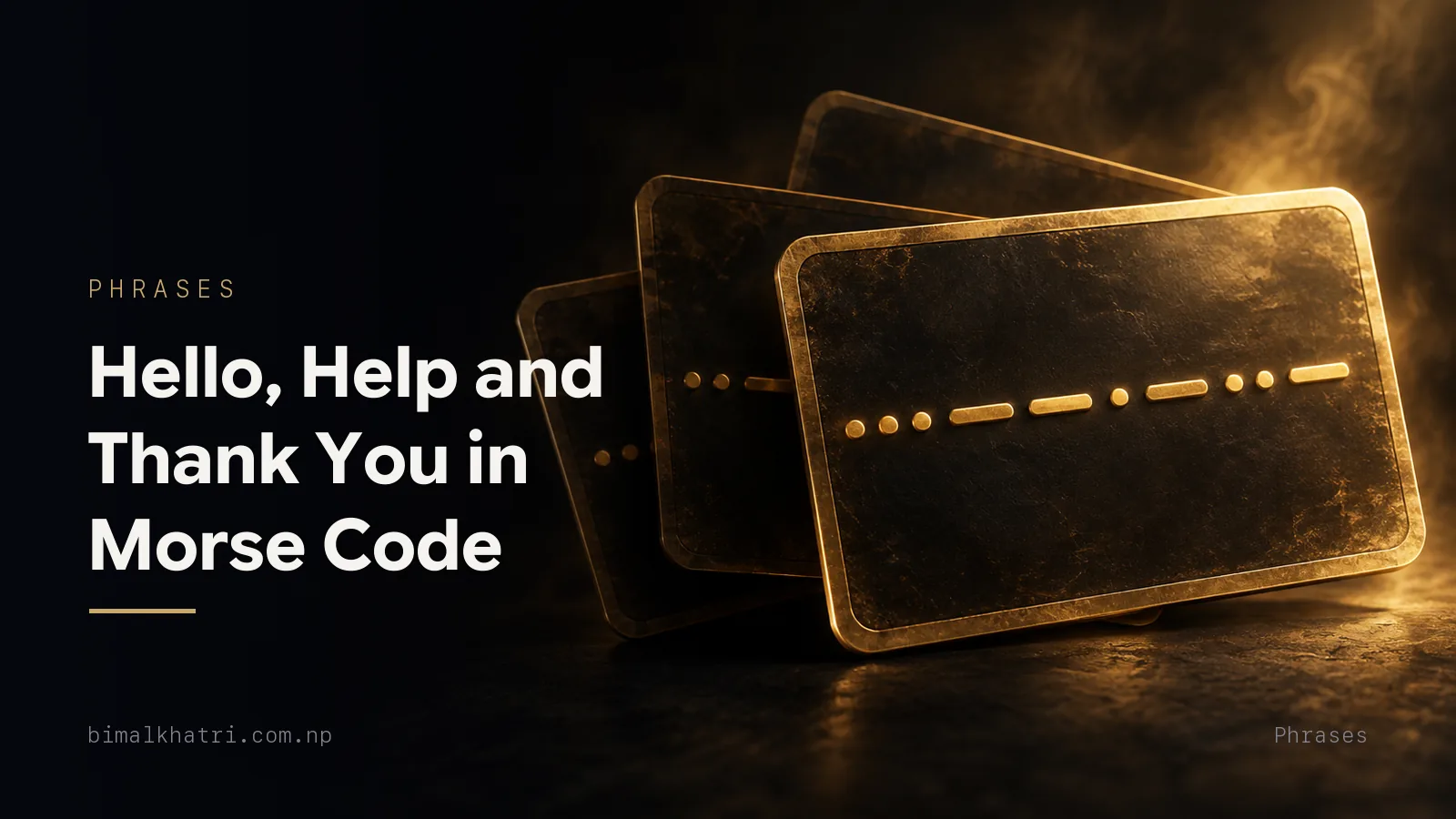
HELLO is .... . .-.. .-.. ---. HELP is .... . .-.. .--.. THANK YOU is
- .... .- -. -.- / -.-- --- ..-.
Letters are separated by a single space and words by a slash, so every line below can be copied straight into a message and still be read by anyone who knows the code. The dots are full stops and the dashes are hyphens: ordinary keyboard characters, which is what makes them survive a paste.
Below are the phrases people actually look up: greetings, the emergency words, the polite ones, the personal ones, and four radio codes that replace a whole sentence. There is a plain block near the end you can copy in one go, plus how long each phrase takes to send, because a phrase in Morse is longer than it looks.
Reading it is not the same as hearing it. MorseLab plays any text back as a tone, a flash or a vibration, free and offline.
Read a line of Morse before you copy it
Three characters do all the work.
| Symbol | What it is | What it means |
|---|---|---|
. | A full stop | A dot, the short beep |
- | A hyphen | A dash, exactly three times as long |
/ | A slash between spaces | The gap between two words |
One space between letters. One / between words. Nothing else. So
.... .. is two letters, H and I, and .. / .- -- is three letters in two
words: I, then A and M.
Spoken aloud, operators say dit for a dot and dah for a dash, and shorten a dot to di when another element follows it. HI is "di-di-di-dit di-dit". Saying a phrase out loud is the fastest way to check you have copied it correctly.
One warning before you paste anything. Many pages write Morse with a Unicode middot or an en dash because it looks tidier. It is not the same character. A translator, an app or another person's search will not always match it, and the line quietly stops working. Everything here uses the two characters on your keyboard.
Hello, hi and the other greetings
| Phrase | Morse | Units |
|---|---|---|
| Hello | .... . .-.. .-.. --- | 49 |
| Hi | .... .. | 13 |
| Hey | .... . -.-- | 27 |
| Good morning | --. --- --- -.. / -- --- .-. -. .. -. --. | 119 |
| Good night | --. --- --- -.. / -. .. --. .... - | 93 |
| How are you | .... --- .-- / .- .-. . / -.-- --- ..- | 103 |
| Welcome | .-- . .-.. -.-. --- -- . | 67 |
| Bye | -... -.-- . | 29 |
| See you | ... . . / -.-- --- ..- | 57 |
Look at the units column. HELLO costs 49 units and HI costs 13, so HI is not a lazy greeting in Morse. It is nearly four times cheaper to send, and that is why short forms took over on the air. A unit is the length of one dot, and the arithmetic behind the column is further down.
Two of these trip people up. In HELLO the double L is .-.. .-.., two separate
letters with a real gap between them, not one long run of dots and dashes. And
the double O in GOOD is six dashes, --- ---, in two groups of three: run
them together and a listener cannot hear where one O ends.
Help, and the signal that outranks it
| Phrase | Morse | Units |
|---|---|---|
| Help | .... . .-.. .--. | 37 |
| Help me | .... . .-.. .--. / -- . | 55 |
| Send help | ... . -. -.. / .... . .-.. .--. | 71 |
| I am lost | .. / .- -- / .-.. --- ... - | 69 |
| I am here | .. / .- -- / .... . .-. . | 57 |
| Water | .-- .- - . .-. | 37 |
| Doctor | -.. --- -.-. - --- .-. | 65 |
| Fire | ..-. .. .-. . | 29 |
| Stop | ... - --- .--. | 39 |
| Wait | .-- .- .. - | 29 |
| Are you ok | .- .-. . / -.-- --- ..- / --- -.- | 93 |
| All ok | .- .-.. .-.. / --- -.- | 59 |
The word HELP is spelled out like any other word. It is useful in a message and useless as a distress call, because nobody is listening for it and it takes 37 units to send.
The distress call is SOS, and it is not the word help translated. It is a prosign: one unbroken sequence with no gaps between letters.
SOS ...---...Written as three separate letters it would be ... --- ..., which is 27 units.
Sent as the prosign it is 23 units, because the two letter gaps shrink from 3
units to 1. That continuous rhythm (three short, three long, three short with
nothing in between) is what makes it recognisable through noise, and it is the
whole reason the pattern was chosen. It does not stand for "Save Our Souls" or
"Save Our Ship". Those phrases were invented afterwards to explain a signal
that already existed. The full story is in
SOS in Morse code.
If you are signalling for real, send SOS. Send it slowly, repeat it, and leave a long pause between repeats so somebody has time to notice the pattern and start watching. A torch works: long presses for the dashes, short ones for the dots, covered in Morse code with a flashlight.
Thank you, please and the polite phrases
| Phrase | Morse | Units |
|---|---|---|
| Thank you | - .... .- -. -.- / -.-- --- ..- | 85 |
| Thanks | - .... .- -. -.- ... | 49 |
| Please | .--. .-.. . .- ... . | 47 |
| Sorry | ... --- .-. .-. -.-- | 55 |
| Yes | -.-- . ... | 25 |
| No | -. --- | 19 |
| Ok | --- -.- | 23 |
| Good luck | --. --- --- -.. / .-.. ..- -.-. -.- | 99 |
THANK YOU is 85 units against 49 for THANKS, about three quarters longer. Both are correct. Which one you send depends on how much time you want to spend, and on the air people almost always take the shorter one.
SORRY starts ... ---, the same two letters that open SOS. In writing that is
obvious. By ear, at speed, it is not, and it is one more reason SOS is sent
unbroken: the gap after the S is exactly what tells a listener this is a word
and not a distress call.
Phrases people send to each other
| Phrase | Morse | Units |
|---|---|---|
| I love you | .. / .-.. --- ...- . / -.-- --- ..- | 93 |
| Miss you | -- .. ... ... / -.-- --- ..- | 73 |
| My name is | -- -.-- / -. .- -- . / .. ... | 75 |
| Nice to meet you | -. .. -.-. . / - --- / -- . . - / -.-- --- ..- | 125 |
| Happy birthday | .... .- .--. .--. -.-- / -... .. .-. - .... -.. .- -.-- | 141 |
| Hello world | .... . .-.. .-.. --- / .-- --- .-. .-.. -.. | 111 |
I LOVE YOU is three words, so it carries two slashes. The single dot pair ..
at the front is the whole word I, and ...- . in the middle is the V and E of
LOVE, not one character. There is more on that phrase, including how to tap it
and how to flash it, in
I love you in Morse code.
MY NAME IS is only useful with a name after it. Add yours letter by letter from the chart: the method is in write your name in Morse code.
Four codes that replace a whole sentence
Radio operators shortened the commonest sentences into three-letter codes beginning with Q. Each one is sent as three normal letters, and each is a question when a question mark follows it and a statement when it does not.
| Code | Morse | Meaning |
|---|---|---|
| QTH | --.- - .... | My location is |
| QSL | --.- ... .-.. | I acknowledge, message received |
| QRZ | --.- .-. --.. | Who is calling me |
| QSY | --.- ... -.-- | Change to another frequency |
QTH is 29 units. Spelling out MY LOCATION IS takes 127. That compression is the
point. There is a longer list, along with the procedure signals such as AR
.-.-. for end of message and BT -...- for a break between paragraphs, in
prosigns and Q-codes.
How long each phrase takes
Everything in Morse is measured in units, where one unit is the length of a dot. A dash is 3 units, the gap inside a character is 1, the gap between characters is 3, and the gap between words is 7. Add those up for a phrase and you get its length in units, which is the number in every table above.
To turn units into time you need a speed. The dot length in seconds is 1.2 divided by the words per minute. At 5 WPM a dot is 240 ms, at 12 WPM it is 100 ms, and at 20 WPM it is 60 ms. Multiply the units by the dot length.
| Phrase | Units | 5 WPM | 12 WPM | 20 WPM |
|---|---|---|---|---|
| Hi | 13 | 3,120 ms | 1,300 ms | 780 ms |
| No | 19 | 4,560 ms | 1,900 ms | 1,140 ms |
| SOS (prosign) | 23 | 5,520 ms | 2,300 ms | 1,380 ms |
| Help | 37 | 8,880 ms | 3,700 ms | 2,220 ms |
| Hello | 49 | 11,760 ms | 4,900 ms | 2,940 ms |
| Thank you | 85 | 20,400 ms | 8,500 ms | 5,100 ms |
| I love you | 93 | 22,320 ms | 9,300 ms | 5,580 ms |
| Hello world | 111 | 26,640 ms | 11,100 ms | 6,660 ms |
Read the 5 WPM column before you plan to signal anything long. HELLO WORLD at beginner speed takes over 26 seconds of steady flashing. THANK YOU takes 20. A real message sent by torch or by tapping is short because sending is slow, not because operators are terse by nature.
The speed itself is measured against the word PARIS, which is exactly 50 units long including the word gap that follows it. That is why 20 WPM means PARIS twenty times a minute and a 60 ms dot. The full arithmetic is in Morse code timing and WPM.
Copy the whole list
Every phrase above, in one block, with real dots and hyphens.
HELLO             .... . .-.. .-.. ---
HI                .... ..
HEY               .... . -.--
GOOD MORNING      --. --- --- -.. / -- --- .-. -. .. -. --.
GOOD NIGHT        --. --- --- -.. / -. .. --. .... -
HOW ARE YOU       .... --- .-- / .- .-. . / -.-- --- ..-
WELCOME           .-- . .-.. -.-. --- -- .
BYE               -... -.-- .
SEE YOU           ... . . / -.-- --- ..-
HELP              .... . .-.. .--.
HELP ME           .... . .-.. .--. / -- .
SEND HELP         ... . -. -.. / .... . .-.. .--.
I AM LOST         .. / .- -- / .-.. --- ... -
I AM HERE         .. / .- -- / .... . .-. .
WATER             .-- .- - . .-.
DOCTOR            -.. --- -.-. - --- .-.
FIRE              ..-. .. .-. .
STOP              ... - --- .--.
WAIT              .-- .- .. -
ARE YOU OK        .- .-. . / -.-- --- ..- / --- -.-
ALL OK            .- .-.. .-.. / --- -.-
THANK YOU         - .... .- -. -.- / -.-- --- ..-
THANKS            - .... .- -. -.- ...
PLEASE            .--. .-.. . .- ... .
SORRY             ... --- .-. .-. -.--
YES               -.-- . ...
NO                -. ---
OK                --- -.-
GOOD LUCK         --. --- --- -.. / .-.. ..- -.-. -.-
I LOVE YOU        .. / .-.. --- ...- . / -.-- --- ..-
MISS YOU          -- .. ... ... / -.-- --- ..-
MY NAME IS        -- -.-- / -. .- -- . / .. ...
NICE TO MEET YOU  -. .. -.-. . / - --- / -- . . - / -.-- --- ..-
HAPPY BIRTHDAY    .... .- .--. .--. -.-- / -... .. .-. - .... -.. .- -.--
HELLO WORLD       .... . .-.. .-.. --- / .-- --- .-. .-.. -..
SOS               ...---...
For any phrase not on the list, spell it from the chart one letter at a time. Every letter is in the Morse code alphabet chart, and a translator will do it faster if you would rather type than look up.
I built the phone app that goes with this series, and the reason it exists is
the gap between reading a line like .... . .-.. .-.. --- and hearing it. Paste any
phrase from the block above into MorseLab and it plays back as
a tone, a flashlight blink, a full-screen flash or a vibration, at whatever
speed you choose, so you can check the spacing by ear instead of trusting a page.
Common mistakes
Writing Morse with the wrong characters. A Unicode middot or an em dash looks correct and breaks the moment somebody pastes it into a translator. Use the full stop and the hyphen.
Losing the word gap. .... .. -.. .- -.. and .... .. / -.. .- -.. are
different messages. Without the slash, a reader has no way to know where a word
ends, and letters run together into something else.
Treating SOS as the word HELP. They are not interchangeable. HELP is four spelled letters; SOS is one unbroken prosign that people are trained to recognise.
Adding punctuation you do not need. "Help!" in Morse would be
.... . .-.. .--. -.-.--, and that exclamation mark costs another 22 units for
no gain (19 for the character, 3 for the gap before it). Punctuation exists in the standard, but phrases like these are sent
plain.
Copying a phrase without knowing how to send it. Reading .... . .-.. .--.
is not the same as producing it. The rhythm has to be right, or a listener hears
different letters. Start with Morse code by sound.
Expecting instant recognition. You can memorise this page in an afternoon. Reading these phrases back by ear, in real time, takes weeks of short daily practice. Both things are true, and the difference is explained in can you learn Morse code in a day.
Questions people ask
What is hello in Morse code?
.... . .-.. .-.. ---. That is five letters (H, E, L, L, O) each separated by
a space. It runs 49 units, which is 2.94 seconds at 20 words per minute. HI
.... .. says the same thing in a quarter of the time.
What is help in Morse code?
.... . .-.. .--., spelled H, E, L, P. Use it inside a message. For an actual
emergency use the SOS prosign ...---..., sent unbroken and repeated, because
that is the pattern people are listening for.
How do you write thank you in Morse code?
- .... .- -. -.- / -.-- --- ..-. The slash marks the gap between the two
words, which is 7 units of silence. THANKS on its own is
- .... .- -. -.- ... and takes a little over half as long.
Can I copy and paste Morse code?
Yes, as long as the page uses ordinary dots and hyphens. Every string here does. If a phrase you copied elsewhere fails in a translator, check for a middot, a bullet or an en dash standing in for the dot and dash, and replace them.
How do I write a space between words in Morse code?
With a slash surrounded by spaces: /. On the air it is not a character at
all, just a silence of 7 units against the 3 units between letters. The slash is
a writing convention that makes the silence visible on a page.
What is I love you in Morse code?
.. / .-.. --- ...- . / -.-- --- ..-, three words and two slashes. It is a
popular one to tap or flash rather than write, and there is a full walkthrough
in I love you in Morse code.
How do I write my own name in Morse code?
Take each letter from the chart and put a single space between them. Names with
double letters need the gap kept, so ANNA is .- -. -. .- with four separate
letters, and a hyphen in a name is a real character, -....-.
Do I need to memorise these phrases?
No. Memorise the 26 letters and you can build any phrase yourself, which is a smaller job than it sounds and covers everything this page does not list. The plan for that is in how to learn Morse code.
Download it: MorseLab for iPhone and Android. Free, and the link picks the right store for you.
Keep reading
- The Morse Code Alphabet Chart — every letter, digit and punctuation mark to build phrases of your own.
- SOS in Morse Code — the prosign, the myth about Save Our Souls, and how to send it.
- I Love You in Morse Code — the phrase people look up most, tapped, flashed and sent.
- Write Your Name in Morse Code — letter by letter, including double letters and hyphens.
- Morse Code Translator — how text becomes dots and dashes, and what a good translator gets right.