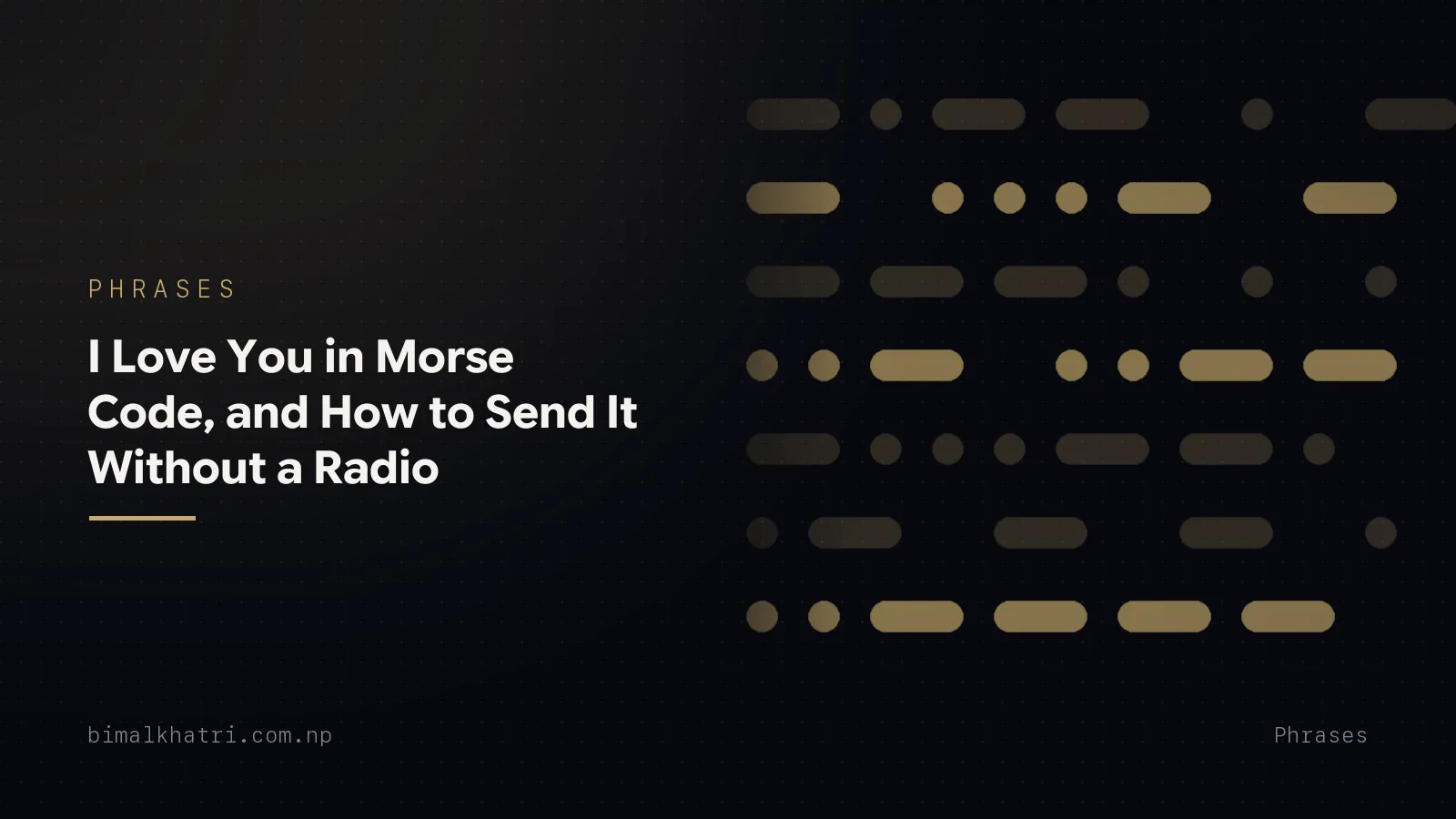
"I love you" in Morse code is .. / .-.. --- ...- . / -.-- --- ..-.
That is three words. .. is I. .-.. --- ...- . is LOVE. -.-- --- ..- is YOU.
A space separates letters, and a slash separates words. That is the whole
notation, and getting it right is what stops the phrase turning into gibberish
when you send it.
You do not need a radio or a telegraph key to send it. A hummed tone, a flashlight, a finger tapping on someone's arm, a phone set to vibrate, or beads threaded on a string all carry the same pattern. Below is the phrase character by character, how many seconds it actually takes, the ways to send it without a transmitter, and the spacing mistake that turns L into two other letters.
Want to hear it, not just read it? MorseLab plays any text back as tone, flash or vibration, free and offline.
The phrase, character by character
International Morse code covers the 26 Latin letters, the ten digits and 16 punctuation marks. Every letter in this phrase is one of them.
| Letter | Code | Said aloud |
|---|---|---|
| I | .. | di-dit |
| L | .-.. | di-dah-di-dit |
| O | --- | dah-dah-dah |
| V | ...- | di-di-di-dah |
| E | . | dit |
| Y | -.-- | dah-di-dah-dah |
| O | --- | dah-dah-dah |
| U | ..- | di-di-dah |
The third column is how operators say the code out loud. A dot is a dit, a dash is a dah, and a dot that runs into another element shortens to di. Saying "di-dah-di-dit" for L is faster than reading four symbols, and it is the first step towards hearing the code rather than looking at it.
Copy the phrase from here:
.. / .-.. --- ...- . / -.-- --- ..-Morse has no capitals and no lower case, so I LOVE YOU and i love you are the same signal. The full set of characters is in the alphabet chart.
How long it takes to send
Morse is measured in units, where one unit is the length of a dot. A dash is 3 units. The gap between elements inside a character is 1, between characters 3, and between words 7. That ratio is fixed, and it is what makes the phrase readable at any speed.
Add the units up and you get how long each letter occupies. The dot length in seconds is 1.2 ÷ WPM, so a 5 WPM dot is 240 ms, a 12 WPM dot is 100 ms and a 20 WPM dot is 60 ms.
| Letter | Code | Units | At 5 WPM | At 12 WPM | At 20 WPM |
|---|---|---|---|---|---|
| I | .. | 3 | 720 ms | 300 ms | 180 ms |
| L | .-.. | 9 | 2,160 ms | 900 ms | 540 ms |
| O | --- | 11 | 2,640 ms | 1,100 ms | 660 ms |
| V | ...- | 9 | 2,160 ms | 900 ms | 540 ms |
| E | . | 1 | 240 ms | 100 ms | 60 ms |
| Y | -.-- | 13 | 3,120 ms | 1,300 ms | 780 ms |
| U | ..- | 7 | 1,680 ms | 700 ms | 420 ms |
The eight letters come to 64 units. The gaps add 29 more: five character gaps of 3 units, and two word gaps of 7. So the whole phrase is 93 units.
| Speed | Dot | Whole phrase |
|---|---|---|
| 5 WPM | 240 ms | 22.3 seconds |
| 12 WPM | 100 ms | 9.3 seconds |
| 20 WPM | 60 ms | 5.6 seconds |
Sent by hand, a quarter-second dot is slow enough to hold steady without a metronome, and that is about 5 WPM, a twenty-second message. Slow is the right choice anyway, because the receiver needs time to see the gaps. The arithmetic behind all of this is in timing and WPM.
Sending it without a radio
The code is a pattern of short and long. Anything that can be short or long can carry it.
As sound. Hum, whistle or beep it. Short hum for a dot, hum three times as long for a dash, and stay silent for one beat between elements. The silence matters as much as the noise: a listener who cannot hear your gaps cannot read your letters.
With a flashlight. Light on for one count is a dot, on for three counts is a
dash, off for one count between elements, off for three between letters and off
for seven between words. Across a room, a garden or a valley a torch is the
only thing you need. One caution: do not flash ...---... as a test signal
outdoors. That pattern is the distress prosign, covered in
SOS in Morse code, and it is not a joke worth making.
The full method is in Morse with a flashlight.
By touch. Tap it on a table, a shoulder or a hand. A short tap is a dot, a longer press or a firmer tap is a dash. A squeeze works the same way, which is why this version travels well in a cinema, a lecture or a hospital ward where nobody can make a sound. There is more on this in tapping and vibration.
As vibration. A phone can buzz the pattern against a pocket. Short buzz, long buzz, silence. It is the easiest method to get exactly right, because the timing is done by software rather than by your thumb.
As text. Paste .. / .-.. --- ...- . / -.-- --- ..- into a message. Write it
with real full stops and hyphens, never with the middle dots or long dashes a
word processor substitutes, or the person on the other end cannot paste it into
anything that will read it back.
I built MorseLab so the playback part is not homework. Type the phrase, choose tone, flashlight, full-screen flash or vibration, and hold the phone out. It also decodes Morse audio through the microphone, which means the person you send it to can point their phone at your beeping and read it without knowing a single character.
Shorter versions, and adding a name
Copy any of these:
I LOVE YOU        .. / .-.. --- ...- . / -.-- --- ..-
LOVE              .-.. --- ...- .
ILY               .. .-.. -.--
I LOVE YOU TOO    .. / .-.. --- ...- . / -.-- --- ..- / - --- ---
143               .---- ....- ...--
ILY is just the three initials sent as three letters. It is not a recognised
prosign, so it means what you and one other person agree it means.
143 is the digits one, four and three, which are the letter counts of I, LOVE
and YOU. Digits are always five elements long and follow a pattern worth
knowing, set out in numbers and punctuation.
To add a name, send the phrase, leave a word gap, then spell the name letter by
letter. ANA is .- -. .-, SOFIA is ... --- ..-. .. .-, and
writing your name in Morse covers the
letters that catch people out.
The phrase in other languages
International Morse code has codes for the 26 unaccented Latin letters. It has none for á, ä, ñ or ç, so send the plain letter instead: Ä becomes A and Ñ becomes N. Anything you can spell in those 26 letters, you can send.
| Language | Written | Morse |
|---|---|---|
| English | I LOVE YOU | .. / .-.. --- ...- . / -.-- --- ..- |
| Spanish | TE AMO | - . / .- -- --- |
| Filipino | MAHAL KITA | -- .- .... .- .-.. / -.- .. - .- |
| Indonesian | AKU CINTA KAMU | .- -.- ..- / -.-. .. -. - .- / -.- .- -- ..- |
| French | JE T'AIME | .--- . / - .----. .- .. -- . |
| Swedish | JAG ALSKAR DIG | .--- .- --. / .- .-.. ... -.- .- .-. / -.. .. --. |
| Japanese, romanised | AISHITERU | .- .. ... .... .. - . .-. ..- |
The apostrophe in JE T'AIME is a real character, .----., sent with normal
character gaps on either side of it. The Swedish Ä is written here as a plain A.
Wearing it: bracelets, engraving and tattoos
A Morse bracelet is the same code in beads. A small round bead is a dot, a long tube bead is a dash, a spacer between letters is the 3-unit gap and a wider spacer is the 7-unit word gap.
Count the elements before you buy anything. I LOVE YOU has 24 elements in total: 2 for I, then 4, 3, 4 and 1 for LOVE, then 4, 3 and 3 for YOU. The eight letters leave seven gaps between them, five of which are letter spacers and two of which are word spacers.
Engraving and tattoos follow the same rule, with one extra risk. Ink and metal
have no timing, so the gaps have to be visible in the layout. If the spacing is
even all the way across, .-.. is not obviously L. A reader is free to break it
as .- and .., which is A followed by I. Draw the letter groups clearly
apart, and check every character against the chart before anything becomes
permanent.
Common mistakes
Losing the word gaps. Written down, the slash carries the meaning. Sent, the 7-unit silence does. Run the words together and the receiver has to guess.
Even spacing. This is the one that ruins tattoos, bracelets and hand-sent
light signals. Morse only works because gaps come in three sizes: 1 unit inside
a character, 3 units between characters and 7 between words. Same dots and
dashes, different gaps, different message: .-.. is L, but .- .. is A I, and
... - is S T where ...- is V.
A dash that is only slightly longer than a dot. A dash is exactly three times a dot. Two times reads as a sloppy dot, and the letters stop being distinguishable.
Typing the code with the wrong characters. Autocorrect turns hyphens into long dashes and full stops into middle dots. They look right and break every translator and every copy-paste.
Expecting to read it back straight away. You can memorise this phrase in five minutes. Recognising it by ear when someone else sends it is a different skill, and it takes weeks of short daily practice, not an afternoon. Nothing about the phrase is hard; the ear is what needs the time, as how to learn Morse code sets out.
Questions people ask
What is I love you in Morse code?
.. / .-.. --- ...- . / -.-- --- ..-. The .. is I, .-.. --- ...- . is LOVE
and -.-- --- ..- is YOU, with a space between letters and a slash between
words.
How do you say I love you in Morse code out loud?
"Di-dit. Di-dah-di-dit, dah-dah-dah, di-di-di-dah, dit. Dah-di-dah-dah, dah-dah-dah, di-di-dah." Pause where the commas are for the character gaps and pause longer between the three words.
How long does it take to send?
The phrase is 93 units long, so about 22 seconds at 5 WPM, 9.3 seconds at 12 WPM and 5.6 seconds at 20 WPM. A dot lasts 1.2 ÷ WPM seconds, and everything else is a multiple of that.
What is the short version?
.. .-.. -.-- for the initials ILY, or .-.. --- ...- . for LOVE on its own.
Neither is a standard signal, so agree on it with the person receiving it first.
Is there a Morse code symbol for a heart?
No. The standard has the 26 letters, the ten digits and 16 punctuation marks, and none of them is a heart or an emoji. If you want the idea of a heart, spell a word.
How do I send it with a flashlight?
Short flash for a dot, a flash three times as long for a dash, a short dark gap between flashes, a longer one between letters and the longest between the three words. Practise at about a quarter-second dot, which is 5 WPM, and keep the dark gaps as deliberate as the flashes.
Can I put it on a bracelet or a tattoo?
Yes, and the only thing that goes wrong is spacing. Use one bead shape for dots and a longer one for dashes, keep letter groups visibly apart, and use a wider break for the two word gaps. I LOVE YOU is 24 elements across 8 letters.
Does it work in languages other than English?
For anything spelled in the 26 unaccented Latin letters, yes. TE AMO is
- . / .- -- --- and MAHAL KITA is -- .- .... .- .-.. / -.- .. - .-. Accented
letters have no code in the international standard, so send the plain letter
instead.
Get it: MorseLab, free on iPhone and Android. The link opens your own store.
Keep reading
- SOS in Morse Code — the one signal you should never send as a test, and the myth attached to it.
- Write Your Name in Morse Code — spelling names letter by letter, including the awkward ones.
- Morse Code With a Flashlight — timing a light by hand so the gaps actually read.
- Tapping and Vibration — sending Morse by touch when sound and light are not options.
- Hello, Help and Thank You — more short phrases you can copy straight out.