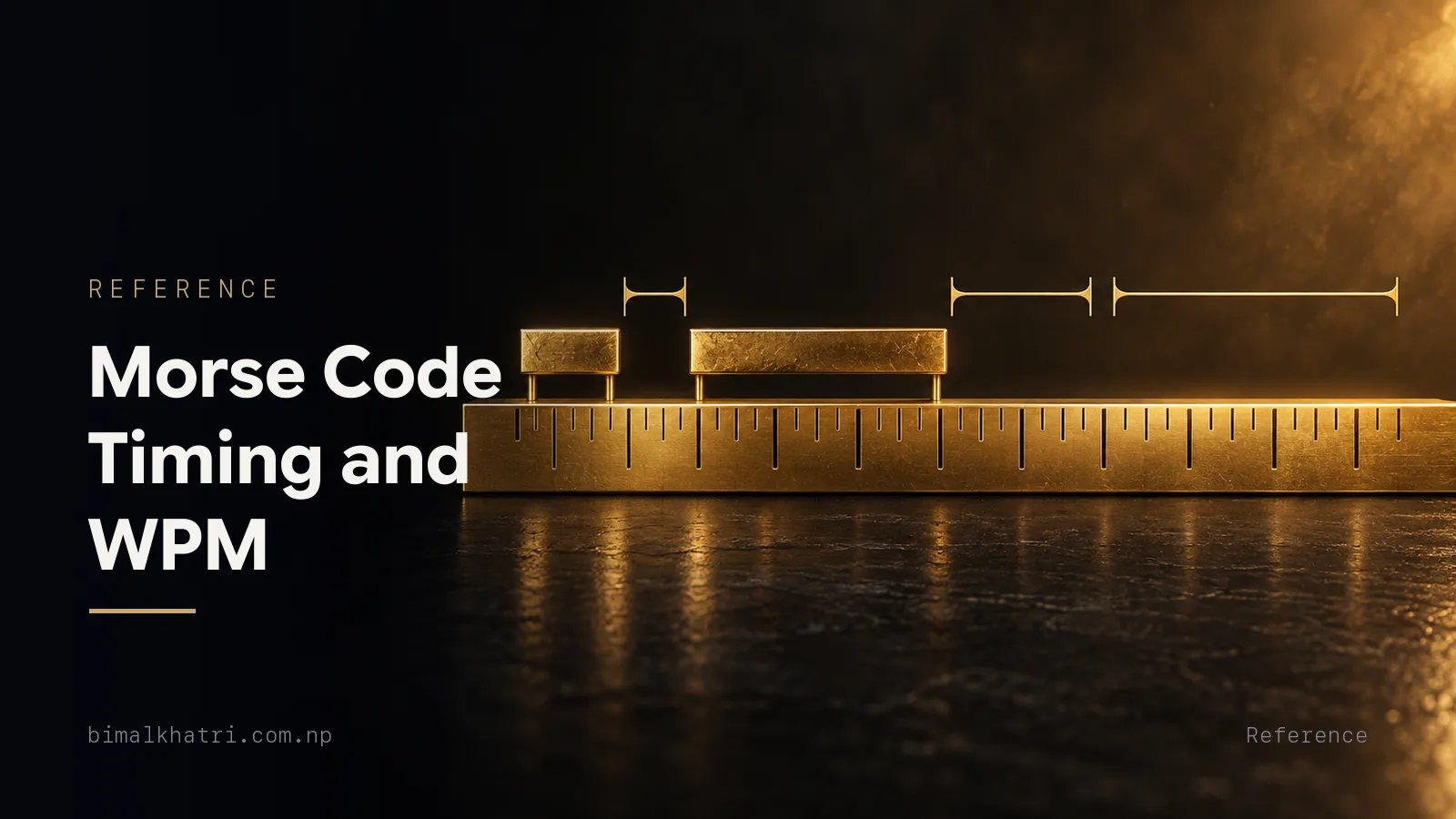
Morse code timing is arithmetic, not feel. Everything is measured in units, where one unit is the length of a dot. A dash is 3 units. The gap between the parts of one character is 1 unit, the gap between characters is 3, and the gap between words is 7. Those five numbers are the whole system.
Speed is quoted in words per minute, measured against the reference word PARIS, which is exactly 50 units long including the word gap that follows it. From that comes the only formula you need: dot length in seconds = 1.2 ÷ WPM. At 20 words per minute the dot is 60 ms, the dash is 180 ms, the gap between characters is 180 ms and the gap between words is 420 ms.
Morse is written here the way it is sent: a space between letters, and /
between words. So PARIS is .--. .- .-. .. ..., and ... --- ... is three
separate letters rather than the distress prosign.
Reading it is not the same as hearing it. MorseLab plays any text back as a tone, a flash or a vibration, free and offline.
The five numbers that define Morse timing
There are only two sounds and three silences. Get their lengths right and the code is readable at any speed. Get them wrong and no amount of practice will fix it, because the receiver is listening to the ratio, not to the absolute times.
| Element | Units | What it is |
|---|---|---|
| Dot | 1 | The short sound. Operators say "dit" |
| Dash | 3 | The long sound. Operators say "dah" |
| Gap inside one character | 1 | Silence between a character's own dots and dashes |
| Gap between characters | 3 | Silence that ends a letter |
| Gap between words | 7 | Silence that ends a word |
Written out in full, the ratio is 1 : 3 : 1 : 3 : 7. A dash is not "a bit longer" than a dot. It is exactly three times as long, and the silence that ends a word is exactly seven times a dot.
Here is the whole standard, ready to copy:
dot                     1 unit
dash                    3 units
gap inside a character  1 unit
gap between characters  3 units
gap between words       7 units

dot seconds = 1.2 / WPM

 5 WPM   dot 240 ms   dash 720 ms   word gap 1680 ms
12 WPM   dot 100 ms   dash 300 ms   word gap  700 ms
20 WPM   dot  60 ms   dash 180 ms   word gap  420 ms
25 WPM   dot  48 ms   dash 144 ms   word gap  336 ms
What 1:3:7 actually names
The short form 1:3:7 is the three silences: 1 unit inside a character, 3 units between characters, 7 units between words. The sounds carry their own ratio of 1:3, dot to dash.
Splitting it that way explains why the same string of dots and dashes can mean
two different things. Take - followed by .. If the silence between them is 1
unit, it is a single character, N: -.. If the silence is 3 units, it is two
characters, T then E. The dots and dashes are identical.
Only the silence decides.
That one idea does more work than the rest of the chart. Beginners hear the sounds and ignore the gaps, and then wonder why their copy is a soup of Es and Ts. The gaps carry as much information as the tones.
PARIS: why the reference word is 50 units
Words are not all the same length in Morse, so "words per minute" needs a reference word. The standard one is PARIS, chosen because it works out at exactly 50 units including the word gap after it, and because it sits close to the average length of English text.
| Character | Code | Units | Running total |
|---|---|---|---|
| P | .--. | 11 | 11 |
| gap | 3 | 14 | |
| A | .- | 5 | 19 |
| gap | 3 | 22 | |
| R | .-. | 7 | 29 |
| gap | 3 | 32 | |
| I | .. | 3 | 35 |
| gap | 3 | 38 | |
| S | ... | 5 | 43 |
| word gap | 7 | 50 |
Count any character the same way: 1 unit per dot, 3 per dash, and 1 unit of silence between each pair of elements. P is dot, gap, dash, gap, dash, gap, dot, which is 1 + 1 + 3 + 1 + 3 + 1 + 1, or 11 units.
Copy PARIS and send it against a clock if you want to check a keyer or an app:
PARIS
.--. .- .-. .. ...
At 20 words per minute, PARIS goes out 20 times in a minute. Twenty times 50 units is 1,000 units per minute, so a unit is 60 ms. That is where the formula comes from.
The formula: dot seconds = 1.2 ÷ WPM
The derivation is two lines. One minute is 60 seconds. At W words per minute you send 50 × W units in that minute. So one unit lasts 60 ÷ (50 × W) seconds, which simplifies to 1.2 ÷ W.
Every other duration follows by multiplication. Dash is 3 dots, character gap is 3 dots, word gap is 7 dots.
| WPM | Dot | Dash | Gap between characters | Gap between words |
|---|---|---|---|---|
| 5 | 240 ms | 720 ms | 720 ms | 1,680 ms |
| 10 | 120 ms | 360 ms | 360 ms | 840 ms |
| 12 | 100 ms | 300 ms | 300 ms | 700 ms |
| 15 | 80 ms | 240 ms | 240 ms | 560 ms |
| 18 | 66.7 ms | 200 ms | 200 ms | 467 ms |
| 20 | 60 ms | 180 ms | 180 ms | 420 ms |
| 25 | 48 ms | 144 ms | 144 ms | 336 ms |
| 30 | 40 ms | 120 ms | 120 ms | 280 ms |
| 40 | 30 ms | 90 ms | 90 ms | 210 ms |
Two things fall out of the table. Doubling the speed halves every duration, so the shape of the sound never changes. And at 40 words per minute a dot is 30 ms, which is shorter than most people can tap deliberately. Fast Morse is sent with a keyer that generates the elements, not by hand.
There is a second unit you will see in apps: characters per minute. PARIS has five characters, so CPM is simply five times WPM. Twenty words per minute is 100 characters per minute.
How long a message takes
Add up the units, then multiply by the dot length. Those two steps cover any text.
Take HELLO WORLD:
HELLO WORLD
.... . .-.. .-.. --- / .-- --- .-. .-.. -..| Part | Units |
|---|---|
| H E L L O, 7 + 1 + 9 + 9 + 11 | 37 |
| four gaps between those characters | 12 |
| gap between the two words | 7 |
| W O R L D, 9 + 11 + 7 + 9 + 7 | 43 |
| four gaps between those characters | 12 |
| Total | 111 |
There is no trailing gap after the final D, because nothing follows it. PARIS counts its trailing word gap only because the measurement repeats the word over and over.
| WPM | PARIS, 50 units | HELLO WORLD, 111 units |
|---|---|---|
| 5 | 12.00 s | 26.64 s |
| 12 | 5.00 s | 11.10 s |
| 20 | 3.00 s | 6.66 s |
| 25 | 2.40 s | 5.33 s |
At 111 units, HELLO WORLD counts as 2.22 PARIS-words. That is why a WPM figure never tells you exactly how long your own message will take. It tells you the unit rate, and you do the rest.
Not all characters cost the same
Because a dash is three dots, characters vary enormously in length. E is a
single dot, 1 unit. J is .---, which is 1 + 1 + 3 + 1 + 3 + 1 + 3, or 13
units. Q --.- and Y -.-- are also 13. So J takes thirteen times as long as E
to send, and at 20 words per minute that is 780 ms against 60 ms.
Digits are worse. Every digit is five elements, and 0 is -----, which runs 19
units, or 1.14 seconds at 20 words per minute. The
digits and punctuation reference has
the full set with their lengths.
Spacing changes length too, and the clearest example is the distress signal. SOS is a prosign, sent as one unbroken string with no letter gaps inside it:
SOS as a prosign   ...---...     23 units
S O S as letters   ... --- ...   27 units
The prosign is 9 elements with 8 one-unit gaps: 3 + 9 + 3 sounds plus 8 units of silence, which is 23. Sent as three separate letters the characters run 5 + 11 + 5 units, with two 3-unit gaps between them, which is 27. At 20 words per minute that is 1.38 seconds against 1.62. They are different signals, and the shorter one is the one that means distress. SOS also does not stand for Save Our Souls or Save Our Ship; those phrases were attached to it afterwards, and the pattern was picked because it is unmistakable. There is more in SOS in Morse code.
Farnsworth: two speeds in one signal
A beginner cannot copy 20 words per minute. The obvious fix is to slow everything down, and it is the wrong fix, because a dot and a dash at 5 words per minute sound nothing like they do at 20. The rhythm you learn is a rhythm you will have to unlearn.
Farnsworth timing solves this by using two speeds at once. Each character is sent at full speed, so the sound inside it is the sound you will hear later. The gaps between characters and words are stretched, which gives you thinking time without changing the shape of anything.
Here is what that looks like with characters at 20 words per minute, where the dot stays at 60 ms and the dash at 180 ms in every row. The extra time is shared out over the gaps, keeping their 3:7 relationship.
| Overall speed | Time for PARIS | Gap between characters | Gap between words |
|---|---|---|---|
| 20 WPM, no stretch | 3.00 s | 180 ms | 420 ms |
| 15 WPM | 4.00 s | 338 ms | 788 ms |
| 10 WPM | 6.00 s | 654 ms | 1,525 ms |
| 5 WPM | 12.00 s | 1,601 ms | 3,736 ms |
The arithmetic for the bottom row: the five characters of PARIS are 31 units long, which at 60 ms a unit is 1,860 ms. Five words per minute means PARIS must occupy 12,000 ms. That leaves 10,140 ms of silence to spread over four character gaps and one word gap, which is 19 gap-units, so each gap-unit becomes 533.7 ms. Three of those is the character gap, seven is the word gap. Software differs a little in how it shares out the extra time, so check the numbers your own tool reports rather than assuming.
This is also the point where two names get confused. Koch and Farnsworth are not competing methods and you do not choose between them. Koch is about which characters you learn and in what order: start with two, sent at full target speed, and add one more only once you are copying at 90% accuracy. Farnsworth is about spacing. They change different variables, so they combine, and combining them is the usual advice. The comparison of Koch and Farnsworth works through what each one actually changes.
I built MorseLab because timing is the part a chart cannot teach you. Reading that a dash is three units is easy; hearing 180 ms against 60 ms and telling them apart at speed is not. The translator plays any text back at a set speed as a tone, a screen flash, a flashlight blink or a vibration, so you can feel the ratio rather than read about it, and the Koch lessons keep the character speed high while stretching the gaps.
Sending by hand without counting
Nobody counts milliseconds while keying. Operators keep the ratio by saying the
sound in their head. A dot is "dit", a dash is "dah", and a character is spoken
as one word: A is "di-dah", N is "dah-dit", C -.-. is "dah-di-dah-dit".
Three habits keep hand-sent Morse readable:
- Send the gaps deliberately. Poor sending is usually not wrong dashes. It is ragged spacing, especially character gaps that shrink until two letters run together.
- Pick a speed you can hold. A steady 10 words per minute is easier to read than an unsteady 18. The receiving operator is tracking your unit length, and every change forces them to re-lock onto it.
- Do not stretch the dash when you hesitate. If you need a moment, take it in the gap. A four-unit dash sounds like a mistake; a long gap just sounds like a pause.
If you want to check your own fist, record yourself and play it into a decoder. A decoder locks onto the unit length and shows you what your spacing really said rather than what you meant. The guide to audio decoding covers what those tools can and cannot do.
Common mistakes
Treating the dash as "a bit longer". It is exactly three units. A dash at twice a dot is a common fault in hand-sent Morse, and it makes fast copy impossible because the receiver's ear is measuring a ratio.
Sending character gaps inside a character. If the silences inside your H
.... grow to 3 units, you have sent E E E E. The dots were right and the
message still failed.
Confusing character speed with overall speed. An app showing 20/5 means characters at 20 words per minute with the gaps stretched to an overall 5. It is not two settings for the same thing, and reporting the pair is more useful than reporting either number alone.
Slowing the characters down to learn. It teaches a rhythm you then have to discard. Stretch the gaps instead and leave the characters at target speed.
Treating Koch and Farnsworth as rivals. One sets character order, the other sets spacing. Use both.
Assuming SOS is three letters. It is one prosign, 23 units, sent with no letter gaps.
Expecting WPM to predict message length. It fixes the unit rate. A message full of digits and Js will take far longer than the same character count of Es and Ts.
Promising yourself a speed by a date. You can memorise the chart in a day. Copying by ear is a different skill and it takes weeks of daily practice. The honest answer on learning Morse in a day sets out what a day actually buys.
Writing Morse with the wrong characters. A middle dot, a bullet or a long dash looks correct and breaks the moment somebody copies it into a translator. Use a plain full stop and a plain hyphen.
Questions people ask
What is the 1:3:7 ratio in Morse code?
It is the three silences: 1 unit between the elements of a character, 3 units between characters, 7 units between words. The sounds add their own 1:3, dot to dash, so the full ratio written out is 1 : 3 : 1 : 3 : 7.
How do you calculate Morse code speed?
Dot length in seconds is 1.2 divided by the words per minute. At 12 words per minute that is 0.1 seconds, or 100 ms. Multiply by 3 for a dash or a character gap and by 7 for a word gap. The 1.2 comes from PARIS being 50 units long: 60 seconds divided by 50 units gives 1.2 second-units per word per minute.
Why is PARIS used to measure Morse code speed?
Because it is exactly 50 units long including the word gap after it, and because its mix of dots and dashes is close to the average of English text. Any reference word would do, but everyone has to agree on the same one, otherwise the same signal gets two different speeds.
How long is a dot at 20 WPM?
60 ms. The dash and the character gap are 180 ms each, and the word gap is 420 ms. At 5 words per minute the dot is 240 ms, and at 25 it is 48 ms.
What is a good Morse code speed?
The one you can copy accurately. Speed with errors is not speed, and the number that matters is the highest rate at which you still get the text right. Send at a speed you can hold steadily rather than the fastest you can manage for one word.
What is the difference between character speed and overall speed?
Character speed is how fast the dots and dashes inside a letter are sent. Overall speed is how much text gets through in a minute once the gaps are included. Farnsworth timing keeps the first high and lowers the second by stretching the silences.
Can I learn to copy at 20 words per minute in a day?
No. You can memorise the whole chart in a day, and that is worth doing. Copying by ear at any real speed is a separate skill built from short daily sessions over weeks. Anyone quoting you a number for it is guessing. The practical guide to learning Morse sets out a schedule that works.
Does the timing change for numbers and punctuation?
No. The same units apply to every character in the code. Digits simply cost more, because each one is five elements and 0 runs 19 units against the 1 unit of an E.
Do I have to count units when I send?
No, and nobody does. Say the character to yourself as dits and dahs, keep the gaps deliberate, and hold a steady speed. Counting is for checking a tool or working out how long a message will take, not for keying.
Keep reading
- The complete guide to Morse code, for how timing fits with the rest of the code.
- Koch and Farnsworth compared, the two methods that are constantly mistaken for alternatives.
- Learning Morse code by sound, which is where these units stop being arithmetic and become rhythm.
- The Morse code alphabet chart, if you want the letter lengths to count for yourself.
- Morse code numbers and punctuation, the slowest characters in the code.
Download it: MorseLab for iPhone and Android. Free, and the link picks the right store for you.