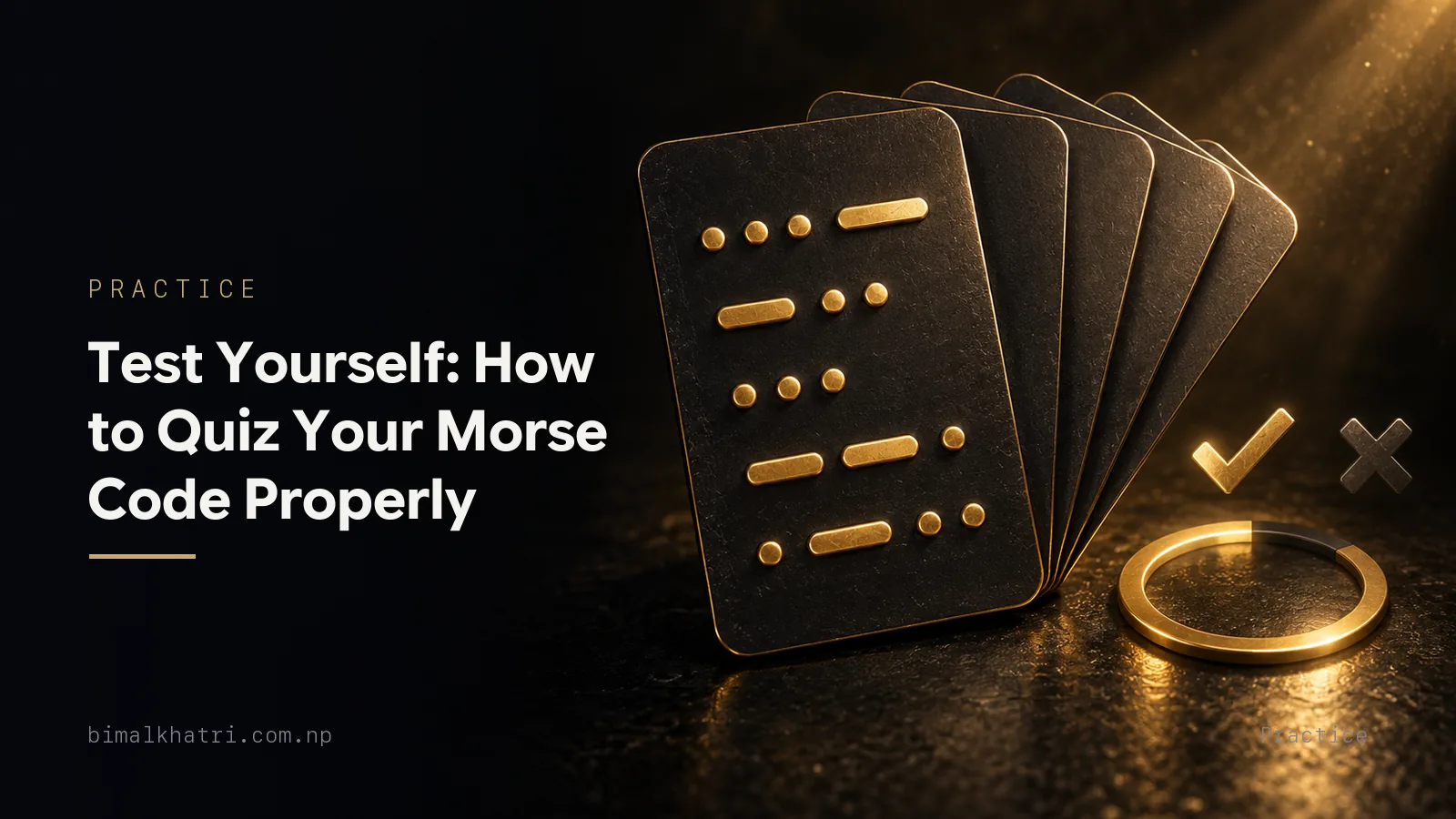
A real Morse code quiz tests one thing: can you hear a character and write down the right letter, at speed, with nothing to look at. Everything else is chart revision with a score attached.
So test in this order. Cover the chart and write the letters from memory. Then have something send you characters as sound and copy them on paper. Then send some yourself and check what comes back. The pass mark is the same for all three: 90% correct, which is the gate the Koch method uses before you are allowed to add a new character.
Below are four tests you can take right now, with answers, plus how to score them honestly and how often to repeat them. None of them needs a radio, a partner or a paid course.
Want to be tested, not just shown the chart? MorseLab plays random drills as tone, flash or vibration and scores every character, free and offline.
What a Morse quiz should actually test
There are three separate skills hiding behind the word "quiz", and they fail independently. Someone can score full marks on the chart and copy nothing by ear.
| Skill | How to test it | Why it matters |
|---|---|---|
| Chart recall | See a code, write the letter, chart out of sight | Reading Morse off a page, writing it down |
| Copying by ear | Hear a character, write the letter, at full speed | This is the actual skill |
| Sending | Key or tap a message, then decode the recording | Being understood by someone else |
Most quizzes online only test the first one, and many do not even do that. They show a code and four options, and you pick. Recognising the right answer in a list is much easier than producing it, so the score comes out flattering and means little. A useful quiz asks for the answer, not for a choice between four.
How the code is written on this page
A dot is . and a dash is -. Letters are separated by a space, words by /.
So this is the word TEST:
- . ... -Operators say the sounds rather than spelling them: a dot is a dit, a dash is a dah. T E S T is "dah, dit, di-di-dit, dah".
The pass mark, and how to count errors
Score by character, not by feel. Take the number of characters sent, count how many you wrote correctly in the right place, and divide.
A missed character is an error. A character written in the wrong slot is an error. Two letters swapped is two errors, not one. Being strict is the point: the number only helps you if it is uncomfortable.
| Test length | 90% means at most |
|---|---|
| 25 characters | 2 errors |
| 50 characters | 5 errors |
| 100 characters | 10 errors |
| 200 characters | 20 errors |
Ninety percent is not an arbitrary number. It comes from the Koch method, where you keep drilling the characters you have until you copy them at 90%, then add exactly one more. Under that, adding another character just spreads the damage.
One more rule: pass twice before you believe it. Everyone has a good run. Two sessions in a row at 90% is a level; one is luck.
Test 1: the chart test, two minutes on paper
Cover every chart you own. Write the letter or digit for each code. No pausing to sound them out on your fingers.
-.-..-.--..-..-...-.--..------...--.--.....--..-
Now the harder direction. Write the code for these:
Q, J, C, 7, V, 4.
Answers
| Item | Answer | Item | Answer |
|---|---|---|---|
1. -.- | K | 7. ..--- | 2 |
2. ..-. | F | 8. ---.. | 8 |
3. --. | G | 9. .--. | P |
4. .-.. | L | 10. --.. | Z |
5. -... | B | 11. ...- | V |
6. -.-- | Y | 12. -..- | X |
And the reverse: Q is --.-, J is .---, C is -.-., 7 is --..., V is
...-, and 4 is ....-.
If the digits were the weak part, they follow a pattern rather than needing raw memory. One to five add dashes from the right, six to zero mirror it with dots, and every digit is five elements long. The numbers and punctuation guide has the whole set.
Test 2: the confusion pairs
Characters do not get lost at random. They get swapped with their neighbours, and the same pairs cause almost all of it. Test these against each other rather than in a long alphabetical list.
| Pair | Codes | What goes wrong |
|---|---|---|
| E and T | . and - | Length, with nothing else to judge it by |
| I and M | .. and -- | Two of something, wrong something |
| S and O | ... and --- | Three of something |
| H and 5 | .... and ..... | Counting dots at speed never works |
| U and V | ..- and ...- | One dot apart |
| D and B | -.. and -... | One dot apart |
| G and Z | --. and --.. | One dot apart |
| A and N | .- and -. | Reversal — one read backwards is the other |
| F and L | ..-. and .-.. | Reversal |
| Q and Y | --.- and -.-- | Reversal |
| K and R | -.- and .-. | Every dot swapped for a dash; each reads the same backwards |
| P and X | .--. and -..- | Every dot swapped for a dash; each reads the same backwards |
Drill a pair the way the Koch method drills anything: only those two characters, sent at full speed, in random order, until you are at 90%. Guessing gets you 50% on a pair test, so anything near half is a fail, not a start.
The counting pairs are the tell. If H and 5 are costing you marks, you are counting dots rather than hearing a shape, and counting collapses somewhere around ten words per minute. The fix is speed, not slowness, and it is covered in reading Morse by sound.
Test 3: the ear test, the one that counts
This is the real quiz. Paste a line into a translator or an app, play it back as tone, write letters on paper, then check.
Rules that make it a test rather than a listen: play it once, do not pause it, write letters and never dots and dashes, and if you miss a character leave a gap and carry on. Stopping to work one out costs you the next three.
Start with five random groups. Random letters give you no context to guess from, which is why every serious practice run uses them.
-.- -- ..- .-. ...- . -. .- ...---- .. --. .... --...--. --.- ..-. -.-- -..-..... -... ....- ----. .--Then plain text, which is easier, because your brain fills gaps from meaning:
- .... . / --.- ..- .. -.-. -.- / -... .-. --- .-- -. / ..-. --- -..-... . -. -.. / -- . / .- / ... .. --. -. .- .-.. / .- - / ..--- ----- / .-- .--. --Score the random groups and the plain text separately. Plain text always scores higher and always flatters you.
Answers
| Line | Answer |
|---|---|
| 1 | KMURS |
| 2 | TENAV |
| 3 | OIGHZ |
| 4 | PQFYX |
| 5 | 5B49W |
| 6 | THE QUICK BROWN FOX |
| 7 | SEND ME A SIGNAL AT 20 WPM |
I built MorseLab because this test is tedious to run by hand. Generating fresh random groups, keeping the speed fixed, marking every character and remembering last week's score is work a phone should do. The quizzes, drills and games score you per character, the Koch lessons hand you the next character only at 90%, and the streak counter is there because two minutes daily beats an hour on Sunday. It runs offline, so a bus with no signal is still a test.
Test 4: the sending test
Receiving is half of it. Sending is the half nobody checks, and bad sending is worse than slow sending because the person on the other end cannot repair it.
Send a short message by tapping, with a torch, or on a key, and record it. Then decode the recording, either by having a phone listen to it or by playing it back to yourself a day later, when you have forgotten what you sent.
Send this, then check what comes back:
.-- .... .- - / .. ... / -.-- --- ..- .-. / -. .- -- .That is WHAT IS YOUR NAME. Mark yourself on three things:
- Every character correct.
- The ratio held: a dash is exactly three dots long, gaps inside a character are one dot, between characters three, between words seven.
- No hesitation in the middle of a character. A pause inside a letter splits it into two wrong ones.
The ratio is the part that fails first. Most beginners send dashes that are too short and word gaps that are far too short, which turns a sentence into one long run-on word. If you want to check that objectively rather than by ear, a Morse decoder will show you exactly what your sending says, and a torch is a fine transmitter for the purpose, as covered in sending Morse with a flashlight.
What speed should the test run at?
At the speed you are training at, and no slower. A test at 8 WPM tells you nothing about whether you can copy at 20, because slow characters have a different rhythm and are decoded by a different method: counting.
Speed is measured against the reference word PARIS, which is exactly 50 units long once you include the word gap after it. A unit is the length of one dot, and dot length in seconds = 1.2 ÷ WPM.
PARIS has five characters, so words per minute times five gives you characters per minute, which is all you need to size a test.
| WPM | Dot | Characters in one minute | Errors allowed at 90% |
|---|---|---|---|
| 5 | 240 ms | 25 | 2 |
| 12 | 100 ms | 60 | 6 |
| 15 | 80 ms | 75 | 7 |
| 20 | 60 ms | 100 | 10 |
| 25 | 48 ms | 125 | 12 |
One caution on the number. PARIS was picked because it is close to the average length of English text, and random letter groups are not average English text. So a group test at a stated 20 WPM can run a little longer than a minute and feel harder than plain sentences at the same setting. Compare group scores with group scores. The full arithmetic is in timing and WPM.
Three things a bad quiz gets wrong
SOS. Plenty of quizzes accept ... --- ... and stop there. SOS is a
prosign, sent as one unbroken sequence with no letter gaps inside it:
...---...Sent as three separate letters, with 3-unit gaps, it is a different signal. And it does not stand for "Save Our Souls" or "Save Our Ship". Those are backronyms invented afterwards; the pattern was chosen because it is unmistakable and easy to send. The full story is here.
Koch or Farnsworth. A quiz question asking which one is better is asking the wrong thing. Koch is about character order and progression: two characters at full target speed, add one more at 90%. Farnsworth is about spacing: full speed characters with stretched gaps between them. They change different variables, so they combine, and the usual setup uses both. The longer version explains why the comparison keeps appearing.
"Learn Morse in a day." You can memorise the chart in a day, and a chart quiz will happily confirm it. Copying by ear in a day is not a thing, because it is motor learning and it needs sleep between sessions. That gap between the two scores is the whole point of testing both, and the honest answer is here.
Common mistakes
Multiple choice. Four options turn recall into recognition and inflate the score. Write the answer down.
Testing slower than you train. A pass at half speed is not a pass.
Writing dots and dashes, then decoding afterwards. It feels like copying and it trains the wrong loop. Write letters, in real time, or write nothing.
Marking yourself generously. "I knew that one really" is not a correct answer. Count it wrong.
Testing the same 12 characters forever. Once you pass, the next test has a new character in it. A test you always pass has stopped measuring anything.
Only testing what you can receive. Send too, and check the recording. Half the skill is invisible otherwise.
Retesting immediately after a fail. You will remember the answers, not the characters. Come back tomorrow.
Treating one good score as a level. Pass twice, on different days.
Questions people ask
What is a good score on a Morse code quiz?
Ninety percent of characters correct, on a test you have not seen before, at the speed you actually train at. Below that, drill the same set again. Above it, add one character and retest.
How long should a Morse code test be?
Long enough that one lucky guess cannot move the score much. Fifty characters is a sensible minimum for a serious check, which is about 30 seconds at 20 WPM. Ten characters is a warm-up, not a test.
Are multiple-choice Morse quizzes any good?
They are fine as a first pass over the chart and poor as a measure of anything else. Picking the right code out of four is much easier than producing it, and neither one tells you whether you can hear the character. Use them for five minutes, then move to writing answers down.
Can I test myself without a partner or a radio?
Yes, and most people never use either. Anything that turns text into a tone will generate a test: paste in a line, play it once, write what you hear, then compare. Random letter groups are better than sentences because you cannot guess from meaning.
How often should I test myself?
Short and often. A few minutes at the end of each practice session, plus one longer honest test a week. Testing more than that eats the practice time that would improve the score.
What speed counts as knowing Morse code?
There is no official line. Around 20 WPM is a common target and comfortably enough for a real conversation on the air; 12 to 15 WPM is a genuinely useful level that most people reach first. Pick a target, test at it, and ignore anybody's leaderboard.
Why do I keep confusing H and 5?
Because you are counting dots. Four dots and five dots are different lengths but the same texture, and counting stops working somewhere around ten words per minute. Drill that one pair at full speed until the two sound like two different shapes rather than two different tallies.
Do quizzes work for children?
They work when they stop looking like quizzes. Score a torch-signalling game across a dark room, or a tapping round where one person sends a word and the other guesses. Same test, better packaging. There is more in Morse code for kids and scouts.
On your phone: MorseLab is free on both iPhone and Android.
Keep reading
- Morse Code Practice — the drill formats that produce something worth testing.
- How to Learn Morse Code — the full plan the 90% gate belongs to.
- Reading Morse by Sound — how to stop counting dots and start hearing shapes.
- The Morse Code Alphabet Chart — every letter, digit and punctuation mark to check your answers against.
- Koch vs Farnsworth — why the two methods stack instead of competing.