The trial is the practical test, and it is the half people fail. The likhit you can pass by reading. The trial you can only pass by practising, and most people show up having never ridden a figure-8 in their life.
The good news is that it is scored, not pass-or-fail on one mistake. Most offices mark you out of 100 across about seven stations and pass you at 70. A wobble costs points. It does not end your day.
Here is what each station is, where the points go, and the specific errors that cost them.
Trial coming up? Yatayat Likhit carries the trial checklists alongside the full written-exam bank. Free and offline.
How the scoring works
You start with 100 points and lose them for errors. Pass at 70 at most offices.
That number changes how you should ride or drive. It means:
- One mistake is survivable. Do not panic and abandon the rest of the test.
- Repeated small errors are not. A foot down on every loop of the 8 adds up faster than one clean mistake.
- The high-value stations matter most. For a bike, the figure-8 alone is worth about 20 points. Getting everything else perfect will not save a bad 8.
Marking varies a little between offices. Ask on the day, and watch the people ahead of you. You will learn the local standard in ten minutes.
The bike and scooter trial
The figure-8 (आठको घेरा)
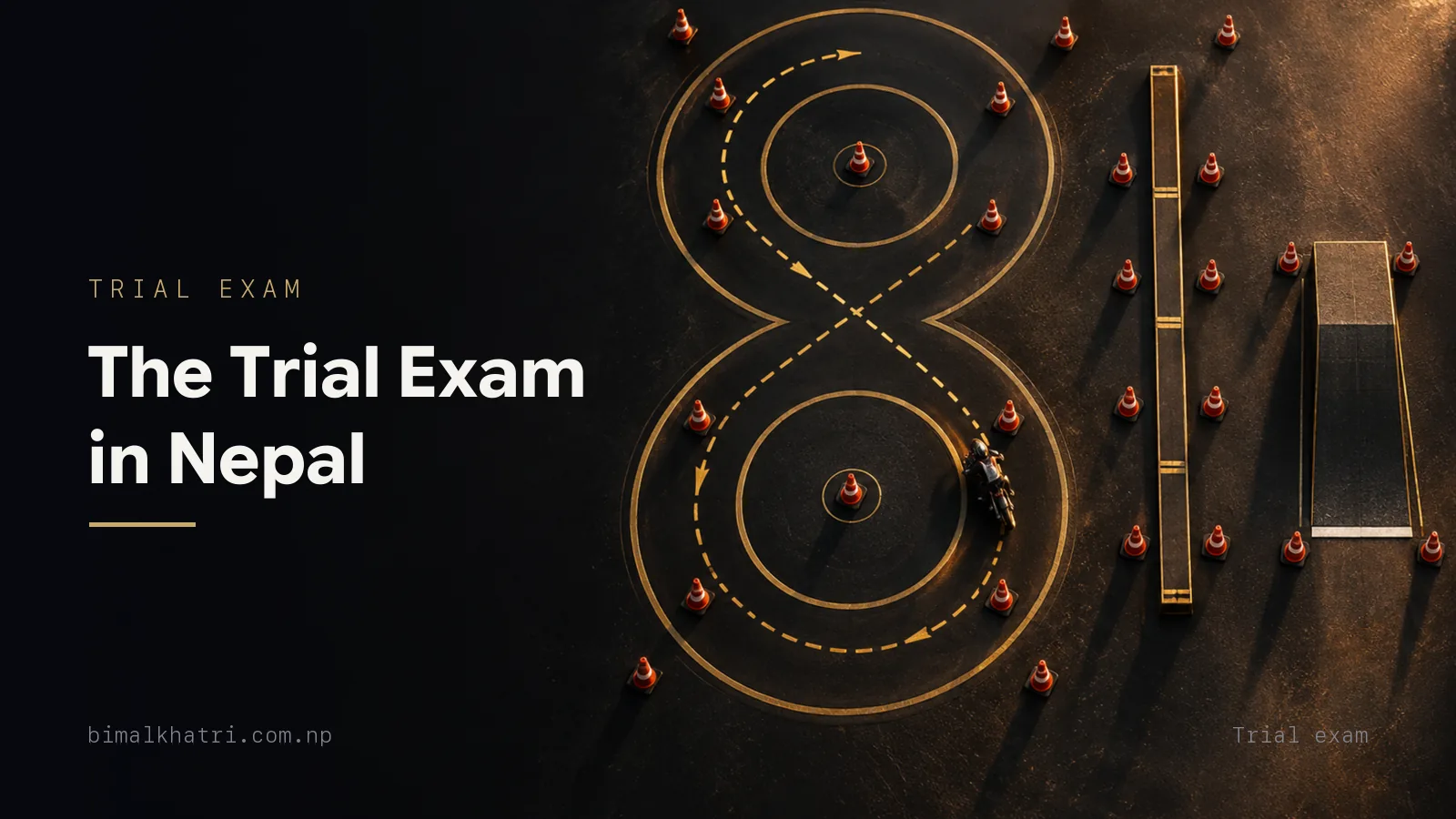
The one that decides it. Two circles joined in an 8, marked in yellow, each about 4 metres across. You enter from the right and ride one and a half rounds without touching a line and without putting a foot down.
Points come off for:
- putting a foot down
- touching or crossing a line
- stalling
- stopping in the middle
What actually works:
- First gear, walking pace, clutch slipping. Do not try to ride it fast. Speed is not what is being tested.
- Look where you want to go, not at the front wheel. This is the single biggest fix. A bike goes where you look. Riders who stare at the line ride onto the line.
- Rear brake, feathered. A gentle drag on the rear brake with the clutch slipping keeps the bike stable at low speed. Front brake at low speed makes it fall.
- Lean the bike, not your body. Push the inside bar gently and keep your weight upright.
Practise in an empty car park with two water bottles about 4 metres apart. Ten minutes a day for a week is genuinely enough for most people.
The other bike stations
| Station | What is tested | Common error |
|---|---|---|
| Straight narrow plank | Balance at very low speed | Foot down, or rushing it |
| Slope or ramp | Control on an incline | Rolling back, stalling |
| U-turn | Tight steering | Too wide, foot down |
| Start and stop | Smooth control | Stalling, jerky start |
| Signals and observation | Awareness | Forgetting the indicator or a shoulder check |
Signals are free points and people throw them away. Indicate before every turn, even in a marked ground where it feels silly.
The car trial
The figure-8
Same shape, more steering. You take the car through the 8 without touching the boundary. It tests steering control and how well you judge where the wheels are.
- Idle speed, clutch controlled. In most cars you can do the whole thing in first with the clutch, barely touching the accelerator.
- Turn the wheel early and unwind smoothly. Late, sharp corrections are what put a wheel over a line.
- Look through the turn, at where the car is going, not at the bonnet.
The hill start
You stop on an incline, then move off without rolling backwards.
The method: handbrake on, clutch to the biting point, a little gas, feel the car try to pull forward, release the handbrake, move away. The mistake is releasing the handbrake first and rolling back, which costs points immediately.
Find any slope and practise until it is automatic.
Parking
Usually garage or parallel parking between cones. Points come off for touching a cone, ending up outside the box, or taking too many attempts.
Go slowly. There is no time bonus. Slow, correct and two shunts beats fast and over a cone.
Why people fail
In rough order of frequency:
- Foot down in the figure-8. Almost always because they went too fast or looked at the wheel.
- Rolling back on the hill start. Handbrake released too early.
- Touching lines and cones. Judging position badly, usually from staring at the wrong place.
- Stalling repeatedly. Not enough clutch practice.
- Panicking after one error and dropping points on every station after it.
- Forgetting signals and observation. Free points, given away.
Five of those six are fixed by the same thing: slow down and look further ahead.
A two-week practice plan
You need a flat, empty space and two markers. An empty car park early in the morning, a quiet compound, a school ground at the weekend. Twenty minutes a day beats three hours on the Saturday before.
| Days | Bike and scooter | Car |
|---|---|---|
| 1–2 | Slow riding in a straight line, clutch slipping, feet up | Clutch biting point, move off and stop smoothly |
| 3–4 | One big circle each way, as slow as you can hold it | Full-lock circles both ways, looking through the turn |
| 5–7 | Join the circles into the 8. Wide at first, then tighten to 4 m | The 8 between markers, wide then tighter |
| 8–9 | The 8 at target size, aiming for zero feet down | Hill start until it is automatic |
| 10–11 | Add the plank, the ramp, the U-turn | Parking, both kinds, between cones |
| 12–13 | Full runs end to end, in order, with signals | Full runs end to end, with mirrors and signals |
| 14 | Light practice only. Rest and check the bike or car. | Same. Do not learn anything new the day before. |
Two things to build in from day one, because they are free points that people forget under pressure: signal before every turn, and check your mirror or shoulder before you move off. Do them every single run in practice and they will happen on their own on the day.
If you can only fix one thing, fix where you look. Riders and drivers who look at the line ride onto the line. Look at where you want the vehicle to end up and it goes there.
What to do on the day
- Arrive early and watch. You will see the exact track layout, where the examiner stands, and what they are marking.
- Walk the track if you can. Knowing where the 8 starts saves a bad entry.
- Use a bike you know. Borrowing an unfamiliar bike on trial day is a self-inflicted wound. Clutch bite and weight differ more than you think.
- Check the basics first. Tyre pressure, brakes, fuel, mirrors.
- Breathe. You need 70, not 100.
Prepare the written half too
The trial and the likhit are usually close together, and the trial is the one that needs a ground and a vehicle. So do the written work in the gaps: waiting for your slot, on the bus, the night before.
The likhit comes from a published DOTM bank of about 500 questions, which means it is one of the few exams where you can genuinely cover everything. I built Yatayat Likhit for that: the full bank with explanations, timed mocks, the road signs, trial checklists, and an Ishihara-style colour-vision test for the medical. Free, offline, Nepali and English. Get the written half banked early so trial week is only about the ground.
Download it: Yatayat Likhit for iPhone and Android. Free, and the link picks the right store for you.
Common mistakes
- Practising on the road instead of a car park. You need a flat, empty space and cones or bottles, not traffic.
- Riding the 8 fast. Speed is not scored. Control is.
- Staring at the front wheel. Look where you want to go.
- Skipping hill-start practice because it seems easy. It is the second biggest cause of car failures.
- Assuming one mistake is a fail. It is not. Keep going.
Questions people ask
How many points do you need to pass the trial in Nepal?
Most offices score out of 100 and pass at 70. Marking varies slightly by office, so confirm on the day.
How big is the figure-8 for the bike trial?
The circles are about 4 metres across. Two markers 4 metres apart gives you a realistic practice track.
What happens if I put my foot down in the figure-8?
You lose points, not automatically the test. Do it repeatedly and you will drop below the pass mark.
Can I use my own bike or car for the trial?
Generally yes, and you should if you can: familiarity with the clutch is worth more than any other preparation.
How soon can I retake the trial if I fail?
You reapply and take the next available slot. You do not have to redo the likhit if you have already passed it, but you do pay again and wait.
Keep reading
- The complete licence guide — where the trial fits in the whole process.
- What the likhit question bank asks — the written half.
- Bike and scooter questions — Category A and K specifically.
- Your province portal — booking your slot.
- The eye and colour-vision test — the medical, before either exam.
- The 70-point system in full — every deduction, station by station.
- Practising at home — the drills, with two bottles.
- If you fail — the retrial process.
- If you pass — how long until the card.
- What to take on trial day — the checklist.
- Finding your trial date — it is published as a name list, not sent to you.
- Driving schools and what they cost — when paying for ground time is worth it.
- Licence print check — for after you pass both halves.