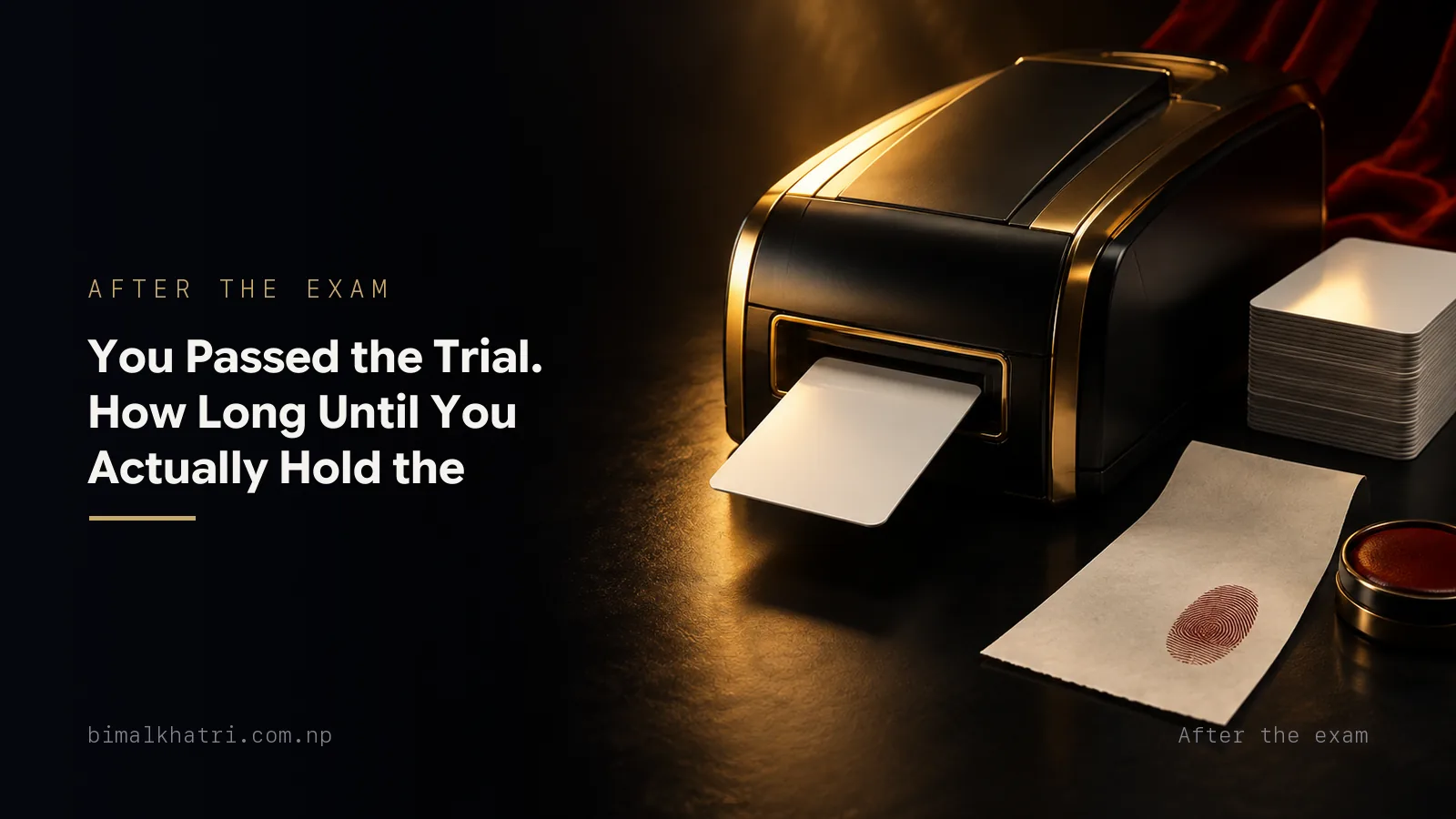
Passing the trial is not the last step. There is a fee to pay, a card to print and a trip back to the office before you actually hold a licence.
The short answer on timing: expect somewhere between about two weeks and two months. Reports range from 7 to 15 working days at the fast end to two to four weeks at the more common end, and longer in practice when a print batch is delayed.
Waiting anyway? Yatayat Likhit is worth passing to whoever is preparing next: the full DOTM bank, free and offline.
What happens, in order
1. You pass, and the office tells you what to pay. The final licence-issue fee comes after both exams, not before. Reported amounts are about Rs 1,500 for a motorbike and Rs 2,000 for a light four-wheeler. Fees are provincial now, so treat those as a guide and check yours. What a licence costs.
2. You pay, and your details go for printing. Nothing moves until the payment is recorded. Keep the receipt.
3. You are commonly given a temporary receipt. It is widely reported that this lets you drive legally until the card arrives. Ask your office directly whether yours does, and what it covers. Do not assume it, and do not treat a screenshot of a print-check website as a substitute. That is a status page, not a document.
4. The card is printed in a batch. This is the part that takes the time. Cards are not printed one at a time; your record joins a batch, goes to the Security Printing Centre and comes back.
5. You are told it is ready. An SMS is commonly sent. Do not rely on it alone: the published print list is the check that always exists. How to check the print list.
6. You collect it. At the office named in the print result, with your original citizenship and your payment receipt.
Why it takes as long as it does
Two separate delays stack, and knowing which is which saves a lot of worry.
Printing. Your record has to reach the printing centre, be printed and come back. The centre has said it aims to turn a licence around within 24 hours of receiving complete applicant data, so the queue is usually the data reaching it, not the printing.
Publishing. After the card is printed and delivered, the list saying so has to be published, and those lists update every two to four weeks. Your card can be sitting at your office before the notice that mentions it goes up.
That second delay is why people occasionally walk in on the off-chance and find the card waiting.
Before you make the trip
- Check the print list. A wasted trip is easy to avoid, especially outside the valley.
- Take the original citizenship. Some offices accept other ID, this one always works.
- Take your payment receipt and your application reference.
- Go early. Collection counters get busy late morning.
Check the card before you walk away
Thirty seconds at the counter, and it saves a fresh application later:
- Name spelling, exactly as on your citizenship
- Date of birth
- Blood group
- Every category you hold — if you added one, both letters should be there
- The expiry date
An error found at the counter is a correction. The same error found six months later is a new application, because these fields are printed on the card rather than editable afterwards.
While you wait
Two things worth doing on the day you collect it, not later:
Photograph both sides and store the images somewhere you can reach without the card: a cloud drive, not only the phone gallery.
Write the licence number down separately, in the format XX-XX-XXXXXXXX.
Nearly every later process (print checks, a duplicate application, insurance)
asks for it, and hunting for it is the slow part.
If it is ever lost.
If nothing happens for months
Give it a couple of print cycles first; one to two months is normal and not a sign of a problem. After that:
- Check your details were right. A misspelled name or wrong date of birth holds a record without anyone telling you.
- Email your office with your reference number, category and exam dates. Every office's contact.
- Go in person with your originals.
- Ask about the urgent list. DOTM publishes separate notices for urgently needed licences; ask what the process is at your office.
- Escalate to DOTM at gunaso@dotm.gov.np if your office cannot resolve it.
Adding a category later
If you already know you want another category, doing it around the same time saves a card cycle: one card carries every category you hold, so adding B to an A means a replacement card either way.
It does mean sitting the written exam and trial for the new category. The Category B paper has far more about clutch, gears, brakes and fluids than the bike paper did, so do not assume your old preparation carries over.
That is the loop I built Yatayat Likhit for: the DOTM bank kept separate per category, with the reason next to each answer, tracking of what you keep getting wrong, timed mocks in the exam format, the Nepali road signs and an Ishihara-style colour-vision test. Free, offline, Nepali and English, for A, K and B.
Get it: Yatayat Likhit — free on iPhone and Android. The link opens your own app store.
Insurance and the other documents
The licence is one of three documents you must be able to produce at a checkpoint. Sort the other two while you are waiting for the card.
| Document | What it is | Renewed |
|---|---|---|
| Driving licence | Yours, once the card arrives | Check the expiry printed on it |
| Bluebook | The vehicle's registration certificate | Annually, with the tax |
| Insurance | Third-party cover at minimum | Annually |
If the vehicle is not yours, make sure the bluebook and insurance are current before you ride it. A roadside check that finds no insurance is a separate problem from anything to do with your licence. Fines and what each costs.
Your first weeks on the road
Two habits worth building immediately, because the trial ground does not teach them:
Following distance. The trial is slow-speed control; real roads are about having time to stop. Leave room.
Mirrors before every move. In the trial it is worth points. On the road it is the whole thing.
Neither is examined again after trial day, and both are what the question bank was trying to teach you all along.
A realistic timeline
Rough, and it varies by office, but this is the shape people describe:
| Stage | Typical |
|---|---|
| Pass the trial | Day 0 |
| Pay the licence-issue fee | Same day, or the next visit |
| Record sent for printing | Days, once payment is recorded |
| Card printed and returned | Reported 7–15 working days at best |
| Print list published | Every 2–4 weeks |
| You see it and collect | 2 weeks to 2 months from the trial |
The wide spread at the end is publishing, not printing. That is worth knowing because it means checking the list is more useful than phoning.
Do not drive on a promise
The gap between passing and holding the card is where people take risks, so it is worth being blunt.
If your office issued a temporary receipt and told you it covers driving, carry it. If it did not, you are not licensed yet, however unfair that feels after passing both exams. Driving without a licence is its own offence and "the card is being printed" is not a defence at a checkpoint.
Ask the counter directly on the day you pay: does this receipt let me drive, and until when? Get the answer from them rather than from a friend who did it in a different province two years ago.
Questions people ask
How many days after passing the trial do I get my licence in Nepal?
Reports range from 7 to 15 working days at the fast end to two to four weeks more commonly, and longer when a print batch is delayed. Check the print list rather than waiting for a call.
Do I get a temporary licence after passing the trial?
A temporary receipt is commonly issued after you pay the licence fee, and is widely reported to let you drive until the card is ready. Ask your own office what yours covers rather than assuming.
How much do I pay after passing the trial?
The final licence-issue fee, reported at about Rs 1,500 for a motorbike and Rs 2,000 for a light four-wheeler. Fees are provincial, so confirm yours.
How will I know my licence is ready?
An SMS is commonly sent, but the published print list is the check that always works. Look for your office's list before travelling.
What if my name is wrong on the printed card?
Raise it at the counter before you leave. Correcting it afterwards is a fresh application rather than an edit.
Keep reading
- Licence print check — how to tell if your card exists yet.
- Failed instead? — the retrial process.
- What it all costs — including the issue fee.
- Transport office contacts — who to chase.
- Renewal, later — and the 35-day grace period.