Almost everything the trial tests can be practised in an empty car park with two water bottles. No school, no instructor, no money.
That is not an argument against driving schools, for a car, especially if you have no vehicle, they are worth it. It is an argument against showing up to your trial having never ridden a figure-8, which is what most people who fail actually did.
The written half is free to prepare for too. Yatayat Likhit has the published DOTM question bank. Free, offline, in Nepali and English.
What you need
| Thing | Notes |
|---|---|
| A flat, empty space | Car park early morning, quiet compound, school ground at the weekend |
| Two markers | Water bottles, bricks, chalk. Two is enough |
| A tape measure or a phone app | To get the figure-8 circles roughly right |
| The vehicle you will use on the day | This matters more than anything else here |
| 20 minutes a day | Beats three hours the Saturday before |
Use the vehicle you will actually be tested on. Clutch bite, weight and turning circle differ more than people expect, and trial day is the worst possible time to discover that.
Set up the figure-8
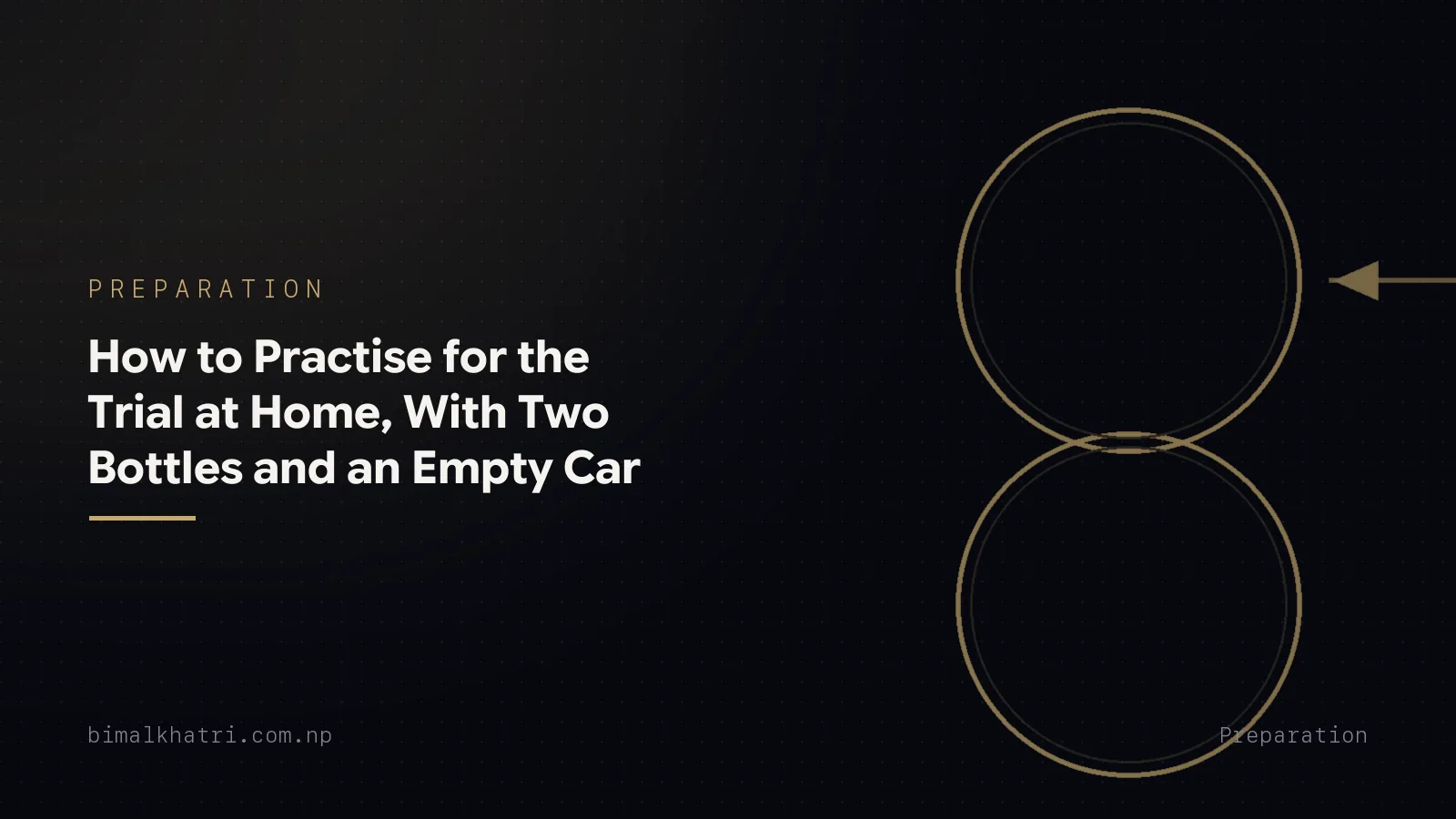
The single highest-value thing you can build. The circles are about 4 metres across, joined in a figure of eight.
- Put your two markers about 4 metres apart.
- Ride a circle around one, then cross over and circle the other, making the 8.
- Start wider than you need, and tighten as you get comfortable.
Once you can do it wide, bring it in to the real size. Being able to ride a tight 8 slowly is the whole skill.
The four things that fix the figure-8
Almost everyone who struggles is doing one of these wrong.
Look where you want to go, not at the front wheel. This is the big one. A bike goes where you look. Riders who stare at the yellow line ride onto the yellow line. Fix your eyes on the exit of the turn.
First gear, walking pace, clutch slipping. Speed is not being tested. Control is. Trying to ride it quickly is why people put a foot down.
Feather the rear brake. A gentle drag on the rear brake with the clutch slipping stabilises the bike at very low speed. The front brake at low speed makes it fall over.
Lean the bike, not your body. Push the inside handlebar gently and keep your own weight upright.
For a car it is the same idea with different hands: idle speed, clutch controlled, turn early and unwind smoothly, and look through the turn rather than at the bonnet.
The two-week plan
| Days | Bike and scooter | Car |
|---|---|---|
| 1–2 | Slow straight-line riding, feet up, clutch slipping | Find the clutch biting point; move off and stop smoothly |
| 3–4 | One big circle each way, as slow as you can hold it | Full-lock circles both ways, looking through the turn |
| 5–7 | Join them into the 8 — wide first, then tighten to 4 m | The 8 between markers, wide then tighter |
| 8–9 | The 8 at full size, aiming for zero feet down | Hill start until it is automatic |
| 10–11 | Add the plank line, the ramp, the U-turn | Reverse and garage parking between markers |
| 12–13 | Full runs end to end, in order, with signals | Full runs end to end, mirrors and signals |
| 14 | Light practice only. Check the vehicle. Rest. | Same. Learn nothing new the day before. |
Practise the free points too
Some of the easiest points have nothing to do with vehicle control, and people throw them away because they never practised them.
The safety check. Before you move off, check mirrors, tyres and brakes. Skipping it is a deduction on its own. Build it into every single practice run.
The indicator. Forgetting it on the U-turn costs the whole station. Signal every time in practice, even in an empty car park where it feels silly, until it happens without thinking.
The seatbelt, for a car. Four points for one second of effort.
Observation. A shoulder check before moving off. Free, and examiners watch for it.
These are worth more combined than most people's figure-8 improvement over two weeks. Exactly what each is worth.
Things that make practice worse
- Practising on a road. You need an empty space, not traffic. It is also illegal without a licence.
- Practising fast. Every station is scored on control.
- Only riding in a straight line because the turns are uncomfortable. The turns are the test.
- A different bike each session. Pick one and stay on it.
- Marathon sessions. Twenty minutes daily beats three hours weekly, because this is muscle memory, not knowledge.
- Skipping the boring stations. The plank and the slope end tests outright.
Where a school genuinely helps
Be honest about this rather than dogmatic.
Pay for training if you have no vehicle, if you have never driven a car at all, or if you have already failed once and want a few hours aimed at the exact station that beat you. Those are real gaps that a car park and two bottles cannot fill.
For a bike, if you can already ride and can borrow one, the free route covers almost everything. What training costs, and when it is worth it.
Do the written half in the gaps
Trial practice needs daylight, a space and a vehicle. The written exam needs none of that, which makes it the perfect thing to do on the bus, in a queue, or the evening before.
It comes from a published DOTM bank of about 500 questions, so covering all of it is realistic. I built Yatayat Likhit to run that on a phone: every question with the reason next to the answer, automatic tracking of what you keep getting wrong, timed mocks in the exam format, the Nepali road signs, trial checklists and an Ishihara-style colour-vision test for the medical. Free, offline, Nepali and English, for categories A, K and B.
On your phone: Yatayat Likhit is free on both iPhone and Android.
Practising the other stations
The figure-8 gets the attention. These are quicker to fix and each ends the test outright if you get it badly wrong.
The narrow plank. Chalk two lines about as wide as a plank, or use the edge of a car park bay. Ride slowly and straight, eyes up and well ahead: looking down at the front wheel is what makes people wobble off it. A single foot down ends this station, so treat it as a balance drill rather than a speed one.
The slope or ramp. Any incline will do, including a car park entrance ramp. For a bike: stop halfway up, hold it on the rear brake, move off without rolling back. For a car: handbrake on, clutch to the biting point, feel the car want to pull, then release.
The speed breaker. A kerb edge or a chalk line works. Approach slowly in first gear, keep the throttle steady, do not brake on it.
The U-turn. Two markers and a lane width. Signal, shoulder check, turn tight, straighten. The indicator is worth more than the turn itself.
Traffic light. Nothing to practise physically: just decide now that you will stop on amber rather than push through it.
Riding or driving with someone watching
If you can, get one person to stand and watch a full run and tell you what they saw. You cannot see your own foot come down, and you certainly cannot see yourself forget an indicator.
Ask them to note three things only: feet down, line touches, and missed signals. That is most of the mark sheet, and a friend with a phone camera is close enough to an examiner for practice purposes.
Questions people ask
How can I prepare for the trial exam at home?
Find a flat empty space, put two markers about 4 metres apart, and practise the figure-8 in first gear at walking pace with the clutch slipping. Twenty minutes a day for two weeks covers most of the test.
How big should my practice figure-8 be?
About 4 metres across per circle, which is roughly the real track. Start wider and tighten as you improve.
Do I need a driving school to pass the trial in Nepal?
No, it is not required. It helps most if you have no vehicle, have never driven a car, or have already failed once and need a few targeted hours.
Why do I keep putting my foot down in the figure-8?
Usually too fast, or looking at the front wheel. Slow to walking pace, slip the clutch, feather the rear brake, and look at where you want to exit the turn.
Can I practise on the road?
No. You need a flat empty space, and riding on a public road without a licence is an offence in its own right.
How long before the trial should I start practising?
Two weeks at twenty minutes a day is comfortable for most people. One session the day before is not preparation.
Keep reading
- The 70-point system — what each mistake costs.
- The trial, station by station — technique for each one.
- Failed already? — the retrial process and what to drill.
- Driving school costs — when paying is the right call.
- What to take on the day — the checklist.