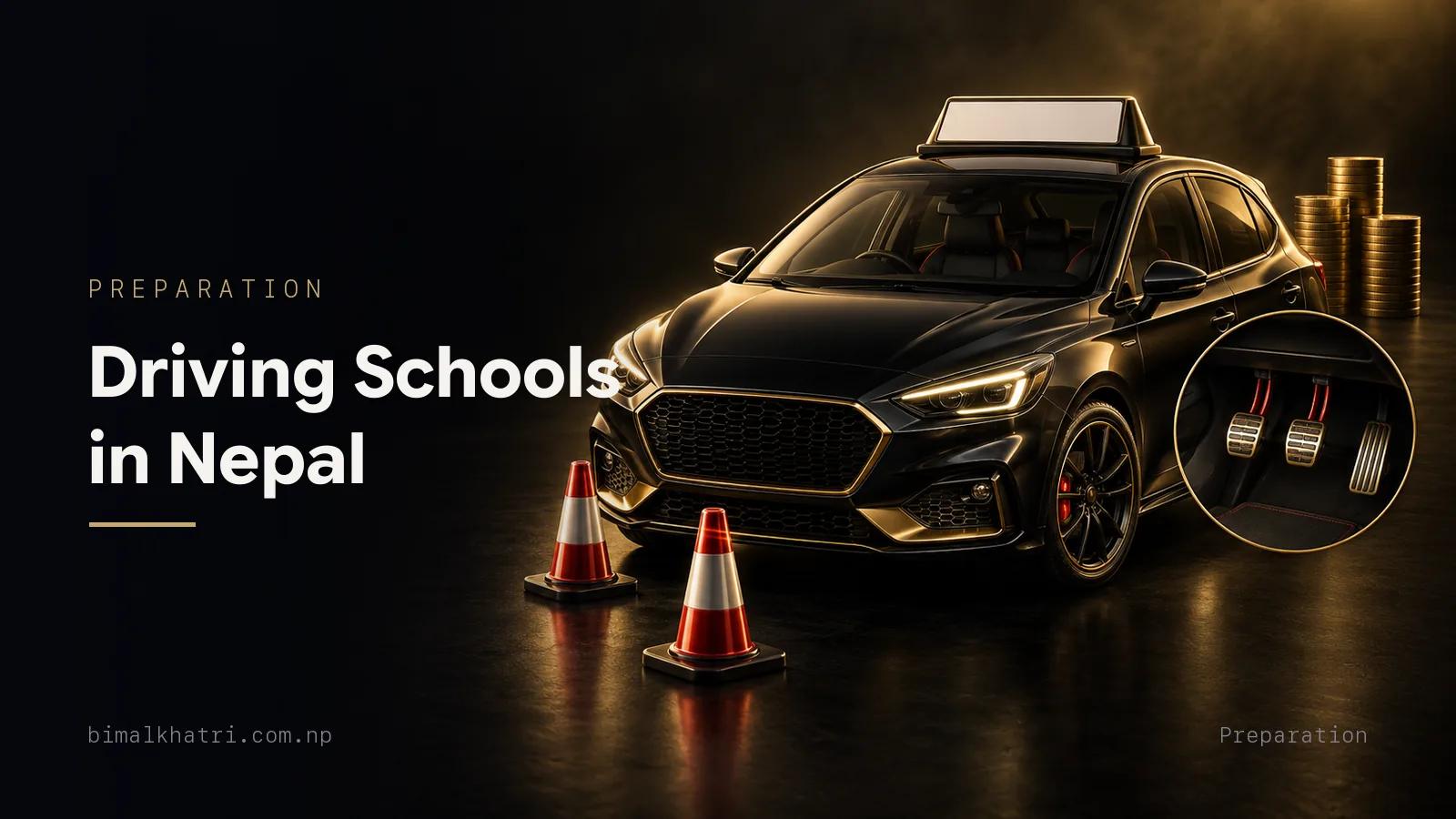
A driving school is worth paying for one half of the licence process and mostly wasted on the other. Knowing which half saves you money.
The written exam does not need a class. DOTM publishes the question bank free. Anyone charging you to "teach" you those questions is selling a public document back to you.
The trial is different. It needs a vehicle, a flat empty space and someone watching you. If you do not have all three, a school is the cheapest way to get them.
The written half needs no paid class. Yatayat Likhit has the published DOTM bank free, offline, in Nepali and English.
What training costs
Reported ranges — treat them as a guide and get a written quote before you pay.
| Course | Reported cost | Typical length |
|---|---|---|
| Bike or scooter | NPR 5,000 – 8,000 | 10 – 15 days |
| Car | NPR 7,000 – 18,000 | 15 – 30 days |
| Car, typical mid-market | NPR 10,000 – 15,000 | 15 – 20 days |
| Car, hourly | NPR 600 – 3,500 per hour | — |
Prices run higher in Kathmandu than in Pokhara or smaller towns. The spread inside a single city is mostly location and reputation, not teaching quality, so the most expensive school on the ring road is not automatically the best one.
On duration, the common view is that about 15 days is enough to pass the car trial, and 20 to 30 days is what it takes to be genuinely comfortable on real roads. Those are different goals. Decide which one you are buying.
When a school is worth it
Pay for training if any of these is true:
- You have never driven a car. Clutch control is the whole Category B trial and it is very hard to self-teach without a car and a patient owner.
- You have no access to a vehicle. This is the big one. The school's car is often most of what you are paying for.
- You have nowhere to practise. The figure-8 needs a flat empty space. If your only option is a live road, do not.
- You have already failed once. A few hours aimed at the exact station you failed is cheaper than another full attempt and another wait for a slot.
- You want confidence, not just a pass. Perfectly reasonable, and worth the longer course.
When it is not
Skip it, or buy much less of it, if:
- You already ride a bike confidently. For Category A, an empty car park and two water bottles reproduce the figure-8 for free. Ten minutes a day for a week fixes most people.
- You only need the written exam. The bank is published. See below.
- You already have a car and someone to sit with you. Then you are paying for supervision you already have.
- Someone offers a "guaranteed licence". No school controls the examiner. A guarantee is a marketing line, and occasionally worse than that.
Choosing a school
Things that actually predict a good experience:
- Ask how many hours you get, not how many days. "20 days" can mean twenty 20-minute turns shared with three other students.
- Ask whether you get trial-ground practice, specifically the figure-8, the hill start and parking. Road driving alone does not prepare you for the trial.
- Ask about the vehicle. You want to train on something close to what you will use on the day. Clutch bite varies more than people expect.
- Ask whether the fee includes the government fees. Usually it does not.
- Get it in writing. Hours, vehicle, ground practice, what happens if you fail.
- Be sceptical of guarantees, and of anyone offering to "arrange" a pass. That is not a service, it is a risk you are taking on.
The costs a school does not cover
Budget the whole thing, not just the tuition:
| Item | Notes |
|---|---|
| Government fees | Provincial since FY 2083/84 — check your own portal |
| Smart card print | Reported NPR 200 |
| Medical and photos | Small |
| Travel to the office | Several trips |
| Resit | The full fee again, plus weeks of waiting |
What the licence itself costs has the province-by-province picture.
The free half, done properly
The written exam is genuinely free to prepare for, and it is half the process. DOTM publishes the sets:
A and K   dotm.gov.np/content/112/written-test-questions-2082-83-for--ak--class/
B         dotm.gov.np/content/111/-b--written-examination-questions-for-class-2082-83/
What a class adds over reading those yourself is mostly structure. You can get the same structure for nothing: read the whole bank once, answer it cold, write down what you got wrong, drill only that, then take timed mocks.
I built Yatayat Likhit to run that loop on a phone: the full bank with the reason next to each answer, automatic tracking of what you keep missing, timed mocks in the exam format, the Nepali road signs, trial checklists, and an Ishihara-style colour-vision test for the medical. Free, offline, Nepali and English, for categories A, K and B. Spend your money on trial-ground time instead.
Get the app: Yatayat Likhit, free and offline, on iPhone and Android.
Practising for the trial without a school
If you can borrow a bike and find an empty space, this is a complete programme:
| Days | What to do |
|---|---|
| 1–2 | Slow riding in a straight line, clutch slipping, feet up |
| 3–4 | One big circle each way, as slow as you can hold it |
| 5–7 | Join them into the figure-8, wide at first, then tighten to about 4 m |
| 8–9 | The 8 at target size, aiming for zero feet down |
| 10–11 | Add the plank, the ramp, the U-turn |
| 12–13 | Full runs end to end, with signals |
| 14 | Light practice only. Rest. |
For a car, swap the middle days for clutch biting point, full-lock circles, hill starts and parking. Every trial station has the detail.
Common mistakes
- Paying for written-exam coaching. The questions are public.
- Buying days instead of hours.
- Training only on roads and never on a trial ground.
- Believing a guaranteed pass.
- Learning on a vehicle nothing like the one you will use.
- Forgetting the government fees are separate.
What a good lesson looks like
If you are paying by the hour, you should be able to tell whether you are getting value. A useful car lesson has most of these in it:
- You drive for most of it. Watching the instructor drive is not a lesson.
- One clear objective. "Today we fix the hill start" beats "today we drive around".
- Trial-ground work, not only road work. The test is on a marked ground.
- Feedback while you are doing it, not a summary at the end.
- Something to practise before next time.
If three lessons in you still have not touched a figure-8 or a hill start, say so and ask for them. You are paying for the trial, not for a tour.
The honest comparison
Where the money actually goes for a Category B licence, roughly:
| Route | Cost | What you get |
|---|---|---|
| Full school course | NPR 10,000 – 18,000 | Vehicle, ground, instructor, structure |
| A few targeted hours | NPR 3,000 – 8,000 | Fixes one or two specific stations |
| Own car plus a patient friend | Fuel only | Everything except structure and a ground |
| Nothing at all | Free | Fine for the written half, risky for the trial |
For Category A the calculation shifts hard toward the free end, because a bike, a car park and two bottles genuinely reproduce the test.
Questions people ask
How much does driving training cost in Nepal?
Reported at about NPR 5,000–8,000 for bike or scooter and NPR 7,000–18,000 for car, with 10,000–15,000 typical. Kathmandu runs higher than smaller cities.
How many days of driving training do I need?
About 15 days is commonly described as enough to pass the car trial. 20 to 30 days is what it takes to be confident on real roads.
Is a driving school compulsory in Nepal?
No. It is optional. It helps most with the practical trial, especially for a car.
Do I need a class for the likhit exam?
No. DOTM publishes the question bank free, and the exam is drawn from it.
Is a "guaranteed licence" course real?
No school controls the examiner. Treat a guarantee as marketing, and be wary of anyone offering to arrange a result.
Does a driving school arrange my licence application for me?
Some offer to help with the form. The application is still yours, on your province portal, and the fees are separate from the tuition.
Can I use the school's vehicle for the trial?
Often yes, and many schools include it. Ask before you enrol, and make sure you have trained on that exact vehicle.
Keep reading
- The trial exam, station by station — what the training is actually for.
- Practising at home for free — what a school is not needed for.
- A two-week tayari plan — the free half.
- What a licence costs — the fees a school does not cover.
- Licence categories — train for the right one.
- The complete licence guide — every step, in order.