Most people who fail the likhit did not fail because it is hard. They failed because they studied a list of "important questions" someone posted, and the paper asked something else.
The likhit is the written half of the Nepali driving licence exam. It is the half you can guarantee, which is exactly why failing it stings.
The exam is drawn from a published DOTM bank of about 500 questions. Cover the bank properly and passing on the first attempt is close to routine. Cover a shortcut list and it is a coin flip.
This is a two-week plan that works. About an hour a day. No class, no money.
Two weeks to go? Yatayat Likhit runs this exact loop for you and remembers what you keep getting wrong. Free and offline.
Why first-attempt matters
Failing is not a disaster, but it is expensive in the way that actually hurts: you reapply, you pay again, and you wait for another appointment slot. Under the province eDLVRS system, slots come in batches, so a resit can cost weeks rather than days.
Two weeks of proper preparation is cheaper than one resit. That is the whole argument.
The method, in one paragraph
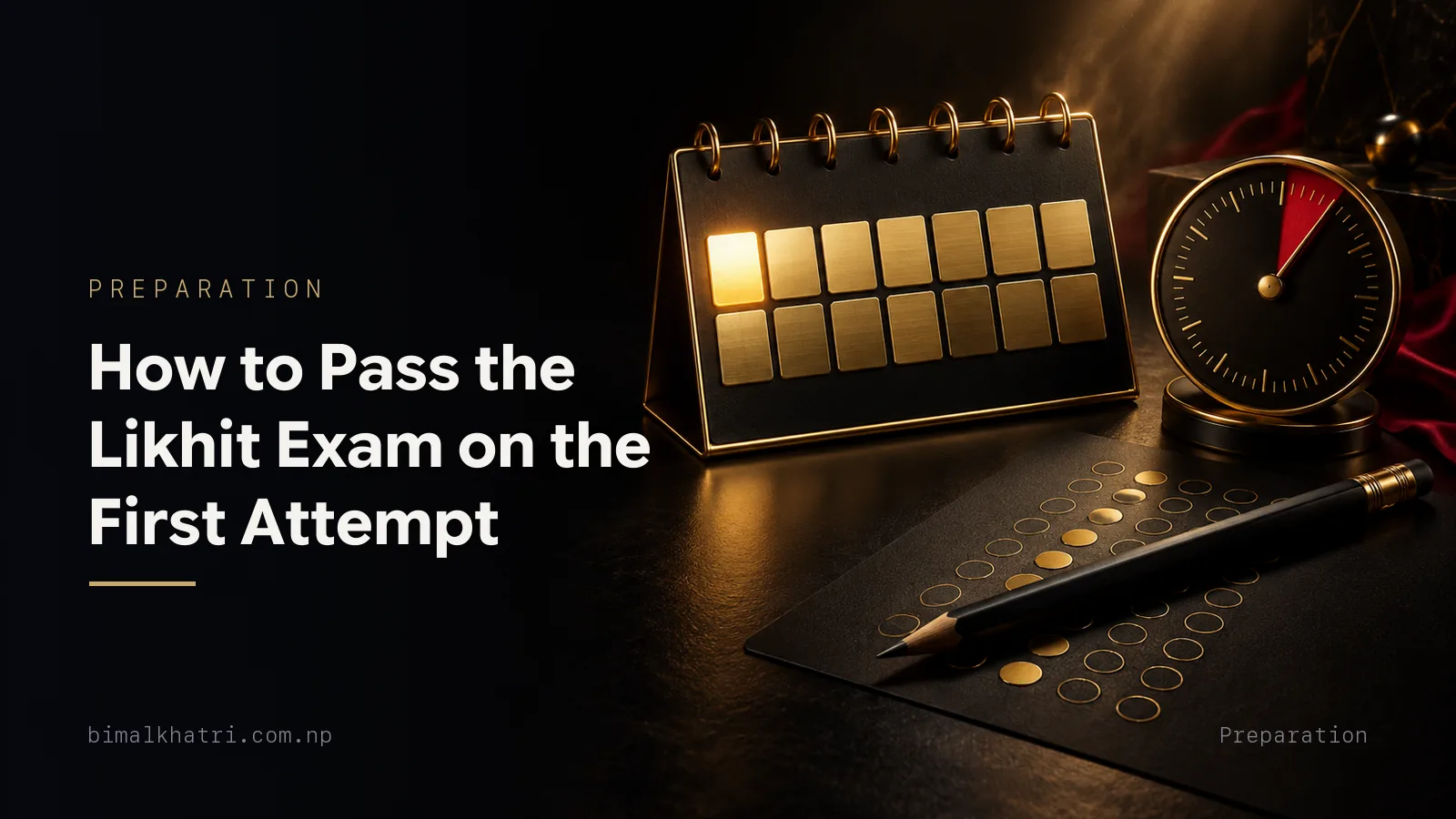
Read everything once without testing yourself. Then answer everything once and write down what you got wrong. Then drill only the wrong list until it is empty. Then take timed mocks until you clear the pass mark twice in a row. That is it. The order matters more than the hours.
Week 1 — cover the ground
Days 1 to 3: read the whole bank with the answers showing.
Do not test yourself. You are not trying to score, you are meeting the material. Testing yourself on things you have never seen just teaches you that you do not know them, which you already knew.
Read in Nepali. The paper is in Nepali. If you study in English and then read a Nepali question under time pressure, you have added a translation step you do not need.
Day 4: signs only.
Learn the shape rule and most sign questions answer themselves:
| Shape | Meaning |
|---|---|
| Triangle | Warning |
| Circle | Must do, or must not do |
| Octagon | Stop |
| Rectangle | Information |
An hour here is worth more than an hour anywhere else in the syllabus, because sign questions are quick as well as easy. The full sign guide has the groups with Nepali names.
Days 5 and 6: the vehicle section.
Engine, clutch, brakes, oil, coolant, battery, tyres. This is the section people skip because it feels unrelated to driving, and it is the section that decides results. You cannot reason your way to what a spark plug does. You have to read it once.
Day 7: rules and law.
Right of way, overtaking, documents, parking, penalties. Anchor everything to two facts and much of it follows: Nepal drives on the left, and you overtake on the right.
Week 2 — find your weak spots and kill them
Day 8: answer the whole bank cold.
No notes. Write down every question you got wrong. That list is now your real syllabus. For most people it is 80 to 120 questions, not 500, and suddenly the job looks small.
Days 9 to 11: drill the wrong list only.
Go through it again and again until it is empty. Every time you get one right twice in a row, take it off the list. Every time you get one wrong, understand why before moving on.
This is the part people skip, and it is the part that works. Re-reading things you already know feels productive and teaches you nothing.
Days 12 and 13: timed mocks.
Full papers, timed, in the exam format. You are practising two separate skills here: knowing the answers, and staying calm with a clock running. They are not the same skill.
One caution on where you practise. Search for a driving licence practice test and most of what comes back is written for American or Indian licensing. Those sites teach right-hand traffic, different signs and a different question bank. Nepal drives on the left. Use the DOTM set.
Target: clear the pass mark twice in a row before you stop.
Day 14: light review, then stop.
Skim your wrong list. Check your documents. Sleep. Learning something new the night before does not help and the anxiety does harm.
Where the marks actually are
Not every topic is worth the same amount of your time. This is roughly how the bank divides up, and how much effort each part deserves.
| Topic | Share of the paper | Effort it needs | Why |
|---|---|---|---|
| Traffic rules and law | Largest | Medium | Mostly logical once you know left-hand traffic |
| Road signs and markings | Large | Low | The shape rule answers most of them |
| Vehicle and engine | Medium | High | Pure recall. You cannot reason it out |
| Maintenance | Medium | Low | Follows from the vehicle section |
| Road safety | Medium | Low | The cautious answer is almost always right |
| First aid | Small | Low | A handful of facts |
| Pollution | Small | Low | A handful of facts |
Read that table again and notice the mismatch. Signs are a large share of the paper and need the least work. Engine questions are a medium share and need the most. Most people do the opposite: they enjoy the signs, keep re-reading them, and never open the engine section.
Spend your hours where the table says, not where the studying feels comfortable.
The two rules that answer questions you have not seen
When you genuinely do not know, these two beat guessing:
- The careful answer is usually right. Slow down, check, wait, keep distance, get it inspected. The bank is written to teach safe habits.
- Anything that reduces your control is wrong. Coasting in neutral, riding the clutch, braking mid-corner, overtaking on a bend, using a phone.
Between them they cover a surprising share of the safety and rules sections.
The tool
You can do all of the above with the DOTM PDFs and a notebook. Plenty of people have.
What a notebook cannot do is remember what you got wrong last Tuesday and put it in front of you again today. That tracking is the difference between drilling your actual weak spots and re-reading things you already know.
That is why I built Yatayat Likhit. It runs this exact loop: the full 500-question bank with the reasoning next to each answer, automatic tracking of what you keep missing, timed mocks in the real format, the road signs, trial checklists, and an Ishihara-style colour-vision test so the medical is not a surprise. Free, offline, Nepali and English, categories A, K and B.
Get it: Yatayat Likhit, free on iPhone and Android. The link sends you to whichever store your phone uses.
Use it or use paper. Just run the loop.
Exam-day tactics
- Answer every question. No penalty for wrong answers, so a blank is a guaranteed zero and a guess is not.
- Do the signs first. Seconds each. Bank them, then spend your time on the law and engine questions.
- Read the whole question. The bank uses "which is not" wording often enough to catch skimmers.
- When two answers look right, pick the more cautious one. The bank rewards care almost every time.
- Do not change an answer without a reason. First instincts on factual recall are usually right.
If your exam is in three days, not two weeks
Compressed version:
- Day 1: Read the whole bank with answers showing. Signs twice.
- Day 2: Answer everything cold, write the wrong list, drill it.
- Day 3: Two timed mocks, then re-drill whatever is still wrong.
It is not as good as two weeks. It is much better than reading a shortcut list.
Common mistakes
- Studying "important questions only". That is someone's guess. The real set is public and finite.
- Studying in English for a Nepali paper.
- Re-reading what you already know instead of drilling what you do not.
- Never practising against a clock.
- Ignoring the engine and maintenance section.
- Leaving the trial until after the likhit. Figure-8 practice is free and needs no permission. Start it now.
What to bring on the day
Sort this the night before, not on the morning.
- Original citizenship certificate. A photocopy is not accepted.
- Your application receipt or token from the province portal.
- A pen. Do not assume one will be handed to you.
- Your appointment details — office, date, time, category.
Arrive early. Names are called in batches, and turning up late can push you to a later sitting or a later day. Phones are put away before the paper starts, so plan on no last-minute revision.
Questions people ask
How many days does it take to prepare for the likhit exam?
Two weeks at about an hour a day is comfortable for most people. Three days is possible if you use them properly. One evening of reading a shortcut list is not.
Should I study likhit tayari in Nepali or English?
Nepali. The official paper is in Nepali, so practise in the language you will be tested in.
Is it worth paying for likhit classes?
For the written exam, generally no: the questions are published and free. Classes help most with the practical trial, where a ground and a vehicle matter.
What is the pass mark for the likhit exam?
It varies by category, office and year. Reported figures include 60 out of 100 and 40 out of 50. Check the notice at your own transport office (yatayat karyalaya, यातायात कार्यालय).
How do I know which questions I keep getting wrong?
Write them down as you go, or use an app that tracks it. Either way, that list is the only part of the syllabus that still needs work.
Keep reading
- What the question bank asks — the seven topics, with examples.
- Bike and scooter questions — Category A and K.
- Car questions — Category B.
- The trial exam — the half you have to practise for.
- Nepali exam vocabulary — about sixty words worth an evening.
- Which practice app to use — the six features that matter, and how to check them.
- The eye and colour-vision test — do this early, not on the day.
- Every traffic sign, by shape — the fastest marks in the paper.
- Traffic fines and rules — the law section, in real-world form.
- Where your result appears — after you sit it.