Traffic sign questions are the cheapest marks in the driving licence written exam. They take seconds, they are a large share of the paper, and you can often answer one you have never seen because the shape and the colour tell you the category before you read a single word.
This is the sign reference for the Nepali likhit exam, and it doubles as the one you actually need on the road.
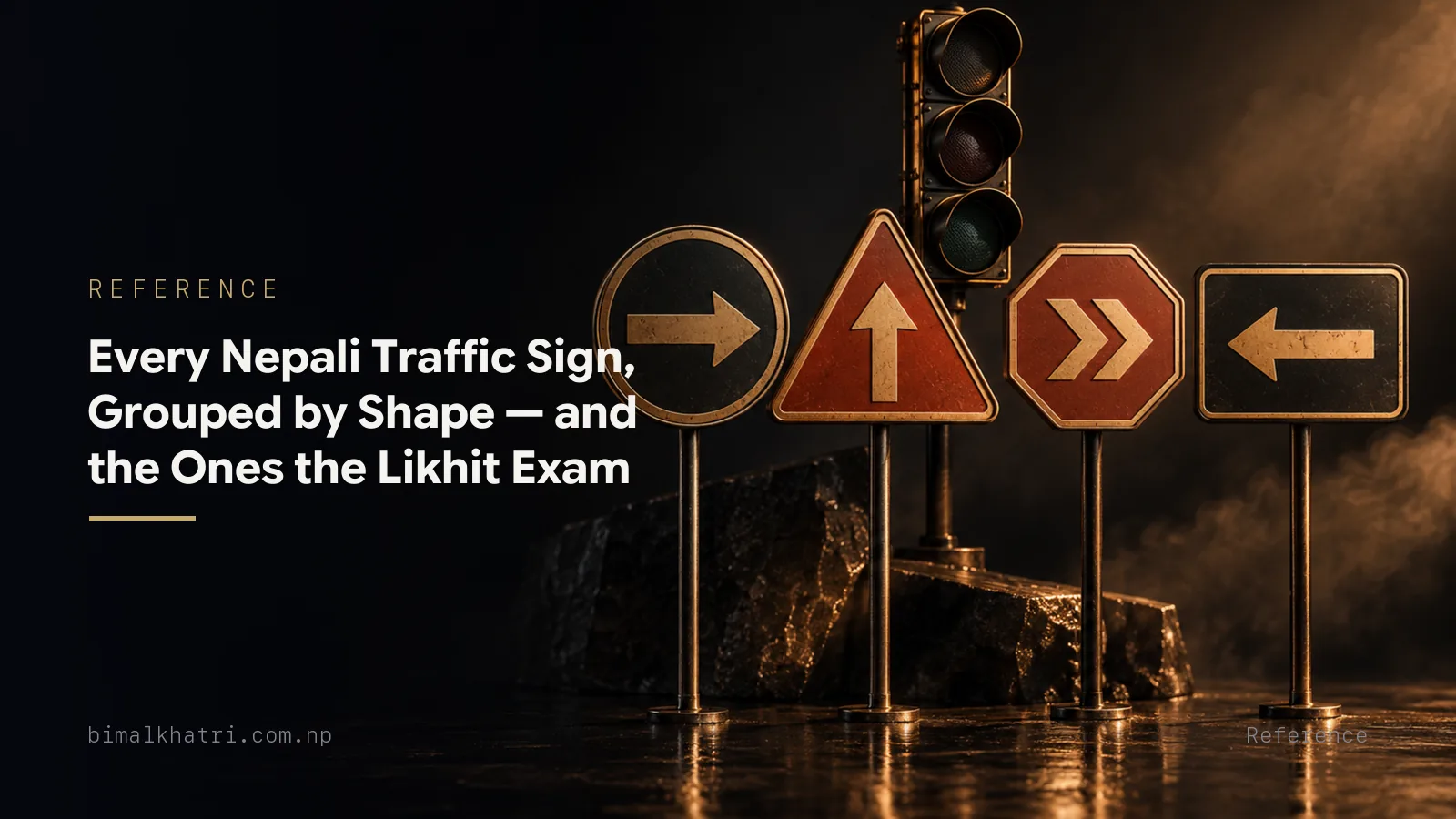
Learn the four shapes first. Everything else is detail.
Learning signs from pictures works better than lists. Yatayat Likhit has every Nepali sign with its Nepali name, plus sign-only practice rounds, all free.
The shape rule
| Shape | Category | It means | Example |
|---|---|---|---|
| Triangle | Warning (सचेतक) | Something ahead needs your attention | Sharp bend, school, narrow bridge |
| Circle | Mandatory or prohibitory (आदेशात्मक) | You must, or you must not | No entry, speed limit, compulsory left |
| Octagon | Stop | Full stop. Only one sign uses this shape | STOP |
| Rectangle or square | Information (सूचनात्मक) | Something useful, no obligation | Hospital, petrol pump, parking |
Colour narrows it further:
- Red — prohibition or danger. Red ring, red border, red fill.
- Blue — an instruction you must follow, or information.
- Yellow or amber — temporary. Roadworks, diversions.
- Green — direction and destination signs on highways.
Put the two together and most questions resolve without any memorising. A red circle is something you must not do. A blue circle is something you must do. A red triangle is a warning. That single sentence is worth several marks.
Warning signs (triangles)
Red-bordered triangle, symbol in the middle. They tell you what is coming so you can slow down. They never order you to do anything. That is the circle's job.
The ones that come up most:
| Sign | Meaning |
|---|---|
| Curved arrow | Bend ahead, left or right |
| Double curve | Series of bends |
| Steep slope symbol | Steep ascent or descent |
| Two children | School or children crossing |
| Walking figure | Pedestrian crossing ahead |
| Narrowing lines | Road narrows |
| Bridge outline | Narrow bridge |
| Cross shape | Crossroads ahead |
| Y shape | Side road or junction ahead |
| Wavy line | Slippery road |
| Bumps | Uneven road or speed breaker |
| Cattle | Animals on the road |
| Falling rocks | Rockfall zone, common on Nepali hill roads |
| Train | Level crossing, guarded or unguarded |
Exam habit: if the question shows a triangle and offers "you must stop" as an option, that option is wrong. Triangles warn, they do not command.
Mandatory signs (blue circles)
Blue circle, white symbol. These are orders you must obey.
| Sign | Meaning |
|---|---|
| Straight arrow | Ahead only |
| Left or right arrow | Turn left or right only |
| Circular arrows | Roundabout, keep going round |
| Bicycle | Cycle track, cycles only |
| Walking figure | Pedestrians only |
| Horn symbol | Sound horn |
| Number in a blue circle | Minimum speed |
Prohibitory signs (red circles)
White or red circle with a red ring, often with a diagonal red slash. These are things you must not do. This group is the most heavily tested of all.
| Sign | Meaning |
|---|---|
| Red ring, white centre, "40" | Speed limit — the maximum |
| Solid red circle, white bar | No entry |
| Two cars, one crossed | No overtaking |
| Car crossed out | No motor vehicles |
| Truck crossed out | No heavy vehicles |
| Horn crossed out | No horn (silent zone) |
| P crossed out | No parking |
| Red X or cross | No stopping |
| U-turn crossed out | No U-turn |
| Left or right arrow crossed out | No left or right turn |
Two that people confuse constantly:
- No parking — you may stop briefly to pick up or drop off, but not leave the vehicle.
- No stopping — you may not stop at all, even for a moment.
The stop and give way pair
Two signs, one shape each, and both come up.
- STOP — the octagon. Red, eight sides. You must come to a complete stop at the line, not a rolling slow-down, then proceed when clear. It is the only octagonal sign, which is deliberate: you can recognise it from behind or in snow.
- GIVE WAY — a downward-pointing triangle with a red border and no symbol inside. You do not have to stop if the road is clear, but you must yield.
The difference between "stop always" and "yield if needed" is exactly what gets tested.
Information signs (rectangles)
Blue or green rectangles. Useful, not obligatory.
Hospital, petrol pump, parking, telephone, first aid, food, rest area, bus stop, one-way, dead end, pedestrian crossing, direction and destination boards.
Low effort, occasionally tested. Read them once.
Road markings
Not signs, but they are in the same section of the bank, and they matter more for a car than a bike.
| Marking | Meaning |
|---|---|
| Solid white line | Do not cross |
| Broken white line | You may cross when safe |
| Double solid line | Do not cross, either direction |
| Solid and broken together | Cross only from the broken side |
| Zebra stripes | Pedestrian crossing — they have priority |
| Stop line | Stop behind it at a signal or STOP sign |
| Yellow box | Keep it clear, do not queue across it |
Traffic lights
Simple, and always on the paper.
- Red — stop before the stop line and wait. Not "slow down". Not "go if clear".
- Amber — stop if you can do so safely. It is not "hurry through".
- Green — go, if the way ahead is actually clear.
- Flashing amber — proceed with caution.
- Red and amber together — get ready, but do not move yet.
A traffic police officer's hand signal overrides the lights. That comes up often enough to be worth remembering on its own.
How to learn these fast
Signs are visual. Reading a list of names does not work nearly as well as looking at the picture and saying the meaning out loud.
The method that works: go through every sign in one sitting, cover the meanings, and test yourself on the pictures. Anything you miss, look at properly and try again in an hour. Most people are solid on the entire set in two or three sessions.
Nepali hill roads add signs you will not see much elsewhere (falling rocks, steep gradient, hairpin bends), so do not skip the ones that look unfamiliar. They are on the paper because they are on the road.
The sign reference in Yatayat Likhit is built for exactly this drill: every Nepali sign with its picture, its Nepali name and its meaning, and sign-only practice rounds so you can hammer them without wading through engine questions. I built the app after seeing how many people lose easy sign marks they could have banked in an afternoon. It is free, works offline, and covers categories A, K and B.
Get it: Yatayat Likhit — free on iPhone and Android. The link opens your own app store.
Common mistakes
- Learning the names, not the pictures. The exam shows you the sign.
- Confusing no parking with no stopping.
- Thinking a triangle can order you to do something. It cannot. It warns.
- Treating amber as "speed up".
- Skipping the hill-road signs because they look unfamiliar. Those are the Nepal-specific ones.
- Forgetting that a police signal beats the lights.
The signs Nepali roads actually need
Some of these barely appear in other countries' tests and are used heavily here, because Nepal's road network runs through hills.
- Falling rocks. A rockfall warning is standard on hill highways. It means do not stop under the slope.
- Steep ascent and steep descent. These pair with the gear rules from the written exam: low gear down a long hill, so the brakes do not overheat.
- Hairpin bend. A single very tight turn, common on switchback roads.
- Narrow bridge. One vehicle at a time. Who gives way is a rules question, not a sign question.
- Landslide-prone area and temporary diversion boards, usually yellow.
- Unguarded level crossing. No barrier, no gatekeeper. You stop, look, and cross.
If a sign looks unfamiliar to you, it is more likely to be examined, not less. Those are the ones written for local conditions.
Questions people ask
What does a triangular traffic sign mean in Nepal?
It is a warning about something ahead: a bend, a school, a narrow bridge. It tells you to be careful, it does not order you to act.
What is the difference between a red circle and a blue circle?
A red circle prohibits something. A blue circle orders you to do something. Red means do not, blue means do.
Which sign is octagonal?
Only STOP. The shape is unique so it can be recognised from any angle, even when the face is dirty or obscured.
What does a broken white line on the road mean?
You may cross it when it is safe to do so. A solid white line means you may not.
Do traffic lights or the traffic police take priority?
The police officer. A hand signal from traffic police overrides the signal.
Keep reading
- What the likhit question bank asks — how signs fit into the whole paper.
- Bike and scooter questions — Category A and K.
- Car questions — Category B, including road markings.
- A two-week tayari plan — where signs fit in the schedule.
- Nepali words for signs and rules — the names behind the pictures.
- Traffic fines and rules — what breaking these actually costs.
- The trial exam — the practical half.