Category B is the licence for a car, jeep, van or pickup: a private four-wheeler under 7,500 kg. Minimum age is 18.
Your written exam comes from the Category B question set, which DOTM publishes:
dotm.gov.np/content/111/-b--written-examination-questions-for-class-2082-83/The rules and signs in it are the same ones a bike rider studies. The difference is everything about the car itself: gearbox, clutch, brakes, steering, fluids, and the safety equipment a two-wheeler does not have.
That car-specific slice is where Category B candidates lose marks, so most of this page is about it.
Sitting Category B? Yatayat Likhit has the car bank with the clutch, gear and fluid questions explained, free and offline.
What Category B covers
| Included | Not included |
|---|---|
| Car, jeep, van, pickup | Motorcycle and scooter (that is A or K) |
| Private four-wheelers under 7,500 kg | Truck, bus, taxi and other commercial work |
Category B is a private licence. Driving commercially needs a higher category, and those require experience on a lighter licence first. The full category list explains the ladder.
Many people hold A and B together. You do not sit the whole thing twice. You apply to add a category on your province portal and take the exam and trial for the new one.
The four parts of the Category B paper
1. Traffic rules and law. Right of way, overtaking, parking, one-way, speed, documents, penalties. The largest section.
2. Road signs and markings. Also includes road markings, which matter more for a car than a bike: lane lines, stop lines, zebra crossings, yellow lines.
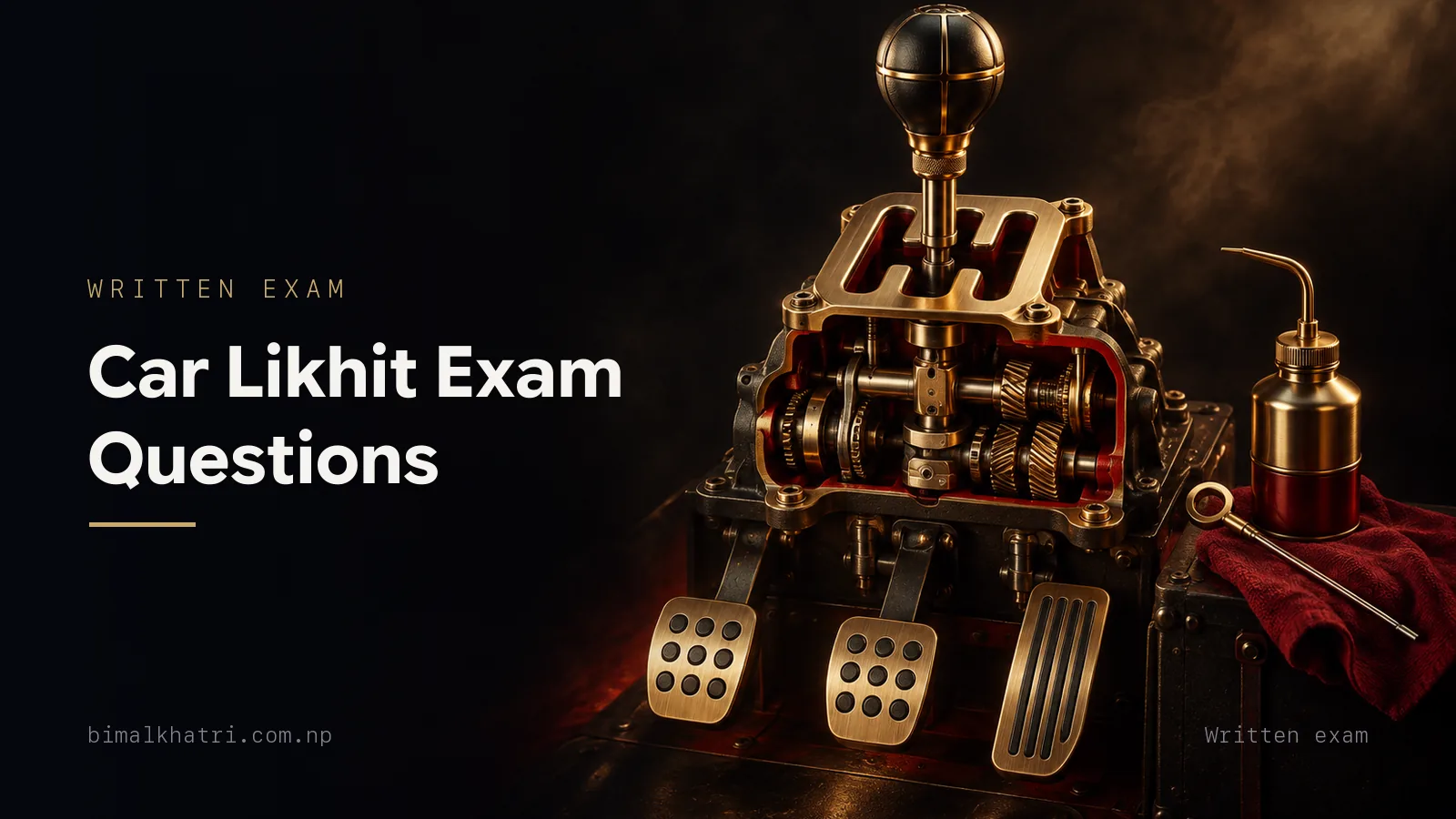
3. Car mechanics. Clutch, gearbox, brakes, steering, battery, radiator, engine oil, coolant, fuel. The section that decides most results.
4. Road safety and first aid. Seatbelts, following distance, night and fog driving, what to do at a crash scene.
The car questions people get wrong
The clutch
The most misunderstood part on the paper. The clutch disconnects the engine from the wheels so you can change gear or stop without stalling.
What is wrong in every question that offers it: resting your foot on the clutch while driving ("riding the clutch"), which wears it out, and coasting in neutral down a hill, which removes engine braking and your control with it.
Gears
Low gear gives more pulling power and less speed. That is why you use first to start, and why you come down a steep hill in a low gear rather than riding the brakes. Brakes that are held on a long descent overheat and stop working. That last point comes up in several forms.
Brakes
Questions cover the brake pedal, the handbrake, and what happens when brakes fail. Standard answers: brake progressively, not in one stab; do not brake hard mid-corner; if the brakes fail, use engine braking and the handbrake gradually.
Brake fluid and worn pads show up too: a spongy pedal means air or low fluid.
Fluids and cooling
Four to keep straight, and the bank tests whether you can:
| Fluid | What it does | Warning sign |
|---|---|---|
| Engine oil | Lubricates moving parts | Warning light, noisy engine |
| Coolant | Stops the engine overheating | Temperature gauge rising, steam |
| Brake fluid | Transmits pedal pressure | Soft or sinking pedal |
| Fuel | Burns in the engine | Warning light |
The one people mix up: oil lubricates, coolant cools. Overheating questions are about coolant and the radiator, not oil.
Steering and tyres
Wheel alignment, why the car pulls to one side, why tyre pressure matters, what worn tread does in the wet. Tyre questions have the same answer as they do for bikes, just with more weight behind them.
Seatbelts and safety equipment
Compulsory for the driver and front passenger. Airbags work with the seatbelt, not instead of it. That is a common trick option.
Signs and markings
Sign questions are the cheapest marks in the paper. The shape gives you the category before you read the text:
| Shape | Meaning | Example |
|---|---|---|
| Triangle | Warning | Bend, school, narrow bridge |
| Circle | Must do or must not do | No entry, speed limit |
| Octagon | Stop | Stop |
| Rectangle | Information | Hospital, parking, petrol |
Road markings matter for Category B in a way they do not for a bike. A solid line means do not cross. A broken line means you may, when it is safe. A yellow box or a zebra crossing means keep it clear. The full sign guide covers each group.
How many questions?
Sources disagree — 20, 25 and 50 all appear online, with pass marks quoted as 60 out of 100 or 40 out of 50. No page that states one number flatly is being straight with you.
The count and pass mark vary by category, office and year, and since FY 2083/84 each province runs its own licence administration, so they vary more than they used to. The notice at your own transport office (yatayat karyalaya, यातायात कार्यालय) is the authority.
Study the whole bank and it stops mattering.
A two-week plan for Category B
The B set is bigger than the bike set, and the mechanics section needs real reading. Give it two weeks at about an hour a day.
| Days | What to do |
|---|---|
| 1–3 | Read the whole set with answers showing. No testing yet. |
| 4 | Signs and road markings only. |
| 5–6 | Car mechanics — clutch, gears, brakes, fluids. Read properly. |
| 7–8 | Rules, law, right of way, documents. |
| 9 | Safety and first aid. |
| 10 | Answer the whole set cold. Write down every wrong answer. |
| 11–12 | Drill only the wrong list until it is empty. |
| 13–14 | Timed mocks until you clear the pass mark twice in a row. |
Study in Nepali. The paper is in Nepali.
I built Yatayat Likhit to run that loop on a phone: the full Category B bank with reasoning next to each answer, automatic tracking of what you keep missing, timed mocks in the exam format, the sign reference, and an Ishihara-style colour-vision test for the medical. Free, offline, Nepali and English. The method is what matters: use whatever tool runs it.
Get it: Yatayat Likhit — free on iPhone and Android. The link opens your own app store.
Sample questions, worked through
Follow the reasoning rather than the answer. The bank rewords, the reasoning does not change.
You are going down a long steep hill. What gear? A low gear. It lets the engine hold the car back so you are not riding the brakes, which overheats them.
What does the clutch do? Disconnects the engine from the wheels so you can change gear or stop without stalling.
The temperature gauge is climbing. What is wrong? Cooling — low coolant, a leak, or a radiator problem. Not engine oil.
The brake pedal feels soft and sinks. What is it? Air in the brake lines or low brake fluid. Get it checked before driving.
When may you cross a solid white line? You may not. A broken line is the one you may cross when it is safe.
Who must wear a seatbelt? The driver and the front passenger, always. Airbags work with a belt, not instead of one.
Which side do you overtake from? The right. Nepal drives on the left.
An ambulance is coming up behind with its siren on. What do you do? Pull left where it is safe and let it pass. Do not brake hard in the middle of the road.
Two rules cover most of the paper: the careful answer is usually right, and anything that reduces your control of the car is wrong.
The Category B trial
Passing the likhit gets you to the practical. For a car that means three things in most trial grounds:
- The figure-8, without touching the boundary lines. Steering control.
- A hill start, without rolling backwards. Clutch control.
- Parking, usually garage or parallel.
Most offices score out of 100 across about seven stations and pass at 70, so small errors cost points rather than ending the test. Rolling back on the hill start and touching lines in the 8 are the usual failures. Both are clutch and patience, and both improve fast with practice. The trial guide has every station.
Common mistakes
- Skimming the mechanics section. It is the difference between passing and resitting for most Category B candidates.
- Confusing oil and coolant. Oil lubricates, coolant cools.
- Memorising answer letters. The bank rewords questions.
- Studying only in English. The paper is Nepali.
- Assuming a B licence lets you drive commercially. It does not.
Questions people ask
Where can I get Category B likhit questions in PDF?
DOTM publishes the set at dotm.gov.np/content/111/-b--written-examination-questions-for-class-2082-83/. A 57-page objective-question collection is mirrored on the Lumbini province transport site.
Is the car likhit exam harder than the bike one?
The rules and signs are the same. The car set has more mechanical questions (clutch, gearbox, fluids, brakes), so there is more to read.
Can I add Category B to a licence I already have for a bike?
Yes. Apply for "अनुमतिपत्र वर्ग थप" (category add) on your province portal, then sit the Category B exam and trial.
What is the minimum age for Category B?
- Categories A and K start at 16.
How many questions are in the Category B exam?
Reported counts vary from 20 to 50 by source, office and year. They all come from the same published bank. Check your own office notice.
Keep reading
- What the whole question bank asks — all seven topics with examples.
- The trial exam, station by station — the hill start and the 8.
- Every traffic sign, by shape — the fastest marks available.
- Licence categories explained — what B does and does not allow.
- Which practice app to use — compared on features you can verify.
- Your province portal — where you apply now.