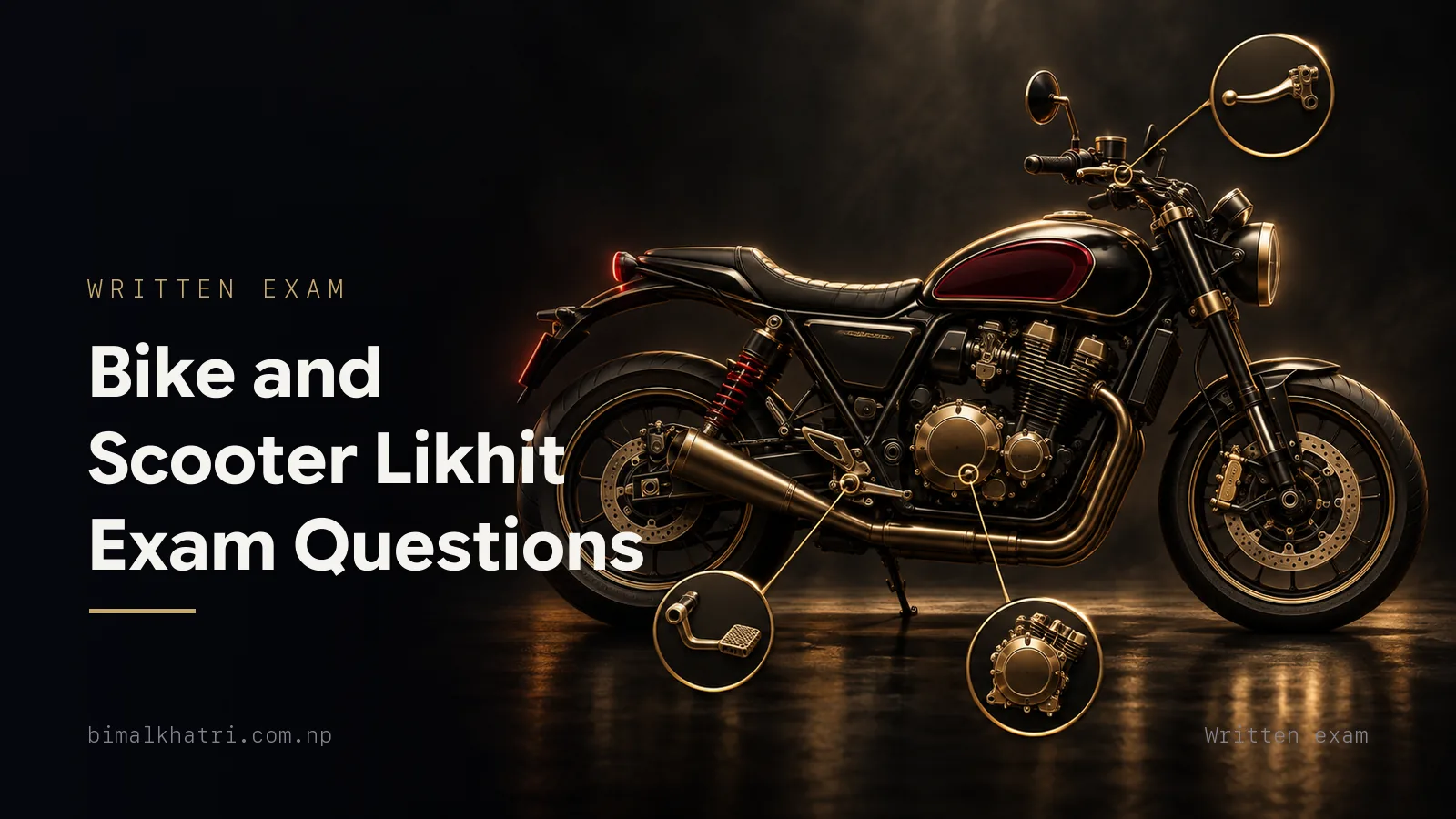
If you are getting a licence for a bike or a scooter, your written exam comes from the Category A and K question set. DOTM publishes it here:
dotm.gov.np/content/112/written-test-questions-2082-83-for--ak--class/That is the real source. Every "bike likhit exam questions 2083" PDF, video and app is a rearrangement of it, including mine.
This page covers what is different about the bike set, the questions people actually get wrong, and how to work through it in a week.
Category A or K? Yatayat Likhit keeps the bike bank separate, with timed mocks in the real format. Free, in Nepali and English.
A or K — which one are you?
Get this right on the application form, because changing it later costs a category-add fee.
| Category | Vehicle | Engine | Minimum age |
|---|---|---|---|
| K | Scooter, moped | Up to 50cc | 16 |
| A | Motorcycle, scooter | Above 50cc | 16 |
Almost every scooter sold in Nepal today is above 50cc, so most people who think they need K actually need A. If your scooter is a 110 or a 125, that is Category A.
A covers everything K covers. If you are unsure, A is the safer choice. The full category list has the rest.
What is in the bike question set
The Category A and K paper splits roughly into four things. Two of them are shared with the car paper. Two are not.
Shared with every category:
- Traffic rules and law — right of way, overtaking, documents, penalties
- Road signs and markings
Specific to two-wheelers:
- Two-wheeler handling and safety — braking, balance, pillion rules, helmets
- Motorcycle engine and maintenance — chain, clutch, spark plug, two-stroke versus four-stroke, tyre pressure
That third group is where most people lose marks. Riders assume that because they ride, they know. The exam asks about things riding does not teach you.
The bike questions people get wrong
Braking
The most-missed topic in the whole set.
The correct answer is nearly always both brakes together, front slightly first, in a straight line. Front brake alone can lock the wheel. Rear brake alone takes far longer to stop. Braking hard mid-corner is the wrong answer to every question that offers it.
Helmets and pillion
Helmets are compulsory for the rider and the pillion passenger. The reported fine is NPR 500. A two-wheeler carries one pillion passenger, not two.
Two-stroke and four-stroke
A classic bank question. Four-stroke engines have separate oil, burn cleaner and are what almost every current bike uses. Two-stroke engines mix oil with the fuel and pollute more. Questions about smoke, oil mixing and emissions usually point at this distinction.
Chain and drive
Chain slack, chain lubrication, what happens if the chain is too tight or too loose. Simple once you have read it, impossible to guess if you have not.
Clutch and gears
What the clutch actually does: disconnects the engine from the wheel so you can change gear. Riding with the clutch part-engaged wears it out. Scooters are automatic and have no manual clutch, which itself shows up as a question.
Spark plug, battery, tyres
What each one does and the sign that it has failed. A fouled spark plug means hard starting. Low tyre pressure means poor grip, more fuel, faster wear.
Signs are your easiest marks
Sign questions are worth the same as everything else and take a fraction of the time. Learn the shapes and you can answer signs you have never seen:
| Shape | Meaning |
|---|---|
| Triangle | Warning |
| Circle | Must do, or must not do |
| Octagon | Stop |
| Rectangle | Information |
Clear every sign question first, then spend your time on the engine questions. The full sign guide groups them all with their Nepali names.
How many questions will there be?
Sites disagree, and you should be suspicious of any that does not admit it. The DOTM Category A and K booklet is cited as 20 questions. Practice sites commonly describe 25 in 30 minutes with a pass mark of 60 out of 100. Others claim 50.
The count and pass mark vary by category, office and year, and since FY 2083/84 each province runs its own licence administration, so the variation grew. The notice at your own transport office (yatayat karyalaya, यातायात कार्यालय) is the authority.
It does not change what you should do. Cover the whole bank and the number stops being a question.
A one-week plan
The bike set is small enough to finish properly in a week, at about an hour a day.
| Days | What to do |
|---|---|
| 1–2 | Read the whole set with answers showing. No testing. Just meet it. |
| 3 | Signs only, until you can name any sign from its shape and colour. |
| 4 | Engine and maintenance only. This is the weak spot. Read, do not guess. |
| 5 | Rules and law. Overtaking, documents, penalties, right of way. |
| 6 | Answer the whole set cold. Write down every one you got wrong. |
| 7 | Drill only the wrong list, then two timed mocks. |
Study in Nepali. The paper is in Nepali, and translating in your head under time pressure is a self-inflicted handicap.
If you search for motorcycle licence test practice and land on an American site, close it. The road rules are different, Nepal drives on the left, and the question bank is Nepal's own. Practise against the DOTM set or you are learning the wrong answers.
I built Yatayat Likhit to run exactly this loop on a phone: the full Category A and K bank with the reason next to each answer, automatic tracking of what you keep getting wrong, timed mocks in the real format, the sign reference, and an Ishihara-style colour-vision test for the medical. Free, offline, Nepali and English. Use it or use anything else, but do the loop.
Download it: Yatayat Likhit for iPhone and Android. Free, and the link picks the right store for you.
Sample questions, worked through
Do not memorise these. Follow the reasoning — that is what transfers to the reworded version on the paper.
You are riding and need to stop quickly. What do you do? Both brakes together, front slightly ahead of rear, bike upright and straight. Front alone can lock the wheel. Rear alone is too slow.
Which side do you overtake from? The right. Nepal drives on the left, so overtaking traffic passes on the outside.
Who must wear a helmet? The rider and the pillion passenger. Both.
What does the clutch do? It disconnects the engine from the rear wheel so you can change gear. It is not a brake and it is not for coasting.
Your bike is hard to start and running rough. What is the likely cause? A fouled or worn spark plug. Starting and misfiring questions almost always point at the plug.
Why check tyre pressure? Grip, braking distance, fuel use and tyre life. Low pressure hurts all four.
A triangular sign means what? A warning about something ahead. An order would be a circle.
When must you not overtake? On a bend, on a bridge, or at a pedestrian crossing.
See the pattern? Two rules cover most of the paper: the careful answer is usually right, and anything that reduces your control is wrong.
Then comes the trial
Passing the likhit gets you to the practical, and for bikes the practical is the harder half.
The figure-8 (आठको घेरा) is worth the most points and is where most riders fail. The circle is about 4 metres across. Putting a foot down costs points. Touching the line costs points. Most offices score the trial out of 100 and pass you at 70, so a small wobble is survivable and a foot down on every loop is not.
Practise it in an empty car park with two water bottles as markers, at walking pace, in first gear, looking where you want to go rather than at the front wheel. The full trial guide has every station.
Common mistakes
- Thinking riding experience is preparation. The engine questions do not care how long you have ridden.
- Studying only "important 50 questions" lists. The set is small. Do all of it.
- Learning answer letters. The wording gets rearranged. Learn the reason.
- Choosing K for a 125cc scooter. That is Category A.
- Ignoring the trial until after the likhit. Figure-8 practice is free and you can start today.
Questions people ask
Where can I get bike likhit exam questions in PDF?
DOTM publishes the Category A and K set at dotm.gov.np/content/112/written-test-questions-2082-83-for--ak--class/. A 57-page objective-question collection is also mirrored on the Lumbini province transport site.
Is the bike likhit exam the same as the car one?
No. The rules and signs overlap heavily, but DOTM publishes separate sets, and the vehicle-knowledge questions are different: two-wheeler topics instead of car ones.
Which category do I need for a 125cc scooter?
Category A. K only covers up to 50cc, which almost no scooter sold in Nepal today falls under.
How many questions come in the bike likhit exam?
Reported counts vary from 20 to 50 depending on the source, office and year. All of them are drawn from the same published set. Check the notice at your own office.
Can I take the exam in English?
The official paper is in Nepali. Practise in Nepali so the wording is familiar.
Keep reading
- What the whole question bank asks — all seven topics, with worked examples.
- The trial exam, station by station — the figure-8 in detail.
- Every traffic sign, by shape — the fastest marks in the paper.
- Your province portal — where you apply now.
- A two-week tayari plan — if you have longer than a week.
- Which practice app to use — compared on features you can verify.