The medical check for a Nepali driving licence is short, and for most people it is over in a few minutes. Two things are actually tested: how well you see, and whether you can tell colours apart.
People worry most about the colour test, usually because they have heard that colour blindness means no licence. That is not what the rule says. Mild colour vision deficiency does not normally stop you getting a standard licence.
Here is what is checked, what the standards are, and what to do if you already know you have a problem.
Test your colour vision before the day. Yatayat Likhit includes an Ishihara-style plate test alongside the exam prep. Free and offline.
What is tested
Visual acuity
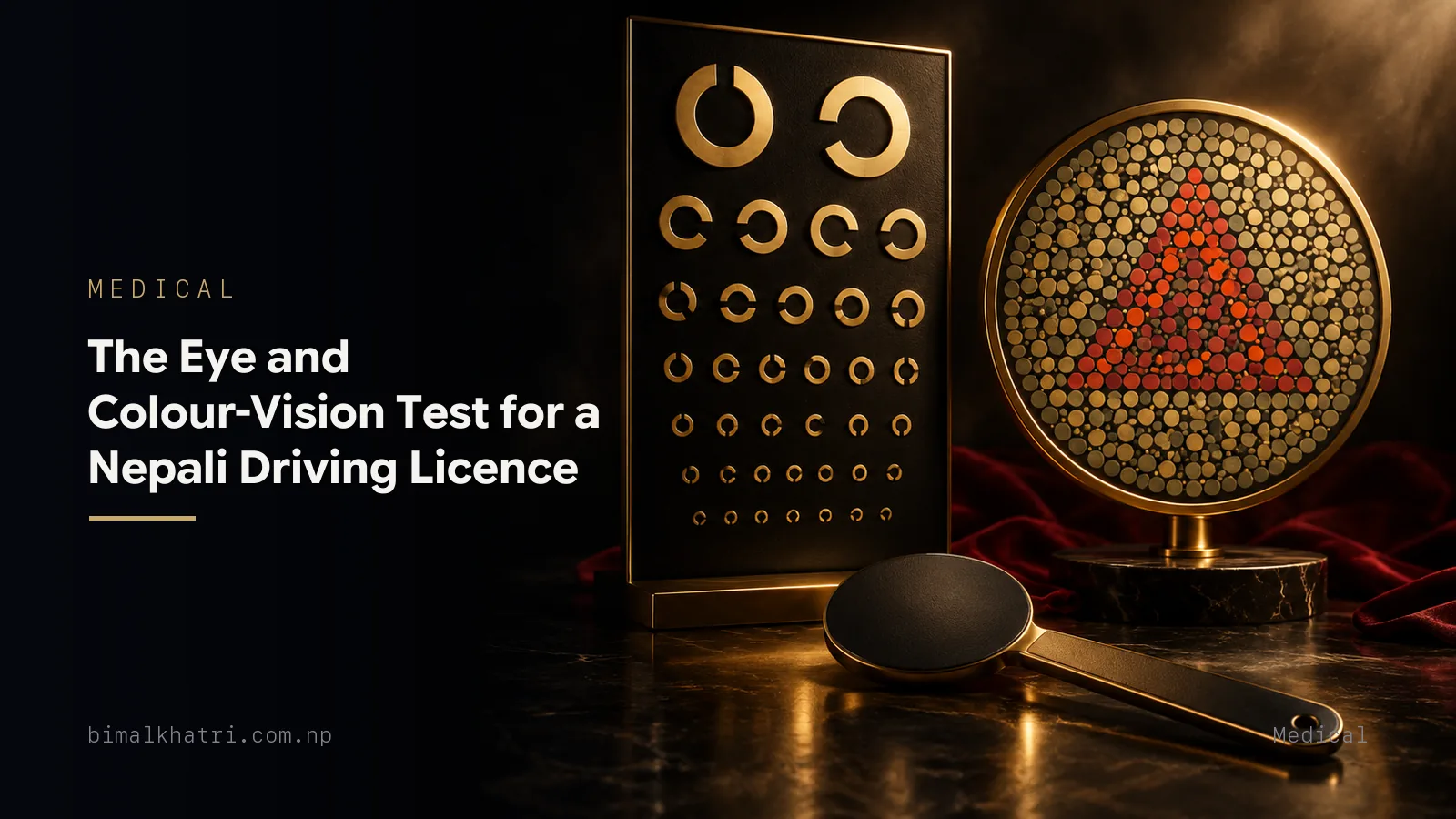
How sharply you see at distance. The standard commonly applied is 6/12 or better, with or without correction.
"With correction" is the important half. Glasses and contact lenses are allowed. If you need them to reach the standard, you wear them, and your card may carry a condition saying you must drive with them. That is normal and it is not a restriction on where or when you can drive.
If you have not had your eyes checked in years, get that done before your appointment rather than finding out on the day.
Colour vision
Usually tested with Ishihara plates: circles full of coloured dots with a number hidden inside. Someone with normal colour vision reads the number easily. Someone with a red-green deficiency reads a different number, or none.
The reason this is tested at all is traffic lights and signs. Red means stop, green means go, and a lot of Nepali signage is red-bordered for prohibition and blue for instruction.
Also checked
Depending on the office and the examining doctor, you may also be checked for general fitness to drive: hearing, limb movement, and any condition that could cause you to lose control at the wheel — uncontrolled epilepsy or blackouts, for example.
Where the test happens
There are three routes, and which one applies depends on your office:
- A medical booth at the transport office (yatayat karyalaya, यातायात कार्यालय). Larger offices have one, and the check is done on your first visit.
- A government health post or hospital.
- A private clinic authorised by DOTM.
There is also a portal at doctor.dotm.gov.np. It responds, and it exists so the examining doctor can file your health verification digitally rather than on paper. It is a doctor's login, not a public page. You cannot book anything there or do your own test on it, so do not spend an afternoon trying.
If you are colour blind
First, the practical position. Colour vision deficiency is common — it affects roughly one man in twelve — and most people who have it drive perfectly safely, because traffic lights are also distinguished by position: red on top, green at the bottom. You do not actually need to see the colour to know which light is lit.
The rules follow that reality:
- Mild deficiency normally does not stop you getting a standard licence.
- Severe deficiency may bring a restriction, or a request for further assessment.
If you know or suspect you have a deficiency, do this before your appointment:
- Get tested properly at an eye hospital. A proper assessment tells you what type and how severe, which is more useful than a phone screen result.
- Ask for a letter. Eye hospitals in Nepal will issue a letter stating that your vision is otherwise fine and the issue is limited to certain colours. That letter is what people take to the transport office.
- Bring it on the day. Arriving with documentation is a completely different conversation from failing a plate test with nothing to show.
Do not try to memorise the Ishihara plates. Test sets get rotated, an examiner will notice hesitation, and if you genuinely cannot distinguish the colours, the letter route is the one that actually works.
Test yourself before you go
There is no reason to find out about a problem in a government office. Run a screening test at home first, in good natural light, at arm's length.
A phone screening is not a diagnosis: screen brightness and colour calibration vary, so a borderline result at home means "go and get properly tested", not "you are colour blind". But it is very good at catching a problem you did not know you had, while you still have time to get a letter.
I built Yatayat Likhit with an Ishihara-style colour-vision test in it for exactly that: run it once, early, in the same app you are using for the written exam. If you read every plate cleanly, that is one thing off your mind. If you do not, you have found out weeks before your appointment instead of during it. The app is free, works offline, and also carries the full DOTM question bank, timed mocks and the Nepali road signs.
On your phone: Yatayat Likhit is free on both iPhone and Android.
What to bring, and what happens on the day
The medical is usually folded into your first office visit rather than being a separate appointment. Bring:
- Your glasses or contact lenses, if you wear them. Correction is allowed and you are meant to use it.
- Any existing eye report or hospital letter, especially if you know you have a colour vision deficiency.
- Your citizenship and application details, as for every other step.
The check itself is short. You read a chart at distance, one eye at a time, then you read the Ishihara plates. If both are fine, the doctor files your health verification and you move on to the next stage. Most people are through it in under five minutes.
If something is borderline, you are normally told to get a proper assessment rather than turned away permanently. That is the point of the letter route: the system is designed to accommodate people whose vision is safe for driving but imperfect on a screening test.
Blood group and general fitness
Your blood group is asked for on the application and printed on the smart card. If you do not know it, get tested before your appointment. It is a cheap test at any lab and it holds up the form otherwise.
Beyond eyes, the examining doctor is confirming that nothing about your health would cause you to lose control of a vehicle. Conditions that come up are uncontrolled epilepsy, fainting episodes, and limb movement that would stop you operating the controls. Managed conditions are generally not a barrier. Declare them honestly — a licence obtained by hiding a relevant condition is a problem for you, not for anyone else.
Common mistakes
- Leaving the eye test to the day. If you need glasses, you want them before, not after.
- Not wearing your glasses to the test. Correction is allowed. Use it.
- Assuming colour blindness is an automatic rejection. It usually is not.
- Trying to memorise the plates. Sets rotate.
- Treating a phone screening as a diagnosis. It is a prompt to get properly checked, nothing more.
- Trying to use doctor.dotm.gov.np yourself. It is for the doctor.
When your eyesight changes later
The medical is not only a one-off at the start. Eyesight changes, and two situations come up.
You start needing glasses after you already hold a licence. Wear them. If your card carries a condition requiring correction, driving without it is a breach of the licence. If it does not, you should still wear them: the standard applies to how you actually see on the road, not to what a card says.
Your vision drops below the standard. You are expected to be fit to drive every time you drive, not only on the day you were tested. If an eye condition develops, get it assessed and follow the advice you are given. Renewal is also a natural point to have this checked properly.
The renewal process itself may include a fresh medical depending on your province and category, so it is a sensible moment for an eye test regardless. More on renewal.
A note on the "colour blindness test app" searches
A lot of people search for a colour blindness test app the week before their appointment, which is a sensible instinct and slightly too late. The point of testing early is the time it buys you: if you need a letter from an eye hospital, you want weeks, not days.
Run the screening now, whenever you are reading this, even if your appointment is months away. It takes two minutes and the worst outcome is that you learn something useful about your own eyes.
Questions people ask
Can I get a driving licence in Nepal if I am colour blind?
Usually yes. Mild colour vision deficiency does not normally prevent a standard licence. Severe deficiency may bring a restriction or need further assessment, and a letter from an eye hospital is the usual route.
What eyesight standard do I need?
Commonly 6/12 or better, with or without correction. Glasses and contact lenses are allowed, and your card may note that you must wear them.
What test is used for colour vision?
Ishihara plates — coloured dot circles with a number hidden inside. It is a screening test for red-green deficiency.
Where do I do the medical test for my licence?
At a medical booth in the transport office, a government health post or hospital, or a DOTM-authorised private clinic, depending on your office.
What is doctor.dotm.gov.np?
A portal for the examining doctor to file your health verification digitally. It is not a public page and you cannot use it to book or take a test.
Keep reading
- The complete licence guide — where the medical fits in the process.
- Your province portal — where you apply and book the appointment.
- What the likhit question bank asks — the written exam.
- Every traffic sign, by shape — why colour matters on the road.
- What it all costs — including the medical.