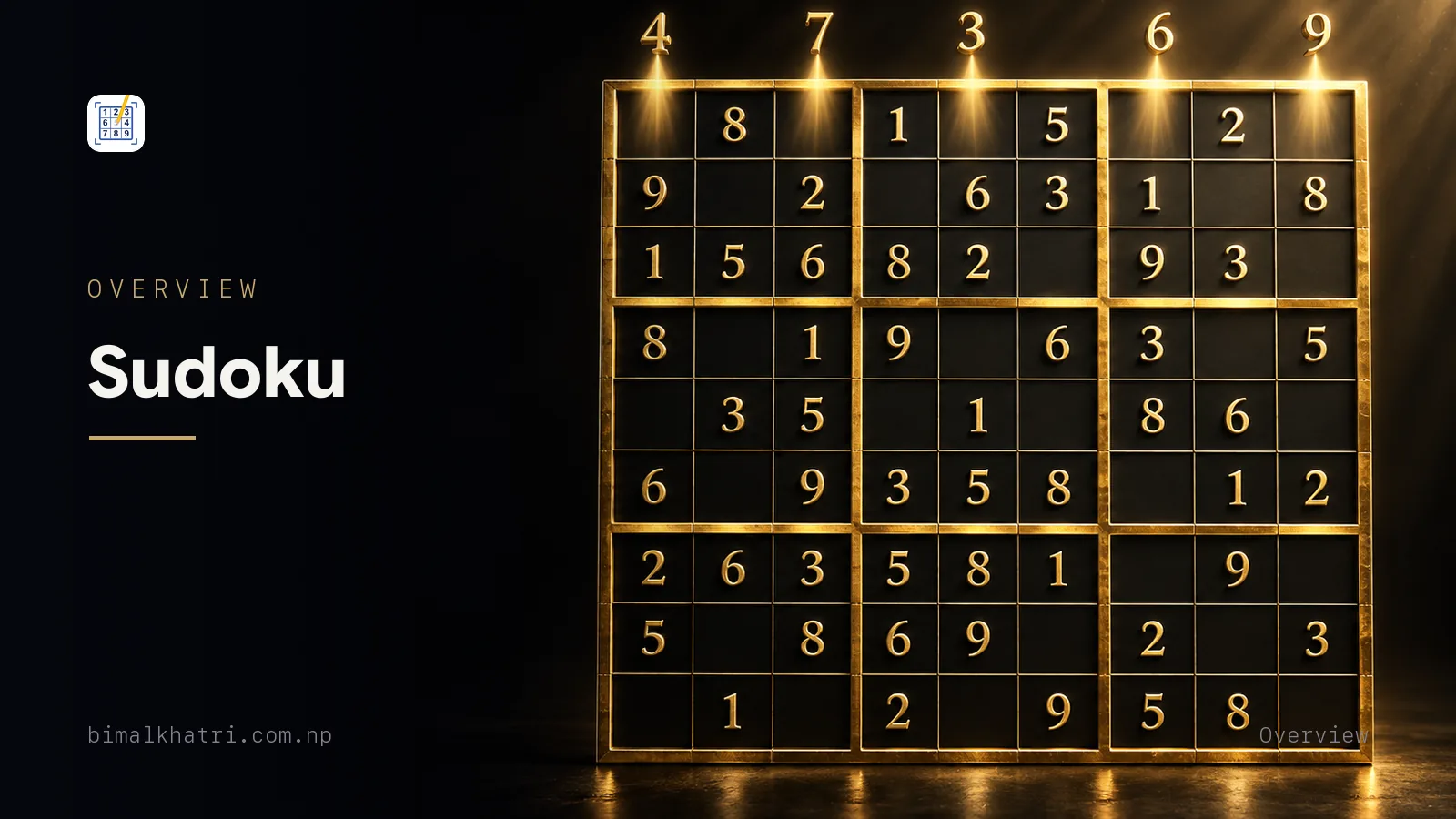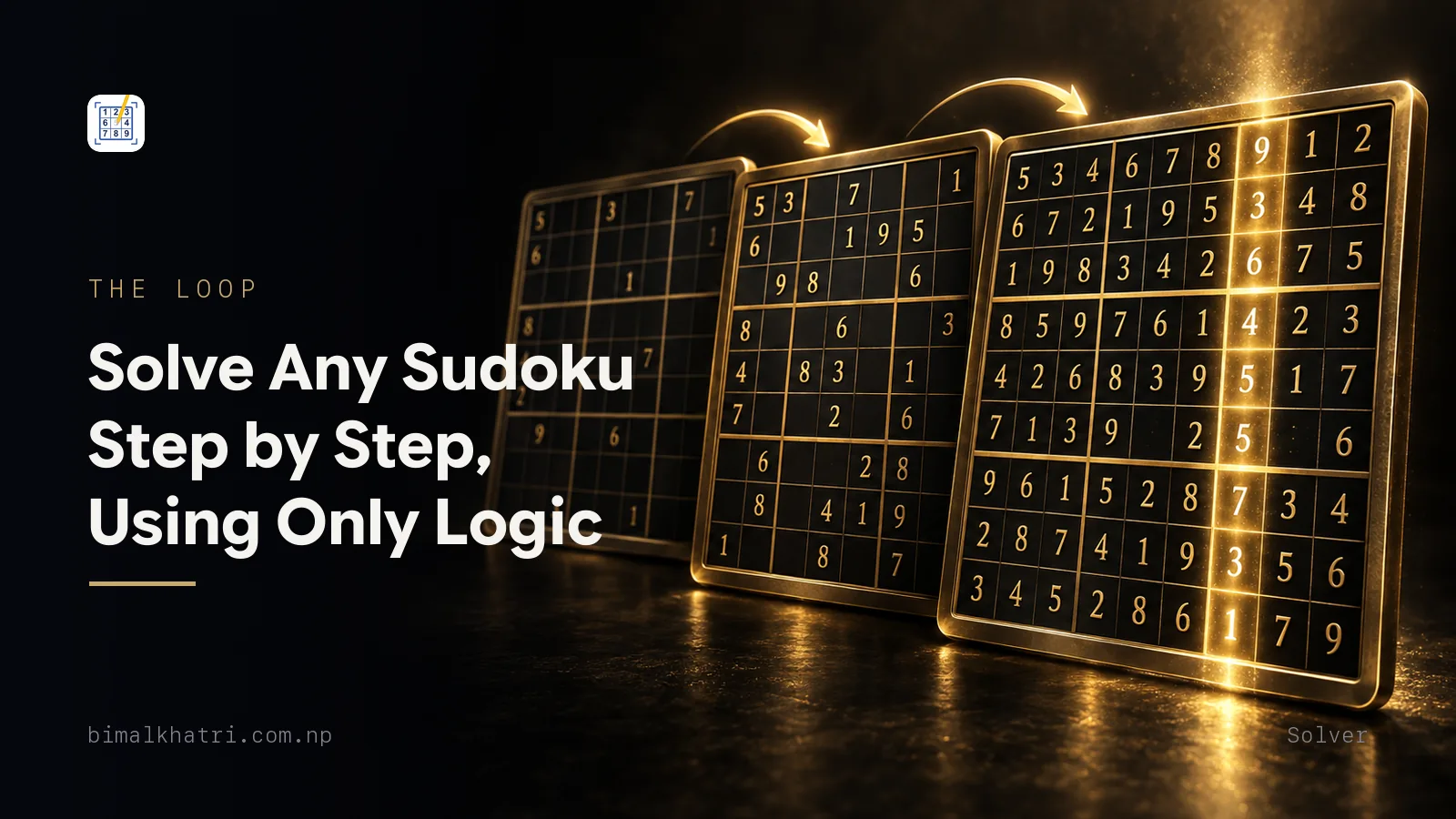
Every Sudoku comes apart the same way, and the method is a loop rather than a list. Scan one digit through all nine boxes. Ask the same question of the rows and the columns. Look for a cell whose peers have already used up eight of the nine digits. Then go back to the top, because the digit you just wrote changed the answer somewhere you have already looked.
That loop finishes most puzzles on its own. When it stops, the next move is not a harder technique. It is pencil marks in one small unit, one elimination, and then the loop again.
The grid below has 26 givens. The loop places 16 digits into it and then dies, with 39 cells still empty. One elimination inside a nine-cell box hands back every one of them. Every move on this page has a reason you can check against the grid.
Notation first, because the rest depends on it. Rows are numbered 1 to 9 from the top and columns 1 to 9 from the left, so r4c7 is row 4, column 7. The 3x3 blocks are boxes, numbered 1 to 9 reading left to right and then top to bottom. A dot is an empty cell.
....3.7.4
84......2
..3......
1........
7..4519.3
..67..5..
4....9..6
.2..64.5.
.1.....3.
Working on a phone? Sudoku Master highlights the row, column and box you are scanning, clears your notes when you place a digit, and shows no ads while you solve.
The loop, on one screen
| Step | What you ask | What it gives you |
|---|---|---|
| 1 | In this box, where can this digit go? | Most of the placements on most grids |
| 2 | In this row, and in this column, where can it go? | The placements a box scan cannot see |
| 3 | What is left for this cell once its 20 peers have spoken? | A digit you were not scanning for |
| 4 | Which of those answers just changed? | The next move, nearly every time |
| 5 | Only if 1 to 4 give nothing: what are the candidates in the tightest unit? | Something to eliminate with |
| 6 | What can I now rule out? | One deletion, which sends you back to step 1 |
Steps 1 to 4 are the loop. Steps 5 and 6 are the repair, and they run only when the loop has stopped. The moment an elimination lands, drop everything and go back to step 1. People lose whole evenings hunting for a second clever move on a grid that has already started giving away singles again.
Step 1: walk one digit through all nine boxes
Take a digit that already has several copies on the board. This puzzle hands you five 4s, at r1c9, r2c2, r5c4, r7c1 and r8c6, which is more blocking power than any other digit here has.
Box 2 is the top middle block. Its only filled cell is r1c5, so eight cells are open, and the 4 has to live in one of them. Row 1's 4 at r1c9 kills r1c4 and r1c6. Row 2's 4 at r2c2 kills r2c4, r2c5 and r2c6. Column 4's 4 at r5c4 kills r3c4, and column 6's 4 at r8c6 kills r3c6. One cell survives. r3c5 = 4.
Box 4, middle left, has six gaps. Column 1's 4 at r7c1 rules out r6c1. Row 5's 4 at r5c4 rules out r5c2 and r5c3. Column 2's 4 at r2c2 rules out r4c2 and r6c2. r4c3 = 4.
Now box 6, and this is the one worth slowing down for. Its gaps are r4c7, r4c8, r4c9, r5c8 and r6c9. Row 5's 4 at r5c4 takes r5c8. Column 9's 4 at r1c9 takes r6c9. The other three all sit in row 4, and row 4 has a 4 in it now: the one you wrote thirty seconds ago at r4c3. r6c8 = 4.
That placement did not exist before your own last move. This is step 4 of the loop doing the work, and it is why finishing a digit beats jumping between them.
Box 9, bottom right, closes the digit. Row 7's 4 at r7c1 takes r7c7 and r7c8. Row 8's 4 at r8c6 takes r8c7 and r8c9. Column 9's 4 at r1c9 takes r9c9. r9c7 = 4.
Nine 4s on the board, from one walk. You never have to think about that digit again.
Step 2: ask a row and a column the same question
Box scans are easy to see, so most people run them and stop. Rows and columns are units in exactly the same way, and they catch what a box cannot.
Column 1 is the example here. After the box sweeps above it reads 5 down to r9c1, with gaps at r1c1, r3c1, r6c1 and r8c1, and it still needs a 5. Row 3 already holds a 5 at r3c9, so r3c1 is out. Row 6 holds one at r6c7, so r6c1 is out. Row 8 holds one at r8c8, so r8c1 is out. r1c1 = 5, found by a scan no box could have made.
Row 5 gives the same lesson from the other side. It is missing 2, 6 and 8 in r5c2, r5c3 and r5c8. Box 4 already contains a 6, at r6c3, and r5c2 and r5c3 both live in box 4. So neither can be the 6. r5c8 = 6, and the block came from a box while the scan ran along a row.
Step 3: the cell that only one digit fits
The third question ignores digits entirely and looks at one cell. List what its twenty peers hold. If they hold eight distinct digits, the ninth is forced.
This puzzle offers none in the first pass, which is normal on a hard grid and
worth knowing so you do not go looking. The first one turns up later, at r2c5.
Its row holds 8, 4, 5, 6, 3 and 2. Its column holds 3, 4, 9, 5 and 6. Its box
holds 3, 5, 6, 4 and 7. Collect them and you get every digit except 1, so {1}
is all that is left and the cell is settled without anyone scanning for a 1.
Both kinds of find are certainties. Neither is a guess. Most solvers spot the box scan faster, because reading nine cells is less work than auditing twenty, which is the only reason step 3 sits third instead of first. There are more worked grids for both in naked singles and hidden singles.
The first pass, in full
Twelve more placements follow the four 4s, each from one of the three questions above. The reason for every one is checkable on the grid as it stood at the time.
| Cell | Digit | Why it is forced |
|---|---|---|
| r2c7 | 3 | Row 3's 3 at r3c3 kills the bottom row of box 3; column 8's 3 at r9c8 kills r1c8 and r2c8 |
| r6c9 | 1 | Row 4's 1 at r4c1 blocks all three box 6 cells in row 4; row 5's 1 at r5c6 blocks r5c8 |
| r3c9 | 5 | Column 8's 5 at r8c8 clears three cells of box 3; column 7's 5 at r6c7 clears r3c7 |
| r4c2 | 5 | Row 5's 5 at r5c5 and row 6's 5 at r6c7 close every other gap in box 4 |
| r9c1 | 6 | Row 7's 6 at r7c9, row 8's 6 at r8c5 and column 3's 6 at r6c3 leave one cell in box 7 |
| r1c1 | 5 | Column 1 scan, worked above |
| r5c8 | 6 | Row 5 scan, worked above |
| r3c7 | 6 | Your new 6 at r5c8 sits in column 8 and takes the other three gaps in box 3 |
| r1c2 | 6 | Column 3's 6 at r6c3 and row 3's fresh 6 at r3c7 leave one cell in box 1 |
| r5c3 | 2 | Row 5 is down to two gaps and column 2's 2 at r8c2 rules out r5c2 |
| r3c1 | 2 | Column 3's new 2 at r5c3 and column 2's 2 at r8c2 close box 1 |
| r5c2 | 8 | The last empty cell in row 5 |
Notice how often a reason names a digit placed two moves earlier. That is step 4 paying for itself. Re-scanning after each placement feels wasteful and is the single fastest habit in Sudoku.
Where the first pass runs out
Here is the grid with 16 digits added and 39 cells empty.
56..3.7.4
84....3.2
2.3.4.6.5
154......
782451963
..67..541
4....9..6
.2..64.5.
61....43.
Row 5 is finished. Boxes 1, 3, 4 and 6 are nearly finished. And there is not a single placement left anywhere on the board. Not a box scan, not a row scan, not a column scan, and no cell whose peers have used eight digits. The loop has genuinely stopped, which is a different thing from you having missed something, and the way to tell them apart is to run all three questions once more before you accept it.
Step 5: mark one unit, not the grid
The instinct at this point is to pencil the candidates into all 39 empty cells. Do not. That is several minutes of writing, it produces a grid you cannot read, and half of it goes stale the moment you place a digit.
Mark the tightest unit instead. Count the gaps.
| Unit | Empty cells |
|---|---|
| Box 4 | 2 |
| Column 1 | 2 |
| Boxes 1, 3 and 6 | 3 each |
| Columns 2, 7 and 9 | 3 each |
| Every other unfinished unit | 4 or more |
Box 4 holds 1, 5, 4, 7, 8, 2 and 6, with r6c1 and r6c2 empty. Two cells, two
missing digits: 3 and 9. Column 1 tells the same story, with r6c1 and r8c1 the
only gaps and 3 and 9 the only digits missing. Neither unit can say which cell
takes which. Both cells are {3,9} and that is all you know.
Twelve seconds of writing, four candidates on the page, and the puzzle is about to fall over.
Step 6: one elimination, and the grid reopens
Look at where those two cells sit. r6c1 and r6c2 are both in row 6. Box 4's 3 is in one of them and box 4's 9 is in the other, so between them they use up both digits, and they are both in row 6.
So row 6's other empty cells cannot hold a 3 or a 9. Row 6 reads . . 6 7 . . 5 4 1, missing 2, 3, 8 and 9. Two of those digits are locked into r6c1 and
r6c2, which leaves r6c5 and r6c6 holding 2 and 8 in some order.
That is the whole move. It is called box-line reduction, and pointing pairs and box-line reduction covers the family properly. Now cash it in.
Column 6 currently reads:
.
.
.
.
1
.
9
4
.
Which of its empty cells can take a 3? Rows 1, 2, 3 and 9 already hold one, at r1c5, r2c7, r3c3 and r9c8, so r1c6, r2c6, r3c6 and r9c6 are all out. And r6c6 is out because you have just proved it holds a 2 or an 8. That leaves one cell.
r4c6 = 3.
One elimination in box 4, and a cell three columns away gets filled.
Back to the top of the loop
Do not look for a second elimination. Go straight back to step 1, because the grid you are looking at is no longer the grid that stalled.
Row 4 wanted its 6 at either r4c4 or r4c6, and r4c6 is now a 3, so r4c4 = 6 immediately. Row 2's 6 has nowhere left but r2c6, then r2c4 = 5, then r4c5 = 9. Then r7c3, r9c6 and r3c6 all fall to box and line scans, and from there the naked singles start arriving faster than you can write them, r2c5 among them.
After eight of those, the grid looks like this:
56..3.7.4
84.5163.2
2.3.476.5
154693...
782451963
..67..541
4.5..9..6
.2..64.5.
61...543.
Thirty cells left, and every one of them comes out on steps 1 to 4. No second elimination is needed anywhere. That is the shape of a hard puzzle: a long opening pass, one wall, one deduction to get through it, and then a collapse.
561932784
847516392
293847615
154693278
782451963
936728541
475389126
329164857
618275439
Thirty-nine cells, one elimination, and the loop did the rest.
Check it before you believe it
A finished grid with a repeat in it is worse than an unfinished one, because you will never find the fault by staring at the last cell you wrote.
Read each row and tick off 1 to 9, then each column, then each box. If you want a faster pass, add each row up: nine different digits sum to 45, so any row that does not is wrong somewhere. Do the same for columns. It takes about a minute and it catches nearly everything.
If a row is wrong, the bad digit is usually not in that row. It is wherever you last wrote something you could not have justified out loud.
What a step-by-step solver actually gives you
Search results promise two different things under the same words, and it is worth knowing which one you are about to install.
| What you want | What it looks like | What it is for |
|---|---|---|
| The answer | You enter or photograph the grid, it returns the finished puzzle | Checking your work, or a grid you have given up on |
| The next move | Something names one cell and one reason | Learning, and only when the reason is a technique you can follow |
| The method | The loop on this page, run by you | Finishing the next puzzle without any app at all |
I built Sudoku Master, and its scanner does the first of those honestly rather than pretending to do the second. Photograph a newspaper grid, correct any digit the camera misread, and it returns the completed puzzle or nothing at all. Nothing means the digits on the page do not fit together, which is itself useful information. It does not narrate the techniques it used, because it does not use them. It backtracks, which is a fine way to get an answer and a poor way to teach a move.
That is the honest limit of every solver. An answer settles an argument about r7c3. It does not tell you which question you failed to ask.
When the loop returns nothing at all
Three things cause a genuine dead stop, and they are not equally likely.
A wrong digit, placed some time ago. By far the most common. The puzzle stopped having an answer twenty moves back and you have been solving a broken grid since. Check each row, column and box for a repeat before you do anything else.
Stale pencil marks. If your candidates were written before your last few placements, they describe a grid that no longer exists. Rewrite the marks in one unit rather than trusting old ones.
A technique above box-line reduction. This is real, and it is rarer than people think. Extreme grids need the X-Wing and friends, but a puzzle labelled hard usually needs a pair or a locked digit and nothing more. The order to work through is in stuck on a Sudoku.
What causes none of it is bad luck. One completion exists, and a chain of deductions reaches it, or the setter did not publish a puzzle. So a guess is never the move the grid is asking for. If you feel pushed towards one, either something on the page is broken or there is a question you have not put to it yet.
Questions people ask
Which digit should I scan first?
The one with the most copies already on the board, as long as several are still missing. Placed digits do the blocking, so a digit with five on the grid cuts far more cells than a digit with two. A digit with eight already placed is not worth the walk either, because there is only one left to find.
Do I need to write candidates in every empty cell?
No, and doing it early is the most common way to slow yourself down. Mark the unit with the fewest gaps, use what it tells you, then place digits and let the marks expire. The full method is in how to use pencil marks.
Is guessing ever right on a hard puzzle?
No. A properly made puzzle has one solution reachable by logic, so a guess only buys you a grid you can no longer trust. Worse, it destroys your ability to find an error later, because you no longer know which digits were earned.
Why did my grid stop having an answer halfway through?
Almost always a digit written on a hunch. Two cells in a row end up needing the same digit, or a cell ends up with no candidates at all, and the fault is much earlier than where you noticed it. On paper, rub back to the last placement you can still justify. On screen, undo.
Can a Sudoku have two answers?
A properly made one cannot. Puzzles with two or more solutions do get printed, usually by generators that skip the uniqueness check, and they are broken rather than hard. No amount of logic finishes them, which is one reason a solver that returns nothing is telling you something worth knowing.
How long should a hard Sudoku take?
There is no standard time and any number you read is somebody else's pace. For a rough anchor, the hard challenges in my own app carry a 22 minute estimate and the extreme ones 35. Track your own trend across a few puzzles instead of chasing a number.
Does a puzzle with fewer clues take longer to solve?
Not reliably, and this page is the counter-example. Twenty-six clues, one box-line reduction, and the rest falls out on scans. Hand yourself a 30-clue grid that hides an X-Wing and you will be there far longer with four more digits printed on the page. Count the walls, not the clues.
Keep reading
- Cross-hatching and scanning, which is step 1 above turned into a drill you can run on any grid.
- Naked singles and hidden singles, the two certainties that fill most of a puzzle.
- How to use pencil marks without covering the grid in numbers you stop trusting.
- Pointing pairs and box-line reduction, the move that reopened the grid on this page.
- Stuck on a Sudoku? The checklist to work in order when the loop returns nothing.
- Sudoku: the complete guide, the overview this page sits inside
Get it: Sudoku Master, free on iPhone and Android. It plays classic 9x9 across four difficulties, and its hard tier ships at 26 to 28 givens, the same range as the puzzle solved above.