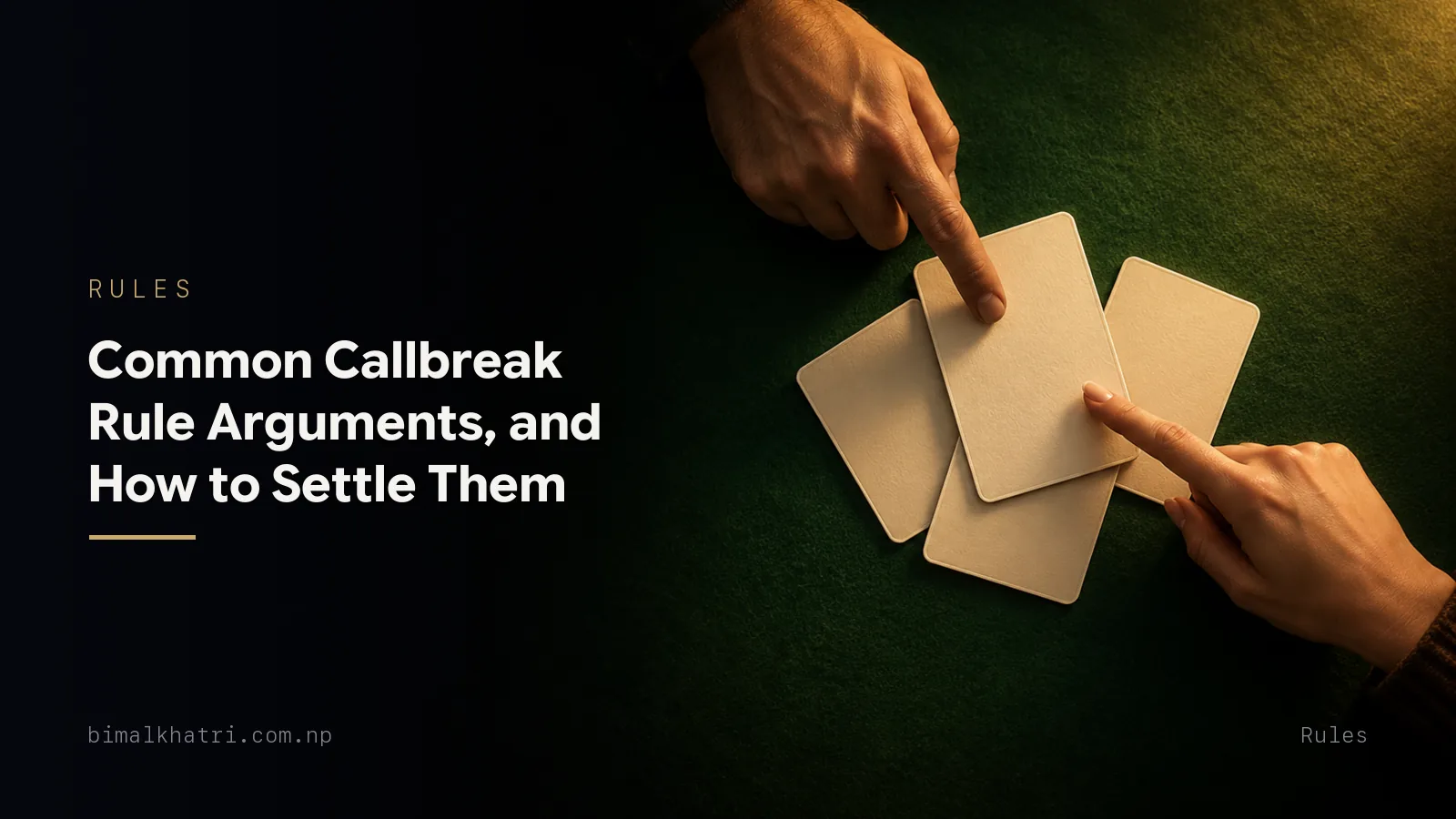
Callbreak has no governing body, no printed rulebook and no referee. That is the whole reason the arguments happen. Two players learned the game at two different tables, both learned it correctly, and now there is a five of spades face up and neither of them will move.
Almost every Callbreak argument is one of about ten questions. Can you call 1. Must you beat the card that is winning. What a missed call costs. Whether a useless low trump has to be thrown. What extra tricks are worth. They come back every week because they are genuinely open questions, not because somebody is cheating.
So the fix is not working out who is right. Usually nobody is. The fix is to answer those questions out loud before the deal, write the answers at the top of the score sheet, and refuse to reopen any of them until the game ends.
Scoring on paper? Callbreak Score Tracker handles the tenths and the negatives so nobody at the table has to. Free and offline.
Why the same arguments come back
Two kinds of written source describe Callbreak rules, and they do not agree with each other.
The first is the reference description of the game, Call Bridge on Pagat. It is the only place that catalogues the variants systematically, and it describes the cautious version: minimum call 2, no obligation to head a trick you can follow, its own scoring. The second is what people deal in Nepal and India, which is stricter in play and looser in bidding.
On top of that, many people now learn the game from an app, and every app picks its own defaults for the same handful of open questions. Someone who learned on one app and someone who learned from an uncle are both quoting a real source. Neither source is the rulebook, because there is no rulebook.
The name adds noise too. Callbreak, Call Break, Call Bridge, and लकड़ी or lakdi in parts of India are the same game with local naming and small rule drift, and so are ghochi, kathi and locha. If somebody says "in lakdi it is different", ask which rule they mean. It will be one of the ones below. The names post covers the words.
Step one: check whether it is actually disputed
Before anyone votes on anything, check the core. Everything here holds at every table except where the row says otherwise. If the argument is about a plain row, it is not a dispute: someone is simply wrong, and you can say so kindly and carry on.
| Rule | Everywhere the game is played |
|---|---|
| Players | 4, each for themselves, no partners |
| Deck and deal | 52 cards, 13 each, dealt one at a time |
| Trumps | spades, permanently — never chosen, never changed |
| Card order | ace, king, queen, jack, ten, nine, eight, seven, six, five, four, three, two |
| Calling | everyone calls a number before the first card is played |
| Following suit | hold the led suit and you must play it — never trump instead |
| Void in the led suit | you must play a spade if you hold one (one corner of this is argued — see below) |
| Breaking spades | no such rule — a spade may be led at any time |
| Winning a trick | highest spade in it, or the highest card of the led suit if there is no spade |
| Round length | 13 tricks |
Two rows get argued about by people who have played Spades. Callbreak has no partnerships and no "spades must be broken" rule: both are Spades rules that travelled. Callbreak vs Spades has the rest, and the full rules lay out the core in order.
Arguments about the call
"You cannot call 1"
Most tables in Nepal and India let you call 1, so calls run from 1 to 13. Pagat's Call Bridge description sets the minimum at 2, with 12 the highest sensible call. Both are real. Neither is universal.
Settle this one first, because it changes every hand. A minimum of 2 forces the player holding nothing to promise two tricks, so bad hands become bigger losses.
How to settle it: ask before the first deal, not when someone is staring at a bad hand. The dealer decides if the table splits evenly.
"The calls are too low — deal again"
Four cautious calls of 2, 2, 2 and 3 add up to 9, leaving four tricks nobody promised. Some tables reshuffle when the total is under 10 and everyone calls again. Pagat records the matching variation. Plenty of groups play it and plenty have never heard of it.
How to settle it: it only exists if you agreed on it before the deal. If nobody mentioned it, play the hand.
"I called 8, so I win"
Two bonus-call house rules turn up often enough to name. A call of 8 that is made exactly can end the game as an outright win. A call of 9 that is allowed to stand can score the call plus 0.1 and close the round. Pagat lists a family of bonus calls of 8 and above, which is where the flat scores in its own system come from.
How to settle it: these are opt-in. Nobody wins a game with a rule that was announced after the tricks were counted.
Arguments during play
"You had a higher heart — you had to play it"
This is the loudest one, and at most tables in Nepal and India the objector is right. If you can follow the led suit and you hold a card in that suit that beats the card currently winning, you must play a beater. Hearts are led with the five, the next player drops the jack, and your hearts are the king, the ten and the three. The king is your only legal card.
Pagat's base description says the opposite in plain words: a player able to follow suit is not obliged to head the trick. It lists compulsory overtaking as a variation. So someone who learned the game from a careful written source is not making it up either.
How to settle it: this is the single most important question on the list, because it changes what every hand is worth. Agree on it before the deal and never mid-round. The following-suit post has every legal move in one table.
"My only spade is the three — do I have to throw it?"
Clubs are led. A player who is void trumps with the five of spades. You are void in clubs too, and your only spade is the three, which cannot beat the five.
| Reading | What you may play |
|---|---|
| Tables that free you | anything — a losing trump is not forced out of your hand |
| Tables that read the trump rule strictly | the three of spades, because you held a trump and trumping is compulsory |
Pagat lists "no wasting a small trump after a suit has already been trumped" as a named variation, which is proof that both are played by real groups. Nothing outside your own table can settle it, so decide it early.
How to settle it: table vote before the deal, and write it down. It is the rule people forget agreeing to.
"There is a spade down and I still played a small heart"
Not a dispute, just a rule people miss. If a spade is already winning the trick and you hold the led suit, any card of that suit is legal. You cannot beat a spade with a side suit, so the must-beat rule has nothing to bite on. Play your worst heart with a clear conscience.
"You cannot lead a spade yet"
Callbreak has no rule about breaking spades. You may lead one to the very first trick. Pagat does list a variation banning spades on the first trick, so a group playing from that description may have it, but it is a house rule they have to claim in advance, not a default.
Arguments about the score
Scoring is where a rule fight actually costs somebody a game, because the disputed points move whole numbers, not fractions.
| Outcome for the round | Score |
|---|---|
| You take exactly your call | your call |
| You take more than your call | your call plus 0.1 for each extra trick |
| You take fewer than your call | minus the whole call |
"You missed by two, so it is minus 2"
The mainstream rule is that you lose the whole call, not the shortfall. Call 4, take 2, score −4.
Some secondary pages say a call of 4 missed with 2 tricks scores −2. That is not the mainstream rule, but people read it and bring it to the table, so it is worth naming before somebody's score is on the line.
How to settle it: the whole call is the default. If your table wants the gentler version, say so in round one, not in round four.
"Extra tricks should not count for anything"
At most tables each extra trick is worth 0.1: small enough that it is really a tie-breaker, not a reward. One variation drops the value of extra tricks entirely. Pagat's own scoring is different again: a call counts as made if you take your call or one more, and calls of eight or above score a flat 13, with some groups using 16.
How to settle it: pick one and keep it for the whole game. Mixing the two inside a game makes the final total meaningless. The scoring post works through the arithmetic in detail.
"The game is not over yet"
A game is five rounds in the Nepali and Indian form. Pagat's base form sets no fixed end at all and mentions 5-deal and 10-deal games as alternatives.
How to settle it: say the number before round one. Adding rounds after someone has taken the lead is how a friendly game ends badly.
One disputed trick, scored two ways
Here is why "we will sort it out later" does not work. Same round, same thirteen tricks, one contested trick in the middle: the must-beat argument from above. You held the king of hearts over a jack. Either you had to play it or you did not.
Table A plays must-beat. You are forced to take that trick with the king.
| Player | Called | Tricks won | Round score |
|---|---|---|---|
| You | 4 | 4 | 4.0 |
| Bimal | 3 | 3 | 3.0 |
| Ashma | 5 | 4 | −5.0 |
| Tulsi | 2 | 2 | 2.0 |
Table B does not. You keep the king, the trick runs on and Ashma wins it instead.
| Player | Called | Tricks won | Round score |
|---|---|---|---|
| You | 4 | 3 | −4.0 |
| Bimal | 3 | 3 | 3.0 |
| Ashma | 5 | 5 | 5.0 |
| Tulsi | 2 | 2 | 2.0 |
One trick moved. You went from +4.0 to −4.0, an eight-point swing, because missing a call costs the whole call rather than the shortfall. Ashma went from −5.0 to +5.0, ten points, for the same reason in reverse. Across a five-round game that is not a detail. It is the result.
Change a second rule and it moves again. Under the minority reading of the penalty, Ashma's −5.0 in table A becomes −1.0. Same cards, different scoresheets.
I built Callbreak Score Tracker, and the work that took longest was exactly this: every disputed point needed a default, and then the alternatives had to be switches, because no single answer is right for a whole region. It ships with the common Nepali and Indian rules (minimum call 1, lose the whole call, 0.1 for an extra trick, five rounds), and keeps the redeal and bonus-call house rules as toggles you turn on. The mode that plays against bots and the mode that tracks a real table run on the same scoring code, so the number it hands your family is the number it holds its own bots to.
Arguments the rules do not answer at all
Some table fights are not about Callbreak rules at all, because the rules say nothing about them. Nobody wins these by quoting a source. Any consistent decision works, as long as it is made in advance.
| Situation | The two workable answers |
|---|---|
| A card is dealt face up, or the deal miscounts | redeal, or fix it and carry on |
| Someone plays out of turn | take the card back and replay, or let it stand |
| A card is exposed by accident | it stays on the table and must be played at the first legal chance, or nothing happens |
| Someone plays an illegal card and it is spotted later | replay from that trick, or let the round finish and let it go |
| Someone forgets to call and play has started | the hand is dead and you redeal, or the player is stuck with the minimum |
| Phone calls, walk-aways, a hand shown by mistake | agree once, apply every time |
Two more belong on the same sheet. Pagat documents both as variations, so they are not gaps, but no table applies them unless somebody says so: a redeal if a player is dealt no spades at all, and announcing a void suit before play begins.
The rule about rules: whatever you choose, apply it to yourself first. A table where corrections run in one direction only stops being a game.
The one-minute rule sheet
Run this out loud with a new group. It takes less time than one round and removes almost every argument you were going to have.
- Minimum call — 1 or 2?
- Must you beat the winning card when you can follow suit?
- Miss your call — lose the whole call, or only the shortfall?
- Extra tricks — 0.1 each, or nothing?
- If your only spade cannot beat the spade already down, must you play it?
- Does a low call total force a redeal?
- Any bonus for calling 8 or 9?
- How many rounds — five, or more?
- Out-of-turn and illegal cards — replay, or let it stand?
Write the answers on the score sheet before the first deal. A written line is much harder to argue with than a memory, and the same sheet settles it for next week. The score sheet post has a layout with room for exactly this.
Common mistakes
Arguing mid-trick. Finish the trick under protest, then settle it. Played cards get forgotten, and then the argument is about who played what.
Changing a rule while you are losing. Every rule on the list moves points. Changing one in round four is changing the result, whatever the intention. Finish under whatever you started with and change it for the next game.
Saying "we always play it this way". That is a description of your table, not an argument. It is also true of the person you are arguing with.
Treating an app as the rulebook. Every Callbreak app picks defaults for the same open questions and they do not all pick the same ones. That includes mine. A default is a design decision, not an authority.
Calling something the Nepali rule or the Indian rule. Almost none of these split along the border. They split by family and by whoever taught you. Pagat is not the last word either: it names its variations precisely because tables differ. Nepal vs India goes through why.
Get it: Callbreak Score Tracker — free on iPhone and Android. The link opens your own app store.
Questions people ask
Is there an official Callbreak rulebook?
No. Callbreak has no governing body and no single published rulebook. The closest thing is the Call Bridge description on Pagat, which lists the regional variations rather than picking one.
Who decides when two Callbreak players disagree?
The table does, before the deal. There is no higher authority to appeal to. A majority vote or the dealer's call both work; what matters is that the answer is fixed before anyone has seen their cards.
Can you change a Callbreak rule in the middle of a game?
You can, but it changes who is winning. Finish the game under the rules you started with and apply the change from the next game, written at the top of the new score sheet.
Is the minimum call 1 or 2?
Both are played. Most tables in Nepal and India allow 1, which puts the range at 1 to 13. Pagat's Call Bridge description sets the minimum at 2, with 12 the highest sensible call. Ask before you bid.
Do you have to beat the card that is winning?
At most tables in Nepal and India, yes. If you can follow the led suit and one of your cards in that suit beats the winning card, you must play a beater. Pagat's base rules do not require it and list compulsory overtaking as a variation, so a group playing from those rules may play it loosely.
Do you lose the whole call when you miss it?
Under the mainstream rule, yes. Call 4 and take 2 and you score −4, not −2. Some pages describe the smaller penalty, so name it before round one rather than after somebody drops to −8. Negative scores covers climbing back out.
Must you play a small trump that cannot win?
Tables differ, genuinely. Some free you: if every spade you hold is lower than the spade already winning, any card is legal. Others make you throw the losing spade anyway. Pagat lists the strict reading as a named variation. Settle it before the deal.
Do spades have to be broken before you can lead them?
No. That is a Spades rule, not a Callbreak rule. You may lead a spade at any time, including the first trick of a round. A table can add a ban on spades to the first trick as a house rule, but it has to be announced.