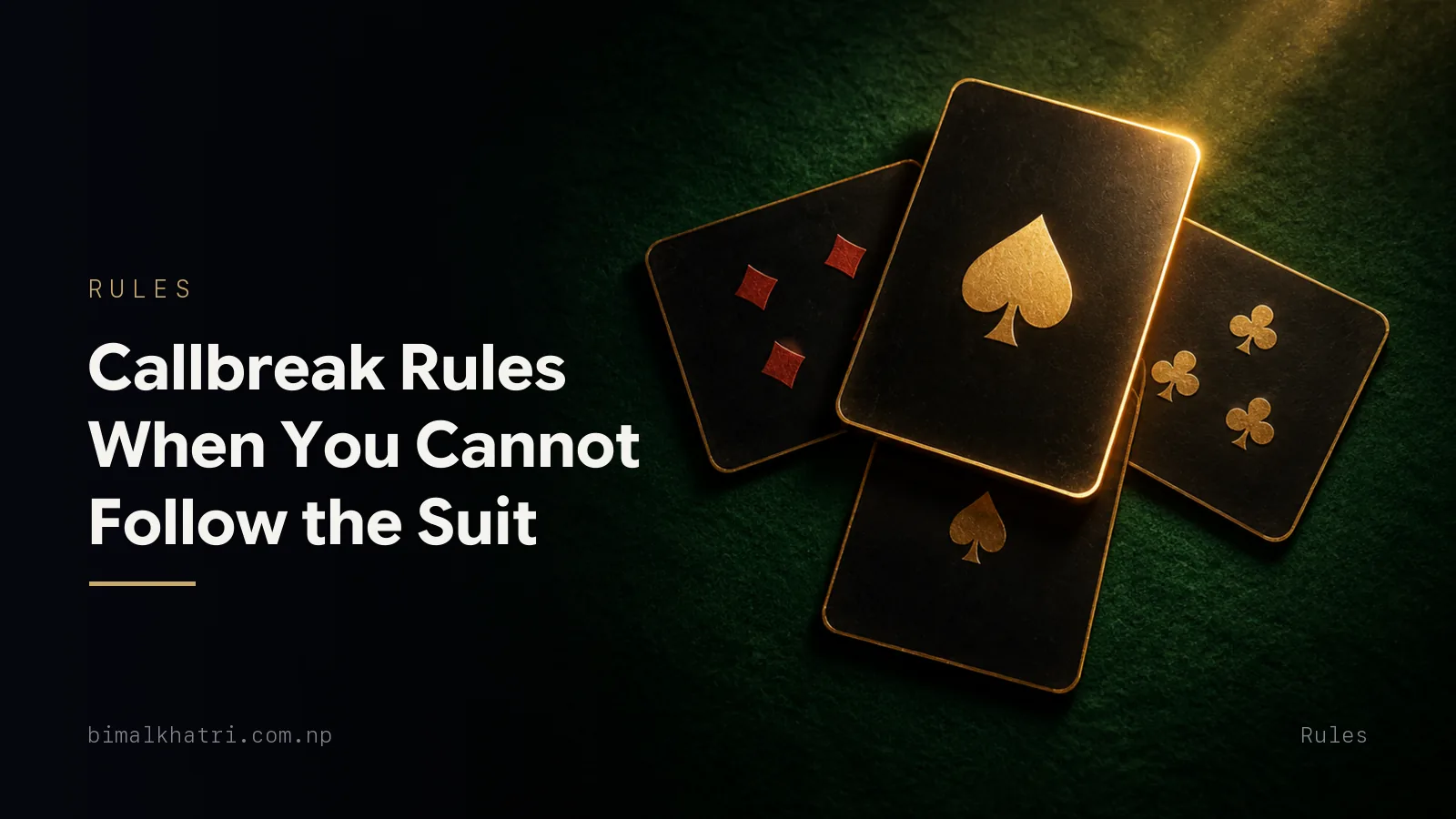
If you hold no card of the suit that was led, you must play a spade. Spades are permanent trumps in Callbreak, and trumping is compulsory, not a choice. Only when you have neither the led suit nor a spade may you throw away anything you like.
There is a second rule that catches people out. While you can follow suit, you must also beat the card that is currently winning, if any of your cards in that suit can beat it. Playing a small card to keep a big one is not allowed.
So the order is: follow suit and beat if you can, otherwise trump, otherwise throw. Below is each step with the exact hands it applies to, the one common position where a low card is legal, and where Nepali and Indian tables part company with the printed Call Bridge rules.
Want the running total without the sums? Callbreak Score Tracker does every round for you, free and offline.
The whole rule, in one table
Read the rows top to bottom and stop at the first one that matches your hand.
| Your hand, when it is your turn | What you are allowed to play |
|---|---|
| You hold the led suit, and a card of it beats the winning card | any card of that suit that beats it |
| You hold the led suit, but none of them beats the winning card | any card of the led suit |
| You hold the led suit, and a spade is already winning (spades were not led) | any card of the led suit — you cannot beat a spade with a side suit |
| Void in the led suit, no spade played yet | a spade, even your smallest one |
| Void, a spade is already down, you hold a higher spade | a higher spade |
| Void, a spade is already down, all your spades are lower | tables differ — see below |
| Void in the led suit and holding no spades at all | anything in your hand |
Two things follow from this table that are easy to miss.
You may never trump while you still hold the led suit. Holding one small heart means you play that heart, even if the trick is worth taking and you have the ace of spades sitting there.
And leading is completely free. Callbreak has no "spades must be broken" rule. You may lead a spade to the very first trick of the round if you want to.
Spades are trumps for the whole game
Spades are not chosen each round and they never change. Any spade beats any card of any other suit. The two of spades beats the ace of hearts, the ace of diamonds and the ace of clubs.
Within a suit, the order is ace, king, queen, jack, ten, nine, eight, seven, six, five, four, three, two. Ace high. When two spades land in the same trick, the higher spade takes it.
A trick is won by the highest spade in it. If no spade was played, it is won by the highest card of the suit that was led. Cards of other suits, thrown in by players who were void, never win anything.
Following suit: beating is not optional
This is the rule most English-language pages get wrong, and it is the rule that makes Callbreak feel tighter than Spades.
Hearts are led with the five. The next player puts down the jack of hearts. Your hearts are the king, the ten, the seven and the three.
The jack is winning. Your king beats it. So the king of hearts is your only legal card. The ten, the seven and the three are all illegal, and so is every card in your other three suits.
Now change one card. Say your hearts are the ten, the seven and the three, with no king. Nothing you hold beats the jack, so the must-beat rule switches off and any heart is legal. Play the three and keep the ten.
One more version. Your hearts are the king and the queen. Both beat the jack, so both are legal and you pick. The rules narrow your choice; they do not always remove it.
The exception: a spade is already on the table
Hearts are led. A player who was void in hearts has already trumped with the five of spades. Your turn, and you hold hearts.
You must still play a heart, because you hold the led suit. But no heart on earth beats a spade, so the must-beat rule has nothing to apply to. Any heart is legal. Throw your smallest one.
This position comes up often, and people get it wrong in both directions. Some players think the trump releases them and try to play a spade of their own, which is illegal while they hold hearts. Others think they must still play their highest heart, which wastes a card for nothing.
When you are void: trumping is compulsory
You have no card of the led suit. You must play a spade if you hold one. This is not optional, and it does not matter how small the spade is or whether you wanted the trick.
Clubs are led with the ace. You hold no clubs. Your spades are the four and the nine. You must play a spade. Both are legal, because both beat the ace of clubs, so you choose between them, but a heart or a diamond is not a choice you are allowed to make.
This is why Callbreak hands unravel. You can plan a round around three high spades, then get forced to spend two of them on tricks you never wanted, because a suit you were void in kept getting led.
Overtrumping, and the case that starts arguments
A spade is already in the trick and you are void in the led suit. If you hold a higher spade, you must play it. Holding back a winner is not allowed here either.
Clubs are led with the king. The next player is void and trumps with the five of spades. You are also void in clubs. Your spades are the three and the eight. The eight beats the five, so the eight is your only legal card.
Now the awkward case. Same trick, but your only spade is the three. It cannot beat the five. Two answers exist:
| Table | What you may play |
|---|---|
| Groups that free you | anything — you keep the useless three, since throwing it away wins nothing |
| Groups that enforce the strict reading | the three of spades, because you held a trump and had to play it |
Pagat's description of Call Bridge lists "no wasting a small trump after a suit has already been trumped" as a named variation, which tells you plainly that both are played by real groups. Neither side is wrong. Agree on it before the first deal, not in the middle of round three.
I built Callbreak Score Tracker, and writing its play mode meant deciding every one of these cases in code rather than in an argument. It frees you in that last position: when your only spade cannot win, you are not forced to burn it. It also never offers you an illegal card in the first place, so tapping the wrong one is not possible: useful if you are still learning which of your cards the rules have already chosen for you.
Four tricks, card by card
One hand, so you can see the rules land in order. Your thirteen cards:
- Spades: ace, nine, four
- Hearts: king, ten, seven, three
- Diamonds: queen, eight, two
- Clubs: jack, six, five
Play runs counter-clockwise: Bimal sits on your left, Ashma on your right, Tulsi across from you. Whoever wins a trick leads the next one.
Trick one. Tulsi leads the five of hearts. Bimal plays the jack of hearts. Your turn. The jack is winning and your king beats it, so you must play the king of hearts. Ashma is void in hearts, so she must trump, and her only spade is the two. The two of spades takes the trick from your king. That is trumps working exactly as intended.
Trick two. Ashma won, so she leads: the ace of clubs. Tulsi is void in clubs and must trump, so down goes the eight of spades. Bimal is void too, and his queen of spades beats the eight, so he must overtrump. Your turn, last. You hold clubs, so a spade of your own is illegal, and no club beats a spade anyway, so any club will do. Play the five. Bimal takes it.
Trick three. Bimal leads the three of diamonds. You hold the queen, the eight and the two. The three is winning, so you must beat it: the queen and the eight are both legal, the two is not. Play the eight and keep the queen. Ashma follows with the four of diamonds: nothing she holds beats your eight, so the must-beat rule leaves her alone. Tulsi has the king of diamonds and has to beat you with it. Tulsi takes it.
Trick four. Tulsi leads the nine of hearts. Bimal is void and trumps with the five of spades. Your turn. You hold hearts, so you must play a heart, even though you are sitting on the ace of spades. And no heart beats a spade, so the three of hearts is fine. Ashma is void in hearts and has no spades left, so she is finally free and throws a club. Bimal takes it with the five of spades.
Four tricks. In one the rules left you a single legal card, in one they cut you down to two, and in the other two your only freedom was which losing card to throw.
What the rule does to your score
Compulsory beating and compulsory trumping both push tricks at you whether you want them or not, so the scoring matters here.
The Nepali and Indian scoring used by most tables works like this. Make your call exactly and you score the call. Make more than your call and you score the call plus one tenth of a point for each extra trick. Miss your call and you lose the whole call, not just the shortfall.
Take a round where the forced plays did their damage:
| Player | Called | Tricks won | Round score |
|---|---|---|---|
| You | 3 | 5 | 3.2 |
| Bimal | 3 | 3 | 3.0 |
| Ashma | 4 | 1 | −4.0 |
| Tulsi | 4 | 4 | 4.0 |
Your two extra tricks are worth 0.2 between them. Taking exactly three would have scored 3.0, so overshooting by two barely helped. That is the point of the small overtrick value. Ashma called four and took one, and loses four, not three.
Some pages claim a missed call of four with two tricks scores minus two. That is not the mainstream rule; the standard is that you lose the whole call. Pagat's Call Bridge describes different scoring again: a call counts as made if you take the call or one more, and calls of eight or above score a flat thirteen. Check which one your table uses before the first round rather than after it.
There is a longer walk through the arithmetic in the scoring rules, including the negative cases.
Common mistakes
Trumping while you still hold the led suit. The most common illegal move at a real table. If you have even one card of the led suit, you play it.
Ducking with a low card when you hold a beater. Legal in Spades, illegal here. If your queen beats the jack that is winning, the queen goes down.
Playing your highest card after someone has already trumped. Once a spade is winning, nothing you hold in a side suit can beat it. Your highest card and your lowest card lose equally, so throw the lowest.
Assuming spades have to be broken first. They do not. Anyone may lead a spade at any point, including the opening lead of the round. Whether that is a good idea is a separate question, covered in opening leads.
Spending a high spade when a small one would win. If you are void and no one has trumped, any spade takes the trick. The two wins as surely as the ace. Overtrumping only forces your hand when a spade is already down.
Where the rulebooks disagree
Some of the rules above are not universal. These two are the ones worth checking before you sit down with a new group.
| Point | Nepal and India | Pagat's Call Bridge description |
|---|---|---|
| Must you beat the winning card while following suit | yes, compulsory | not required in the base rules; compulsory overtaking is listed as a variation |
| Minimum call | 1 | 2, with 12 the highest sensible call |
Pagat also records house rules that touch play directly: a redeal if a player is dealt no spades, announcing a void before play starts, a ban on leading spades to the first trick, and the no-wasting-a-small-trump rule above. If your family plays one of these, it is a real variant with a name, not someone making things up. More of them are collected in the rule disputes post.
Download it: Callbreak Score Tracker for iPhone and Android. Free, and the link picks the right store for you.
Questions people ask
What happens if you cannot follow suit in Callbreak?
You must play a spade, because spades are trumps and trumping is compulsory. If a spade is already in the trick, you must play a higher one when you hold it. Only when you have no card of the led suit and no spade at all may you throw whatever you like.
Do you have to play a higher card in Callbreak?
Yes, in the Nepali and Indian game. While you can follow the led suit, you must beat the card that is currently winning if you hold anything in that suit that beats it. Pagat's description of Call Bridge treats this as an optional variation, so a group using those rules may play it loosely.
Can you play a spade whenever you want in Callbreak?
You can lead a spade at any time, including to the first trick, because Callbreak has no "spades must be broken" rule. You cannot play a spade in the middle of a trick while you still hold a card of the suit that was led.
What if a spade is already played and I have the led suit?
Play any card of the led suit. Nothing in a side suit can beat a spade, so the must-beat rule has nothing to bite on and your smallest card is legal.
Do I have to play a small spade that cannot win?
This is the one genuinely disputed spot. If a higher spade is already down and all of yours are lower, some tables free you to throw anything; others hold you to playing the trump because you had one. Settle it before the deal.
Is the minimum call 1 or 2 in Callbreak?
It depends whose rules you are using. Nepali and Indian tables allow a call of 1, which matters when the compulsory rules are about to hand you tricks you did not ask for. Pagat's Call Bridge sets the minimum at 2, and treats 12 as the highest sensible call. Settle it before anyone bids.
Is this the same as the Spades rule?
No. Spades lets you follow suit with any card of that suit and never forces you to trump when void. Callbreak forces both. That single difference is why a hand that looks strong in Spades can collapse in Callbreak: more on that in Callbreak vs Spades.