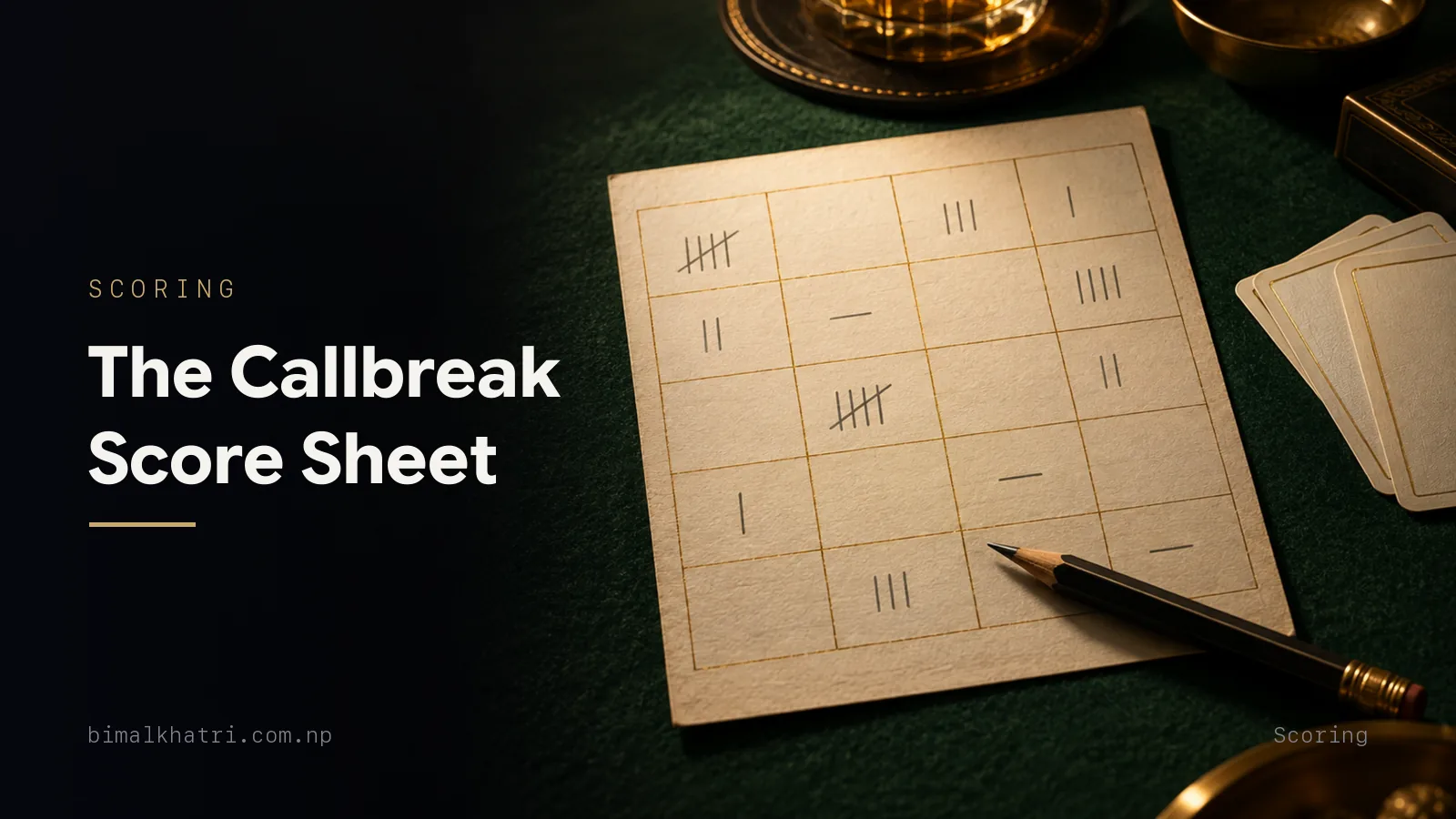
A Callbreak score sheet is a grid. One column for each of the four players, one row for each round, a totals line at the bottom. Every cell holds the same three numbers: what the player called, what they took, and what the round scored them.
Five rounds is the standard game in Nepal and India, so five rows is the usual sheet. The calls go down before the first card is played. That is the sheet's real job: nobody argues about a total, they argue about what somebody called, and a call written in ink settles it.
Here is a blank sheet you can copy onto any scrap of paper, a filled one from a whole game, and the three checks that catch a wrong entry before it travels all the way to the last round.
If the arithmetic is slowing the table down, Callbreak Score Tracker keeps all five rounds straight, free and offline.
What the sheet has to hold
Five parts, and nothing else. Anything more and people stop filling it in.
| Part of the sheet | What goes in it | Why it is there |
|---|---|---|
| Header row | The four players' names | Fix the seating order once so cells never shift |
| Call | What each player called, written before play | The number people misremember |
| Took | Tricks actually won that round | The number that must add to 13 |
| Round score | The call scored against the tricks | One line of arithmetic per player |
| Running total | Score so far, after every round | Finds a mistake in round 2 while it is still round 2 |
The scoring itself is three rules. Take exactly your call and you score the call. Take more and you score the call plus 0.1 for each extra trick. Take fewer and you lose the whole call: the entire number, not the shortfall.
| What happened | Round score | Worked number |
|---|---|---|
| Took exactly the call | The call | Called 4, took 4 → 4.0 |
| Took more than the call | The call, plus 0.1 per extra trick | Called 4, took 6 → 4.2 |
| Took fewer than the call | Minus the whole call | Called 4, took 3 → −4 |
That third row is why the sheet needs room for a minus sign. A missed call of 5 is −5, whatever the shortfall was. There is a fuller treatment in the scoring rules; for the sheet, the only thing that matters is that a round score can be negative and the total carries it.
Draw the sheet in ten seconds
Five columns and seven rows. The left column is the round number. The other four are the players. The rows are the header, rounds 1 to 5, and the total.
Write each cell as call / took = score. Three numbers, a slash and an equals sign. Every round in one line, no second sheet, no second page.
| Round | Player 1 | Player 2 | Player 3 | Player 4 |
|---|---|---|---|---|
| 1 | ||||
| 2 | ||||
| 3 | ||||
| 4 | ||||
| 5 | ||||
| Total |
If you would rather see a running total after each round instead of only at the bottom, split each player's column into two narrow ones: score, then total. That is nine columns on a page and it works better on a wide sheet than on the back of a receipt.
The other layout puts the players down the side and the rounds across the top.
| Player | R1 | R2 | R3 | R4 | R5 | Total |
|---|---|---|---|---|---|---|
| Bimal | ||||||
| Ashma | ||||||
| Tulsi | ||||||
| Hem |
Both hold the same information. Players down the side reads better on a phone photo, because names line up with a single row you can follow with a thumb. Players across the top reads better on paper, because the totals sit in a straight line at the bottom where everyone can see them at once.
A filled sheet, round by round
Four players, thirteen tricks a round, five rounds. Each cell is called / took = round score.
| Round | Bimal | Ashma | Tulsi | Hem |
|---|---|---|---|---|
| 1 | 3 / 3 = 3.0 | 4 / 5 = 4.1 | 2 / 2 = 2.0 | 3 / 3 = 3.0 |
| 2 | 5 / 4 = −5 | 3 / 3 = 3.0 | 3 / 4 = 3.1 | 2 / 2 = 2.0 |
| 3 | 4 / 5 = 4.1 | 4 / 4 = 4.0 | 2 / 1 = −2 | 3 / 3 = 3.0 |
| 4 | 4 / 4 = 4.0 | 3 / 2 = −3 | 4 / 5 = 4.1 | 2 / 2 = 2.0 |
| 5 | 5 / 6 = 5.1 | 3 / 3 = 3.0 | 3 / 2 = −3 | 2 / 2 = 2.0 |
| Total | 11.2 | 11.1 | 4.2 | 12.0 |
Now the same game as running totals, which is the version that actually stops arguments.
| After round | Bimal | Ashma | Tulsi | Hem |
|---|---|---|---|---|
| 1 | 3.0 | 4.1 | 2.0 | 3.0 |
| 2 | −2.0 | 7.1 | 5.1 | 5.0 |
| 3 | 2.1 | 11.1 | 3.1 | 8.0 |
| 4 | 6.1 | 8.1 | 7.2 | 10.0 |
| 5 | 11.2 | 11.1 | 4.2 | 12.0 |
Three things the sheet shows that nobody at the table noticed while playing.
Hem won without ever calling more than 3 and without ever missing. Twelve points, no minus signs, no tenths. Small calls that come off beat big calls that sometimes do not: the whole case for careful bidding is visible in one column.
Bimal finished second by one tenth of a point. He called 5 in round 2, took 4, and dropped to −2.0 while Ashma sat on 7.1. He climbed back and took second place by the single extra trick he won in round 5. Rub the decimals off this sheet and you have a tie where there was a result.
Ashma led after round 3 by three clear points and finished third, 0.9 behind Hem. One missed call of 3 in round 4 did it. A leader is one bad round from mid-table, which is why the running-total column is worth the ink.
Keep the tenths in a column of their own
Decimals are fiddly to add in your head five times over. Do not add them.
Keep extra tricks as whole numbers in a small column of their own all game, and divide by ten once at the end. Bimal won one extra trick in round 3 and one in round 5, so his column says 2, so his score ends in .2. Hem's column is empty, so his total is a round number.
| Player | Whole points | Extra tricks | Final |
|---|---|---|---|
| Bimal | 11 | 2 | 11.2 |
| Ashma | 11 | 1 | 11.1 |
| Tulsi | 4 | 2 | 4.2 |
| Hem | 12 | 0 | 12.0 |
Only a round where the call was made can put anything in that column. Miss the call and you score minus the call, with no tenths anywhere in the line.
Three checks before you accept a round
Run these as the scores go down. Each takes a couple of seconds and together they catch nearly every arithmetic slip.
| Check | Why it works |
|---|---|
| The four "took" numbers add to exactly 13 | Thirteen tricks a round, and every one of them goes to somebody |
| No round score is exactly 0 | The smallest call in the Nepali and Indian game is 1, so a round score is either 1.0 and up or −1 and down |
| No score has two decimal places | Extra tricks come in tenths, so one decimal digit is all any score can carry |
The calls are not part of the first check. Four calls adding to 11, 13 or 15 are all normal, and there is no rule forcing them to match the number of tricks. Only the tricks taken are fixed at 13.
A fourth check, for the end of the game: add all four totals together and see whether the number looks sane. It is not fixed — misses drag it down — but a game with no misses in it lands near the sum of the calls, and a total that is wildly off usually means a round got copied into the wrong column.
Put the house rules at the top of the sheet
Most scoring arguments are not arithmetic. They are two people using two different rulebooks. Write the table's choices in the margin before the first deal, so nobody gets to relitigate them at round 4.
| Line in the margin | The mainstream version | Where sources disagree |
|---|---|---|
| Minimum call | 1 in the Nepali and Indian game | Pagat's Call Bridge sets the minimum at 2, and treats 12 as the highest sensible call |
| Missed call | You lose the whole call | Some pages state you lose only the shortfall — a call of 4 with 2 tricks scoring −2. That is not the standard, but tables do play it |
| Extra tricks | 0.1 each | Pagat records a variation that drops overtrick value entirely and caps calls at 8 |
| Length of the game | 5 rounds | Pagat's base description has no fixed ending, and lists five-deal and ten-deal games as alternatives |
Three optional rules turn up often enough to deserve a line of their own, because each one changes what you write down.
| House rule | What the sheet has to do |
|---|---|
| Redeal on a low bid total | If the four calls add up to too little the hand is redealt, so the round is scratched out and rebid. Pagat's version of this sets the threshold at 10 |
| Bonus for an exact 9 | A called 9 that is allowed to stand scores the call plus 0.1 and closes the round there |
| Instant win on 8 | Call 8, make exactly 8, and the game ends — the remaining rows stay blank |
Region also shifts a few of these, and the differences between tables in Nepal and India are worth reading once before you host a game with a new group.
I built Callbreak Score Tracker because my own table kept losing the sheet somewhere around round 4. It keeps the same grid you have just drawn (four players, five rounds, a running total), and does the call-against-tricks arithmetic itself, so nobody adds 1 where they meant 0.1. It also plays full games against bots, and both halves run the same scoring code, so a round typed into the tracker scores exactly what the same round scores inside a played game. The three optional rules above are switches, a round you entered wrong can be edited, and rounds past the fifth can be added when the game is still alive. Offline, no login, no ads.
When the sheet runs past five rounds
Five rows is a convention, not a law of the game. Tables extend for two ordinary reasons: the game is level and nobody wants to stop, or somebody was so far down after a bad round 2 that a sixth round was agreed as a courtesy.
Rule the extra rows before you start rather than squeezing them into the margin, and settle two questions out loud first. How many extra rounds — one, three, or "until somebody clears 20"? And does the deal keep passing the same way, to the right, so the same player is not stuck leading forever?
If the totals finish exactly level, the tenths have already done everything they can. One more round is the simplest tiebreaker, and agreeing on that before the first deal is easier than agreeing on it at midnight.
Keeping the sheet when you are not on paper
Paper is the best sheet at a table with real cards, right up until somebody knocks over the tea. Three practical alternatives, none of which needs an internet connection.
| Sheet | Works well because | Watch out for |
|---|---|---|
| Paper and pen | Everyone can see it, nobody owns it, no battery | Gets lost, gets wet, arithmetic is on you |
| Phone notes app | Always in your pocket | You are still adding by hand, and columns wander on a small screen |
| A scoring app | Adds up correctly and keeps the running total | One person holds the phone, so the table has to trust the typing |
Whichever you pick, show the sheet after every round instead of at the end. A score everyone has seen is a score nobody disputes. If your group also plays apart, the options for playing online and offline change what the sheet needs to do: a game against bots keeps its own score, a game across four phones does not always.
Common mistakes
Writing the call after play. The sheet exists to record a promise. Filled in afterwards, it records a memory, and memories favour whoever is loudest.
Recording the shortfall instead of the call. A missed call of 5 is −5, not −1. Get it wrong once and the whole sheet has to be re-added.
Adding 1 for an extra trick. A call of 3 that takes 5 is 3.2, not 5. If your sheet has a 5 in that cell, someone scored the tricks instead of the call.
Skipping the running total. Five round scores added at the very end hide a round-2 error where nobody can find it. Totalling after every round shows it immediately.
Rounding the tenths off. In the game above, 11.2 and 11.1 were second and third. Rounded, they are a tie and a fight.
Letting the "took" column drift. If it adds to 12 or 14, a trick has been mis-assigned. Fix it before the next deal, while people still remember the hand.
Not writing the house rules down. Minimum call and the missed-call penalty both vary. Two minutes at the start beats twenty minutes in the middle.
Questions people ask
What is a Callbreak score sheet?
A grid with one column per player and one row per round. Each cell records the call, the tricks taken and the round score, and a totals line at the bottom carries the running score. Five rounds is the standard game in Nepal and India.
How do you make a Callbreak scorecard on paper?
Rule five columns and seven rows. The left column is the round number, the other four are the players, and the rows are a header, rounds 1 to 5, and a total. Write each cell as call slash tricks equals score.
What do you write in each box?
Three numbers. The call, which goes down before the first card. The tricks actually taken. The round score, worked from the two: the call if they match, the call plus 0.1 per extra trick if the player took more, minus the whole call if the player took fewer.
Do the calls have to add up to 13?
No. Only the tricks taken add to 13. Calls totalling 11 or 15 are ordinary. Some tables use a house rule that a hand is redealt when the calls total too little, and Pagat records that variation with a threshold of 10, but no rule forces the calls to match the tricks.
How many rounds should the sheet have?
Five, for the Nepali and Indian game. Pagat's base description of Call Bridge gives no fixed ending and lists five-deal and ten-deal games as alternatives, so rule as many rows as your table has agreed on before the deal.
Can a round score be zero?
No. The smallest call in the common ruleset is 1, so the smallest round scores are 1.0 and −1. An empty-looking cell on a filled sheet means somebody forgot to write, not that a round scored nothing.
How do you record a negative score?
Write it with the minus sign and carry it into the total. There is no floor at zero and nothing resets between rounds. Circling negatives helps, because a minus sign written quickly is easy to miss when you add the column.
Is there a printable Callbreak score sheet?
The grid is five columns by seven rows, which is quicker to rule with a pen than to find and print. Copy the blank table above onto any piece of paper, or let a phone keep it and read the running total aloud after each round.
Keep reading
- Callbreak scoring rules, explained with worked examples
- How to calculate Callbreak points
- Negative points in Callbreak, and how to recover
- Common Callbreak rule arguments, and how to settle them
- Callbreak: the complete guide to rules, scoring and winning
Download it: Callbreak Score Tracker for iPhone and Android. Free, and the link picks the right store for you.