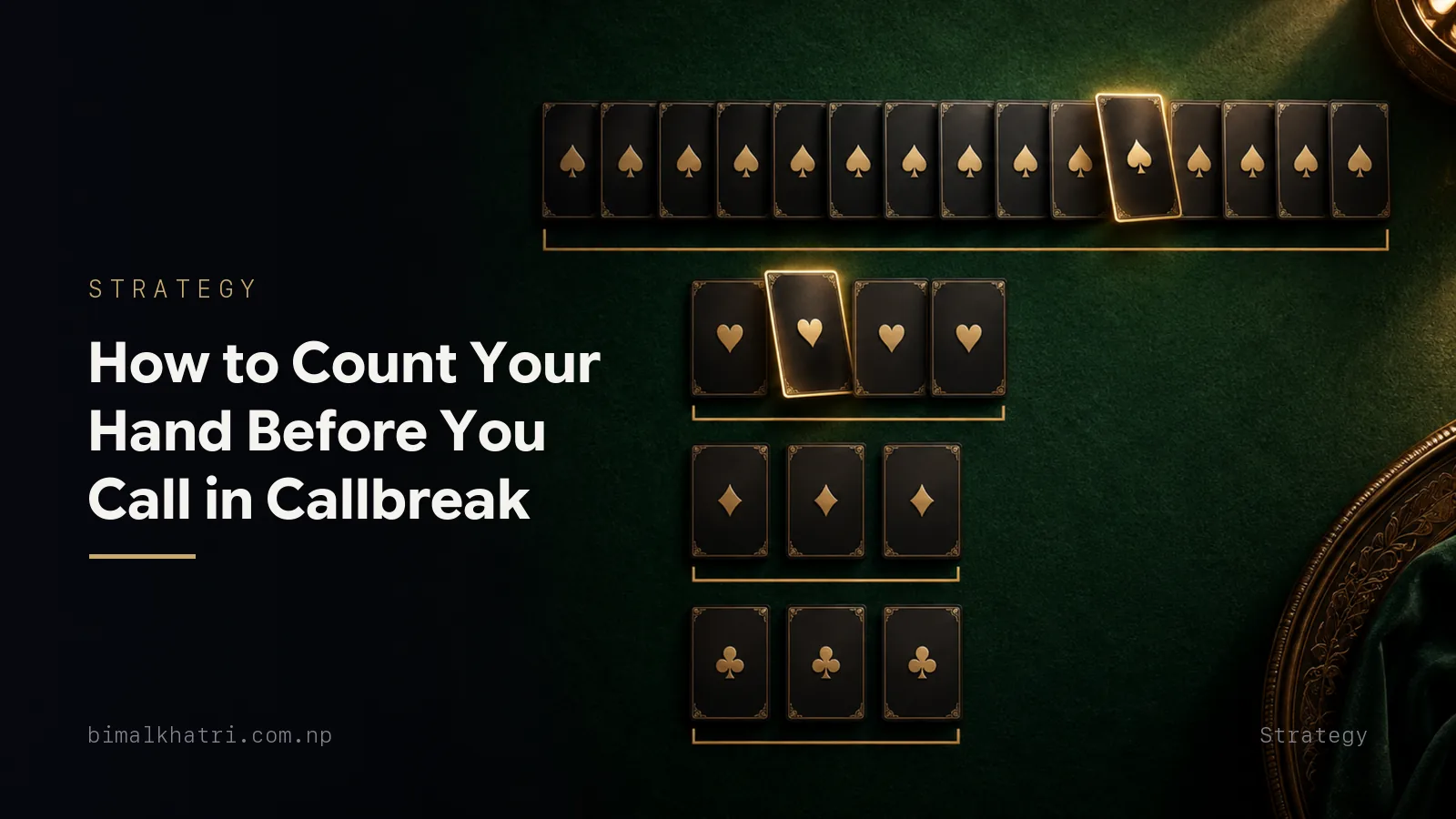
Count your hand in three passes: trumps first, then the winners in your other suits, then the adjustments for shape. Add up only what you can give a reason for. That total is your call.
Most players count the wrong thing. They see two aces and a king, call four, and take two. Callbreak pays for trumps and shape more than it pays for high cards, because spades beat everything and there is no rule stopping you from leading them.
The other half of counting is knowing what the rules will take out of your hand. In the Nepali and Indian game you must beat the winning card when you can, and you must trump when you are void. Those two rules spend your cards for you, whether you wanted to spend them or not.
Keeping score by hand? Callbreak Score Tracker does the maths for all five rounds, free and offline.
Sure tricks and maybe tricks
Before the passes, one habit. Sort every trick you find into two piles.
A sure trick is one you lose only to something unlikely: the ace of spades, or the ace of hearts on the first round of hearts. A maybe is a card that wins if the cards around it sit kindly: the king of diamonds, a fifth spade, a void you have not used yet.
Then call all your sure tricks plus half your maybes, rounded down. Four sure and three maybes is a call of five. Two sure and one maybe is a call of two. The rounding-down is doing real work: it is the difference between a call you keep and a call that costs you the whole bid.
Pass one: count your spades
Spades are permanent trumps. Any spade beats any card in any other suit, and Callbreak has no "spades must be broken" rule, so you can lead them whenever you like. That makes trump length the most reliable trick source in the game.
| What you hold in spades | Count it as |
|---|---|
| The ace | Sure — nothing in the deck beats it |
| The king with at least one small spade behind it | Sure, unless the ace falls on the same trick |
| The queen with two small spades behind it | Maybe |
| Your fifth and sixth spade | One maybe each |
| Your seventh spade and beyond | Sure — nobody has trumps left to stop them |
| Two spades or fewer with no honour | Nothing, and mark the hand as short of trumps |
The length rule is arithmetic, not faith. There are 13 spades and four hands, so the average holding is a little over three. Hold six and the other three players share seven between them. Two or three rounds of trumps and yours are the only ones on the table. After that a spade three wins a trick that an ace of hearts cannot.
The reverse is the part people skip. A hand with two small spades has no engine. Every side-suit winner in it is one void away from being trumped, and you have nothing to trump back with.
Pass two: count your side suits
Hearts, diamonds and clubs win tricks only until somebody runs out of them.
| What you hold in a side suit | Count it as |
|---|---|
| The ace | Sure on the first round of that suit |
| The ace and king together | Two sure |
| The king with two small cards | Maybe |
| A singleton king | Nothing |
| The queen with three small cards | A weak maybe |
| Five or more cards with no honour | Nothing — and treat it as a warning |
The singleton king is the clearest example of the must-beat rule taking a card off you. Somebody leads a small heart, you hold only the king of hearts, and you must beat the card that is winning. The king goes down on trick one, into three players who still hold hearts. If the ace is out there, you have paid a king for nothing.
Length in a side suit is a liability. Five clubs means the other three players hold eight between them, so somebody is short and somebody will be void by the third round. Your fourth and fifth club get trumped. Count them as zero and expect to lose them.
One rule works in your favour here. When a spade is already on the table and you still hold the led suit, any card of that suit is legal: a heart cannot beat a spade, so the must-beat rule has nothing to bite on. That is how a bare ace survives a trumped trick. It also means it wins nothing.
Pass three: count your shape
Shape is where Callbreak differs most from the games it looks like. When you are void in the led suit you must play a spade, and if someone has already trumped you must play a higher spade when you hold one. A void is not an escape hatch. It is a machine that converts your spades into tricks, and it runs whether you feed it or not.
| Shape | What it adds |
|---|---|
| A void, holding three or more spades | One sure |
| A void, holding two spades or fewer | One maybe — and it may burn the trump you needed later |
| A singleton | One maybe, from the second round of that suit onwards |
| A doubleton | Nothing early, a weak maybe late |
| A flat 4-3-3-3 hand | Nothing. No ruffs anywhere |
Two voids do not usually mean two extra tricks. Once you are forced to trump twice, you have spent two spades, and if a second player was void as well the higher spade took the trick. Count the first void generously and the second one carefully.
Then subtract
After the three passes, take one trick back off the total if any of these is true:
- Every trick you counted rests on kings and queens rather than aces and trump length.
- You hold five or more cards in one side suit.
- You hold two spades or fewer.
- Two of your maybes are in the same suit and depend on the same card being placed well.
Never add for optimism. Overcalling and undercalling do not cost the same, and the next section is why.
What one extra trick in the call is worth
The scoring is three rules. Make your call exactly and you score it. Take extra tricks and each one adds 0.1. Fall short by any amount and you lose the whole call, not the difference.
Now put a real hand through it. You have counted four sure tricks and you are tempted by a fifth.
| What you call | What you take | Round score |
|---|---|---|
| 4 | 4 | +4.0 |
| 4 | 5 | +4.1 |
| 5 | 5 | +5.0 |
| 5 | 4 | −5.0 |
Calling the fifth trick and getting it earns 0.9 more than calling four and taking five. Calling the fifth and missing it turns +4.1 into −5.0. That is a 9.1-point swing for one greedy trick, against a 0.9-point gain. The scoring is built to punish the optimistic count, which is exactly why the method rounds maybes down.
One caution. Some pages say that missing a call of 4 with 2 tricks scores −2. That is not the mainstream rule, and it is not what most tables or apps do: the standard is that you lose the whole call. Pagat, the reference site for card game rules, also records alternative systems for Call Bridge: one treats your call or one trick more as success, one gives calls of 8 or higher a flat 13 points (16 at some tables), and one removes the value of extra tricks entirely and caps calls at 8. If your table plays one of those, the maths above changes and your counting should change with it. Callbreak scoring rules, explained works through the cases.
Three hands, counted
Hand A: the ordinary good hand
- Spades: ace, king, nine, five, two
- Hearts: ace, seven, three
- Diamonds: king, six, four
- Clubs: eight, two
Sure: the ace of spades, the king of spades (it has guards behind it), the ace of hearts. That is three.
Maybe: the fifth spade, because five trumps is one more than average and the small ones win late. The king of diamonds with two cards to protect it. The club doubleton, which becomes a void after two rounds. Three maybes.
Three sure plus half of three, rounded down, is four. Nothing on the subtract list applies. Call 4.
Hand B: trump length with no top spades
- Spades: queen, jack, ten, eight, six, four
- Hearts: king, five
- Diamonds: nine, seven, three
- Clubs: ace, two
No ace of spades, no king of spades, and the hand is still worth as much as Hand A.
Sure: the ace of clubs. Then the trump length. Six spades means the other three players hold seven. The ace and king of spades take one trick each, and after that your queen, jack and ten are the highest spades on the table. Count two sure tricks from the run. That is three sure.
Maybe: the fifth and sixth spade winning at the end, and the club doubleton turning into a void. The king of hearts has one guard rather than two, so it counts as nothing. Three maybes.
Three plus one is four. Call 4. The subtract list does not fire: the tricks rest on trump length, not on kings.
Hand C: the hand that looks like five and is worth two
- Spades: seven, four
- Hearts: ace, queen, six, three
- Diamonds: king, jack, five
- Clubs: ace, ten, nine, two
Two aces, a king, a queen and a jack. Most players call four on this and lose four.
Sure: the ace of hearts and the ace of clubs. Two.
Maybe: the king of diamonds, and the queen of hearts if the king of hearts sits in front of it. Two maybes, so the raw count is three.
Now the subtract list. Two spades and no honour in them fires the third line on its own. Nothing in the hand rests on trump length: every trick counted is a high card waiting to be trumped. Take one off. Call 2, and be pleased if you make three.
This is the hand that teaches the lesson. By the third round somebody is void in hearts, your ace gets trumped, and there is nothing in your hand to trump back with. High cards are not tricks. Cards that beat everything are tricks.
Counting after you hear the other calls
If your table calls in turn rather than all at once, the calls before yours are free information. There are exactly 13 tricks. If the three players before you have called 4, 4 and 3, all eleven of those tricks are spoken for and only two are loose. Somebody is going to break a call. Trim your own count rather than adding to the pile.
The opposite case matters too. If the calls before you total 5, tricks are lying around unclaimed, and a hand you counted at three can often be called at four.
Some tables use a minimum total. If the four calls add up to less than 10 the cards are reshuffled and everybody calls again: Pagat lists the same variation. Knowing whether your table plays it tells you whether an honest low call gets you a fresh hand or a bad round.
The minimum call, and why sources disagree
If your count comes out at one, what you are allowed to do depends on where you play.
| Ruleset | Minimum call | Maximum |
|---|---|---|
| Common Nepali and Indian play | 1 | 13 |
| Pagat's Call Bridge | 2 | 12 is the highest sensible call |
Neither is wrong, and neither is universal. Settle it before the first deal.
Counting for a call of 1 is harder than it sounds anyway. To take exactly one trick you have to lose twelve, and the must-beat rule will not let you duck: if you can follow suit and beat the card that is winning, you play it. Hold the ace of hearts and you will win a heart trick whether it suits your call or not. Two small spades and no honours anywhere is a genuine call of 1. An ace in a side suit usually is not. Callbreak rules when you cannot follow the suit has the full legal-move list.
Common mistakes
Counting high cards instead of trumps. Three aces in three suits is three tricks at best, and fewer once people start running out of suits. Six spades to the queen is often more.
Forgetting the must-beat rule when you plan to duck. You cannot keep a card back to control the count. If it beats the winning card and you can play it, you must.
Treating a void as a free trick. It is a forced trump. If your spades are short, the void is spending them, not earning them.
Counting a singleton king or queen. It goes down on the first lead of that suit, into everyone who still holds the suit.
Rounding maybes up. One trick of greed is worth 0.9 when it lands and 9.1 when it does not.
Calling the same number every round. A hand does not know what you called last time. Count it fresh.
Never checking whether the count was right. This is the fixable one. I built Callbreak Score Tracker so the counting can be tested rather than argued about: its play mode deals you real hands against bots that bid and play by the same rules engine, so you can count a hand, call it, and see within thirteen tricks what it was actually worth. The tracker mode uses the same scoring code, so the numbers agree whether you are playing on the phone or keeping score for four people at a table.
Questions people ask
How many tricks should I call in Callbreak?
Count sure tricks, count maybes, and call the sure tricks plus half the maybes rounded down. On an ordinary hand that lands between two and four. Anything above five needs trump length, not just high cards.
What is the minimum call in Callbreak?
Most Nepali and Indian tables allow 1. Pagat's description of Call Bridge sets the minimum at 2, with 12 the highest sensible call. Both are played, so agree before the deal.
How many spades do I need to call four?
There is no fixed number, but four tricks off two small spades is rare. With five spades including the ace or king, four is a normal call. With two spades you are relying on side-suit aces surviving, and they usually do not.
Do aces always win in Callbreak?
Only the ace of spades. Any other ace loses to any spade, and the moment a player is void in that suit they must trump it. Count side-suit aces as sure on the first round of the suit and no further.
Is it better to call low and go over?
Usually, yes. Extra tricks are worth 0.1 each, so calling 3 and taking 5 scores 3.2. Calling 5 and taking 4 scores −5. The scoring rewards an honest count far more than a brave one.
Does a void help or hurt my call?
It helps if you have spades to spare and hurts if you do not. Being void means you must trump, so each round of that suit costs you a spade whether the trick was worth taking or not.
Should I count a king as a trick?
As a maybe, and only when it has small cards behind it. A king with two guards is worth counting. A singleton king is worth nothing, because you have to play it on the first lead of the suit.
What happens if I call more than I take?
You lose the whole call, not the shortfall. Call 5 and take 4, and the round scores −5. Some pages state a smaller penalty; that is not the mainstream rule. Negative points in Callbreak covers recovering from one.
Get it: Callbreak Score Tracker, free on iPhone and Android. The link sends you to whichever store your phone uses.